

Buy Physical Copy At:


Che: Part One | Che: Part Two
Licensor Information
IFC Films
Directed by: Steven Soderbergh
Featuring: Benicio Del Toro, Demian Bichir, Carlos Bardem, Santiago Cabrera, Vladimir Cruz, Joaquim De Almeida, Alfredo De Quesada, Pablo Duran, Jsu Garcia, Eduard Fernandez, Kahlil Mendez, Lou Diamond Phillips, Elvira Minguez, Franka Potente, Andres Manuel Munar, Matt Damon, Julia Ormond, Jorge Perugorria, Édgar Ramírez, Victor Rasuk, Othello Rensoli, Oscar Isaac
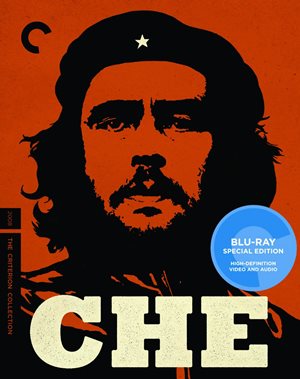
Far from a conventional biopic, Steven Soderbergh’s film about Che Guevara is a fascinating exploration of the revolutionary as icon. Daring in its refusal to make the socialist leader into an easy martyr or hero, Che paints a vivid, naturalistic portrait of the man himself (Benicio del Toro, in a stunning, Cannes-award-winning performance), from his overthrow of the Batista dictatorship to his 1964 United Nations trip to the end of his short life. Composed of two parts, the first a kaleidoscopic view of the Cuban Revolution and the second an all-action dramatization of Che’s failed campaign in Bolivia, Che is Soderbergh’s most epic vision.
Details by Film







Release Information:
Technical Specifications
Format:
Blu-ray
Discs:
BD-50 (2 Discs)
Total: 2 Discs
Regions:
A (Blu-ray)
Aspect Ratio:
1.78:1
2.39:1
Audio Options:
Spanish DTS-HD MA Surround 5.1
Resolution:
1080p/24
Subtitles:
English
Supplements
Types of Supplements Included: Audio Commentary, Documentary, Interview, Deleted Scenes, Theatrical Trailer, Booklet, Poster
- New audio commentaries featuring Jon Lee Anderson, author of Che Guevara: A Revolutionary Life
- Making “Che,” a new documentary featuring Steven Soderbergh, producer Laura Bickford, actor-producer Benicio Del Toro, and writers Peter Buchman and Ben van der Veen
- Interviews with participants in and historians of the Cuban Revolution and Che’s Bolivian campaign
- End of a Revolution, a short documentary made in Bolivia right after Che’s execution in 1967
- “Che” and the Digital Cinema Revolution, an original video piece looking at the RED camera and its effect on modern film production
- Deleted scenes
- Theatrical trailer
- A booklet featuring a new essay by critic Amy Taubin
- Fold out poster
Forum Member Statistics
Sign-in with your forum account to rate this release
Che: Part One
Che: Part Two
Picture
Audio
Supplements
Artwork
Release Credits
Producer: Kim Hendrickson
Artwork: Eric Skillman
Release Notes on Restoration
Che: Part One
Che: Part Two
Che: Part One is presented in its original theatrical aspect ratio of 2.39:1. Black bars at the top and bottom of the screen are normal for this format. Che: Part Two is presented in the aspect ratio of 1.78:1. On standard 4:3 televisions, the image will appear letterboxed. On widescreen televisions, the image should fill the screen.
Both films were shot with the RED One Digital Cinema camera at 4K resolution, and the entire production was complete in a fully digital workflow. The original theatrical color timing was done with Assimilate Inc.’s SCRATCH system, viewed on a 2K digital cinema projector through custom Technicolor 3D Look-Up Tables (LUTs) designed to emulate film print stocks. During the grading sessions, the original R3D RED files were used and standard 2K 10-bit log DPX files were rendered out within SCRATCH. The DPX files were then used as the source for the film outs and the digital cinema DCDM. The final color-corrected DPX files were then timed in the Rec.709 high-definition color space for recording on HDCAM SR tape for all home-video uses, such as these Blu-ray and DVD releases.
Note that certain sequences in Che: Part One were photographed in 16mm film: the black-and-white 1964 New York scenes in standard Super 16mm, and the color 1955 Mexico scenes in Super 16mm with custom anamorphic lenses (squeeze ratio 1.44:1) manufactured by Panavision. Had RED digital cameras not become available in spring 2007, Part One would have been photographed in its entirety in this format, and Part Two would have been photographed in standard Super 16mm.
The 5.1 soundtracks presented on this release are identical to the theatrical mixes. On Che: Part One, there is the option of hearing the film with Che’s voiceovers in Spanish, instead of the “simultaneous translation” into English heard in the U.S. theatrical release of the film.
Both films were shot with the RED One Digital Cinema camera at 4K resolution, and the entire production was complete in a fully digital workflow. The original theatrical color timing was done with Assimilate Inc.’s SCRATCH system, viewed on a 2K digital cinema projector through custom Technicolor 3D Look-Up Tables (LUTs) designed to emulate film print stocks. During the grading sessions, the original R3D RED files were used and standard 2K 10-bit log DPX files were rendered out within SCRATCH. The DPX files were then used as the source for the film outs and the digital cinema DCDM. The final color-corrected DPX files were then timed in the Rec.709 high-definition color space for recording on HDCAM SR tape for all home-video uses, such as these Blu-ray and DVD releases.
Note that certain sequences in Che: Part One were photographed in 16mm film: the black-and-white 1964 New York scenes in standard Super 16mm, and the color 1955 Mexico scenes in Super 16mm with custom anamorphic lenses (squeeze ratio 1.44:1) manufactured by Panavision. Had RED digital cameras not become available in spring 2007, Part One would have been photographed in its entirety in this format, and Part Two would have been photographed in standard Super 16mm.
The 5.1 soundtracks presented on this release are identical to the theatrical mixes. On Che: Part One, there is the option of hearing the film with Che’s voiceovers in Spanish, instead of the “simultaneous translation” into English heard in the U.S. theatrical release of the film.