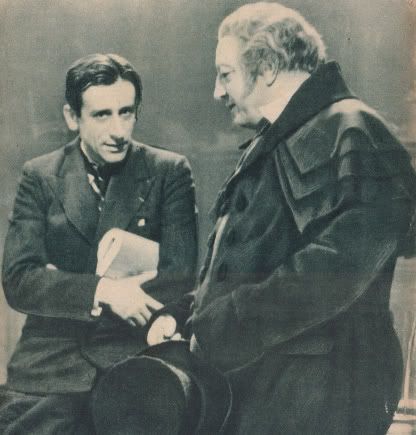
Raymond Bernard with Harry Baur on the set of Les Misérables (1934)
Biography
Raymond Bernard is the youngest son of writer Tristan Bernard. In 1913, he started as a theatre actor with Sarah Bernhardt in one of his father's play Jeanne Doré. He discovers cinema shortly after when the play was filmed by Louis Mercanton. The discovery of DeMille's The Cheat (1915) converted him completely to the new art of cinema. He is Feyder's assistant in a series of short films produced by Léon Gaumont with screenplays by Tristan Bernard. In 1917, Feyder leaves for the front and Bernard is asked to finish the film. He goes on making comedies such Le Petit Café with Max Linder or the delightful Triplepatte, based on his father's plays. In 1924, he directs a big epic, Le Miracle des Loups where he displays a particular flair for directing crowds, superb editing and even hand-held camera shots. Le Joueur d'Echecs in 1927 is also a superb epic film. Bernard adapts quickly to the new medium of talking picture and is asked to produce a French film about WWI to compete with All Quiet on The Western Front (1930) and Westfront 1918 (1930). Les Croix de Bois is shot in 40 nights in gruelling conditions. In 1933, Pathé-Natan ask him to make a new version of Hugo's Les Misérables in 3 parts. The film's budget was enormous and the company didn't recoup the cost. Amond his later 30s films, we can single out Le Coupable with Pierre Blanchar, an harsh study of bourgeois hypocrisy; J'étais une aventurière a comedy about crooks brilliantly performed by Edwige Feuillère and Les Otages which shows a French village occupied by the Germans in 1914. After the war, one of his best pictures is Le Jugement de Dieu, a superb historical reconstruction of a German legend with doomed lovers. His last film, Le septième ciel, is a dark humoured comedy where Danielle Darrieux kills a series of crooks to provide funds for her charities.
Filmography
Le ravin sans fond (1917) co-directed with J. Feyder
Le traitement du hoquet (1918)
Le gentilhomme commerçant (1918)
Le petit café (1919)
Le secret de Rosette Lambert (1920)
La maison vide (1921)
Triplepatte (1922)
L'homme inusable (1923)
Grandeur et décadence (1923)
Le costaud des épinettes (1923)
Le miracle des loups (1924)
Le joueur d'Echecs (1927) (DVD R1 US Milestone )
Tarakanova (1930)
Faubourg Montmartre (1931)
Les croix de bois (1932) (Eclipse DVD set R1 US)
Tartarin de Tarascon (1934) (DVD R2 France Pathé)
Les Misérables (1934) (Eclipse DVD set R1 US)
Amants et voleurs (1935)
Anne-Marie (1935)
Le coupable (1936) (SECAM VHS-PAL compatible)
Marthe Richard au service de la France (1937) (DVD R2 France Canal)
J'étais une aventurière (1938) (SECAM VHS-PAL compatible)
Les otages (1939) (DVD R0 France)
Cavalcade d'amour (1940)
Un ami viendra ce soir (1946) (DVD R2 France Canal Plus)
Adieu Chérie (1945)
Maya (1949) (DVD R2 France)
Le cap de l'espérance (1951)
Le jugement de Dieu (1952)
La dame aux camélias (1953) (SECAM VHS-PAL compatible)
La belle de Cadix (1953) (DVD R2 France René Chateau)
Les fruits de l'été (1954) (SECAM VHS-PAL compatible)
Le septième commandement (1956) (SECAM VHS-PAL Compatible)
Le septième ciel (1957)
[SECAM VHS will play in PAL VCR but only in B&W]
Books:
Eric Bonnefille - Raymond Bernard : Fresques et miniatures (2010, Ed. L'Harmattan)
Anthologie du Cinéma, Vol 11 - Raymond Bernard by Jacques Salles (1983, Ed. L'Avant-Scène)
Le Cinéma Français-Le Muet (P. d'Hugues/M. Marmin/J. Mitry/J. Richard) (1986, Ed. Atlas)
Web resources:
Rediscovery of Le Joueur d'Echecs (The Chess Player) by Kevin Brownlow
William K. Everson on Le Miracle des Loups (Miracle of the Wolves)
William K. Everson on Les Croix de Bois (Wooden Crosses)
Biography and filmography at Films de France
Biography, filmography and bibliography at the Bibliothèque du Film (BiFi)
Forum discussion:
Eclipse Series 4: Raymond Bernard