Thanks Paul. I had the same thing happen to me. I got a reply from Angie Bucknell 2 days after emailing the Mulvaney address.
Re your Rohmer replacement, perhaps they have a change of heart about sending outside of North America once they acknowledge that there is a widespread problem with a disk?
Any reported problems with some people missing the booklet or anything with this?
359 The Double Life of Véronique
-
miless

- Joined: Sun Apr 02, 2006 1:45 am
I e-mailed the newsletter address and got a reply within 4 hours, and a booklet in a week... I'd try again.Paul Moran wrote:I got "Clean, Shaven" with no booklet. I emailed "John Mulvaney" with my address, but haven't had a reply yet. They did send me a replacement slipcase for the Rohmer Six Moral Tales box set.
-
TheGodfather

- Joined: Sun Sep 17, 2006 8:39 pm
- Location: The Netherlands
-
Mental Mike
- Joined: Thu Sep 22, 2005 4:06 am
I want to take back what I said about the Double Life in a previous post. I saw the criterion edition the other night and thought it was a very beautiful film..at 17 yrs old when I first saw it I was disappointed...now that I am 27 and (hopefully) more patient, I can appreciate it. A great edition to my personal criterion collection
-
domino harvey

- Dot Com Dom
- Joined: Wed Jan 11, 2006 6:42 pm
-
HerrSchreck

- Joined: Sun Sep 04, 2005 3:46 pm
-
thethirdman
- Joined: Wed Nov 03, 2004 8:26 pm
I have to admit that it is very strange to watch a film on your birthday and find out that the primary fictional character(s) in the film share your birthday.
This film really lived up to its reputation in my opinion and this release is certain to strengthen that reputation. My only complaint is that I wish the documentary on Kieslowski was a half hour longer in order to cover the remainder of life and works rather than focusing only on the Polish era. The Double Life is such an effective bridge between the Polish and the French periods of his career that both periods should be considered in toto.
This film really lived up to its reputation in my opinion and this release is certain to strengthen that reputation. My only complaint is that I wish the documentary on Kieslowski was a half hour longer in order to cover the remainder of life and works rather than focusing only on the Polish era. The Double Life is such an effective bridge between the Polish and the French periods of his career that both periods should be considered in toto.
-
Paul Moran

- Joined: Wed Nov 03, 2004 5:06 pm
- Location: UK
Took your advice, and emailed "Jon Mulvaney" again (via the Criterion website) on November 28. I've now had a satisfactory reply from Angie Bucknell:miless wrote:I e-mailed the newsletter address and got a reply within 4 hours, and a booklet in a week... I'd try again.Paul Moran wrote:I got "Clean, Shaven" with no booklet. I emailed "John Mulvaney" with my address, but haven't had a reply yet. They did send me a replacement slipcase for the Rohmer Six Moral Tales box set.
I included my postal address in the email, so she knows that I live in UK.Hi Paul, apologies for the oversight and delay with shipment. We will be more than happy to send the missing booklet. It will be shipping directly from the manufacturer (Sony) and you can expect it to arrive within a week.
-
zedz

- Joined: Sun Nov 07, 2004 11:24 pm
Appropriately lovely transfer of the feature, and the features I've explored so far seem excellent, but I can't believe how ropey the elements for the alternative ending are. Is this flickering, washed-out, indistinct mess all that remains of a version of the film that was in wide circulation little more than a decade ago?
I think I still prefer this ending to the original one, not because of any supposed 'clarification' it offers (as noted before, I think Kieslowski completely misinterpreted the audience's 'confusion' here), but because the concluding music cue is far less bombastic and it offers a great closing image. Unfortunately, on this disc, the entire point of that final image (the ghostly doubling of Veronique on the glass inside the room) seems to be completely obliterated. I think I can pick it out of the murk because I know it's there, but is it noticeable to newcomers?
I think I still prefer this ending to the original one, not because of any supposed 'clarification' it offers (as noted before, I think Kieslowski completely misinterpreted the audience's 'confusion' here), but because the concluding music cue is far less bombastic and it offers a great closing image. Unfortunately, on this disc, the entire point of that final image (the ghostly doubling of Veronique on the glass inside the room) seems to be completely obliterated. I think I can pick it out of the murk because I know it's there, but is it noticeable to newcomers?
-
Dylan

- Joined: Wed Nov 03, 2004 1:28 am
I just finished watching this, and I was nearly moved me to tears, although I only have the faintest ideas as to why. Other than some individual scenes (like the second to last Polish scene, where she's singing with the orchestra...incredible!) I didn't particularly love it, but the feelings it communicates and suggests were very affecting.
Does anybody have any theories as to why (exactly) Alexandre was sending Veronique packages? Why they were playing the little "games" with each other? It almost reminded me of the subplot in "Red" with the guy's girlfriend cheating on him, which you're not sure how to react to at all (since we have no idea who he is) until Trintignant tells the story of when he was younger...then you can go from there. But here, it seemed that the characters knew a lot more than I did (or could). Any thoughts as to what the characters are thinking in these parts?
SPOILER:
The part where she sees the picture of Weronika, cries, and Alexandre has sex with her...that was very surreal, almost frighteneing, to me in how ominously emotional and physical it felt. I don't think Veronique 'knows' or has any revelation about that picture, she knows nothing at all...she's crying because of what she's feeling when she sees it, what she feels the connections may be. Has anybody else had this feeling before when waking up from a dream? The effect of such an occurence (being viciously stirred by something, but you have no idea why you are so other than the faintest of connections you make within yourself, usually in that you feel tied or familiar with what you're seeing, even if it's completely foreign) typically, at least for me, results in tears (I seem to remember dreams that had this effect on me that involve me looking at a photograph, although I can't recall them beyond that one detail at the moment). Then the sensual element is introduced, which is almost disposing the feelings she's getting from seeing the picture. I would love to hear thoughts from other members regarding this scene.
Like Zedz, I was a little surprised how terrible the elements were for the alternate ending. I'm guessing that Miramax refused to cooporate with Criterion to provide the proper film elements (or even a print/dup of them) for the alternate ending, and either just gave them a VHS copy or a VHS master (I'm guessing the former...but did the VHS really look that bad?).
I'd like to get a discussion going on this...anybody have any thoughts? Did any of this film personally strike anybody here? Anybody else connect with its ideas and emotions?
I'll also try to listen to some of the commentary when I get home tomorrow afternoon.
Does anybody have any theories as to why (exactly) Alexandre was sending Veronique packages? Why they were playing the little "games" with each other? It almost reminded me of the subplot in "Red" with the guy's girlfriend cheating on him, which you're not sure how to react to at all (since we have no idea who he is) until Trintignant tells the story of when he was younger...then you can go from there. But here, it seemed that the characters knew a lot more than I did (or could). Any thoughts as to what the characters are thinking in these parts?
SPOILER:
The part where she sees the picture of Weronika, cries, and Alexandre has sex with her...that was very surreal, almost frighteneing, to me in how ominously emotional and physical it felt. I don't think Veronique 'knows' or has any revelation about that picture, she knows nothing at all...she's crying because of what she's feeling when she sees it, what she feels the connections may be. Has anybody else had this feeling before when waking up from a dream? The effect of such an occurence (being viciously stirred by something, but you have no idea why you are so other than the faintest of connections you make within yourself, usually in that you feel tied or familiar with what you're seeing, even if it's completely foreign) typically, at least for me, results in tears (I seem to remember dreams that had this effect on me that involve me looking at a photograph, although I can't recall them beyond that one detail at the moment). Then the sensual element is introduced, which is almost disposing the feelings she's getting from seeing the picture. I would love to hear thoughts from other members regarding this scene.
Like Zedz, I was a little surprised how terrible the elements were for the alternate ending. I'm guessing that Miramax refused to cooporate with Criterion to provide the proper film elements (or even a print/dup of them) for the alternate ending, and either just gave them a VHS copy or a VHS master (I'm guessing the former...but did the VHS really look that bad?).
I'd like to get a discussion going on this...anybody have any thoughts? Did any of this film personally strike anybody here? Anybody else connect with its ideas and emotions?
I'll also try to listen to some of the commentary when I get home tomorrow afternoon.
Last edited by Dylan on Sun Dec 10, 2006 8:09 pm, edited 2 times in total.
-
Mental Mike
- Joined: Thu Sep 22, 2005 4:06 am
My interpretation of the ending is that, however affecting her relationship with her 'double' is, there are more important relationships that are based on stronger bonds in 'the real world'...the intercutting between Veronique and her father at the forge in the final scene shows the palpable and more important relationship she has with her father...the emotional bond she has to her double is 'frivolous' and is not as 'rooted' in reality as her relationship with her dad....This final scene is triumphant - saying that our "roots" are important for our spiritual survival..and frivolous interactions with others (such as the double) will ultimately fall by the wayside to more meaningful connections with loved ones...
from this scene, we move next to "The Three Colors' trilogy and finally RED - The episode of the trilogy with the theme of "Fraternity"...We learn that our interactions with others is problematic, but are necessary for spiritual wholeness...I think this theme of 'human bonding' and the nature of our associations with other human entities has been Kieslowski's subject matter throughout his directing career....
as for the letters and things that keep getting sent to Veronique? I think I read somewhere that it was 'God' or some 'angel' that was sending some of the puzzling things...we are not for sure certain who sent some of them (I'm guessing)...they could all have been from the marionette-man...What do you guys think?
from this scene, we move next to "The Three Colors' trilogy and finally RED - The episode of the trilogy with the theme of "Fraternity"...We learn that our interactions with others is problematic, but are necessary for spiritual wholeness...I think this theme of 'human bonding' and the nature of our associations with other human entities has been Kieslowski's subject matter throughout his directing career....
as for the letters and things that keep getting sent to Veronique? I think I read somewhere that it was 'God' or some 'angel' that was sending some of the puzzling things...we are not for sure certain who sent some of them (I'm guessing)...they could all have been from the marionette-man...What do you guys think?
-
rgross
- Joined: Wed Nov 03, 2004 5:43 pm
- Location: Kansas City
Perhaps the return of Veronique to her father at the end indicates the further development of her being influenced by her double.
Earlier Veronique decides to give up her singing "career". That was one of the things that contributed to Weronika's death and was a "warning" in a sense to Veronique. Weronika was physically separated from the obviously good relationship she had with her father by her new singing career concluding with a more "permanent" separation by her death.
At the end Alexandre had just explained to Veronique the plot for his new puppet show about one double benefitting from the other's misfortunes. So, perhaps, Veronique is responding when she goes to her father.
Certainly this is a film that offers and can suffer many interpretations. Kieslowski seems to have had his finger on that aspect of experience throughout his career. When is a coincidence "just" that and when is it caused (not chance)? Can it be both? At the same time?
Earlier Veronique decides to give up her singing "career". That was one of the things that contributed to Weronika's death and was a "warning" in a sense to Veronique. Weronika was physically separated from the obviously good relationship she had with her father by her new singing career concluding with a more "permanent" separation by her death.
At the end Alexandre had just explained to Veronique the plot for his new puppet show about one double benefitting from the other's misfortunes. So, perhaps, Veronique is responding when she goes to her father.
Certainly this is a film that offers and can suffer many interpretations. Kieslowski seems to have had his finger on that aspect of experience throughout his career. When is a coincidence "just" that and when is it caused (not chance)? Can it be both? At the same time?
-
Felix

- Joined: Fri Nov 24, 2006 5:48 pm
- Location: A dark damp land where the men all wear skirts
Eh, yes, and then some. I saw it three times in the first month or two after it came out (and many time since on video) and it completely floored me, did the same to my partner when I took her to see it and it is not her sort of film. She thought it was the first time she had really seen a film get inside of a woman.Dylan wrote:Did any of this film personally strike anybody here? Anybody else connect with its ideas and emotions?
The scene in the square when Veronika sees Veronique is breathtaking, the way the bus swings round reminds me always of the tram ride in Sunrise. The astonished looks on the faces of the orchestra members when they see Veronique, the only other link between Poland and France.
The music floored me in particular and in those pre-internet days I spent ages hunting down any music I could find by Budenmayer, only to realise about the time of Blue that I'd been had and there was no such thing. It seemed to suggest Gorecki's Third which did big business in the UK a little later. Priesner's CD of Requiem For My Friend, dedicated and about Kieslowski, is an essential purchase if you like the music, the wonderful Elzbieta Towarnicka reprising her role and it is almost like Veronika did not die and went on to enjoy that stellar career.
I shudder when I think that Andie MacDowall might have butchered this role, or Binoche, if she had not been held up filming Les Amants Du Pont
Neuf. Jacob is absolutely perfect in the role. Best legs in the business as well.
I saw it again on its recent re-release in the UK, and it still enthralled me but I find its flaws just a little more apparent now, (they were always there, and it shares that with many of the greatest, or at least my favourite, works of art). The acting as witness in the divorce case. The bit to which you refer when you talk about the tearful lovemaking (to me it struck a false note). And what was the flasher about? Humour in Kieslowski?
My thoughts change with each viewing, it is like a mirror of where I am when I see it. I think that was Kieslowski's intention, to leave it open for multiple interpretations. I also have a feeling he drops in little things that appear to be significant which in reality aren't. The woman pushing the pram, wasn't she in the Decalogue? Is she death? Is KK at it?
His masterpiece and in the upper echelons of my Top Ten.
(And while we're at it does anyone else think that Peter Falk in Wings of Desire is no ordinary angel but the No1 of fallen angels, Lucifer, tempting the others with that which they want the most and causing division in the heavenly host?)
-
zedz
- Joined: Sun Nov 07, 2004 11:24 pm
On one level, mechanical - he's doing research for a story and wants to see if his character's behaviour is plausible: will a random girl will follow his clues and meet up with an unknown guy?Dylan wrote:Does anybody have any theories as to why (exactly) Alexandre was sending Veronique packages? Why they were playing the little "games" with each other?
On another level, psychological - he's targetted Veronique for this experiment presumably because he's noticed her and is attracted to her (and wants to make his fiction come true).
On a third level, metaphysical - his actions, and other events in the second part of the film, are being subtly directed by the ghost / spirit of Weronika, who is trying to undo her own mistakes in the life of her double. Hence Veronique's sudden decision to give up singing, and the fact that the consummation of Veronique's relationship with Alexandre takes the place of Weronika's unkept appointment with her lover (same hotel room number). At this level, Alexandre also become the device through which Weronika ultimately reveals her presence to her astral twin.
I've always found this film impressive and moving, but the French section has always seemed inferior to the Polish one (a little cuter, a little more diffuse). Maybe it's because the concert climax of Weronika's story is such a stunning sequence (as you note) that everything after that seems like an anticlimax.
-
Dylan
- Joined: Wed Nov 03, 2004 1:28 am
I watched it again today, and the second viewing is much more powerful, and the reasons why are as plain as day. Thanks in part to your posts, I found myself caught in the exhilaration of trying to figure out the film's mysteries while knowing what's going to happen next and having some theories to consider during the viewing, as opposed to the first viewing where I wasn't entirely sure at all what was going on after the first hour, rendering many of the French scenes initially cold. Consequently, I think this is a pretty great film.
I couldn't get Priesner's music out of my head when I woke up this morning, and it was flowing in and out of my mind all day until I watched the film again. It's amazing music, and Priesner is a great composer. I'll definitely consider purchasing “Requiem for My Friendâ€The music floored me in particular and in those pre-internet days I spent ages hunting down any music I could find by Budenmayer, only to realise about the time of Blue that I'd been had and there was no such thing. It seemed to suggest Gorecki's Third which did big business in the UK a little later. Priesner's CD of Requiem For My Friend, dedicated and about Kieslowski, is an essential purchase if you like the music, the wonderful Elzbieta Towarnicka reprising her role and it is almost like Veronika did not die and went on to enjoy that stellar career.
Last edited by Dylan on Mon Dec 11, 2006 3:54 am, edited 3 times in total.
-
zedz
- Joined: Sun Nov 07, 2004 11:24 pm
And you've got the ghost story of No End as a precedent. For Kieslowski, I think the real liberation of the end of the communist era was a new freedom to address his metaphysical concerns directly, which is why we see a sharp turn away from the political and social concerns of his Polish work in the last four films.Dylan wrote:Then again, I should be more open to the possibilities of actual spirits, since in "Red" we essentially have Trintignant as "God."
Looking at imdb, it seems like slim pickings (has anybody seen the remake of Letter from an Unknown Woman? has anybody even heard of it?) Personally, I've always found Jacob much less impressive in Red than in Veronique - she's acting (acceptably) rather than being. Maybe this is a case of an actor finding the role she was born to play immediately, and thereafter coasting downhill?Other than "Red," what are some other great Irene Jacob performances?
-
numediaman2

- Joined: Wed Nov 03, 2004 8:51 pm
I also looked at IMDB to see what she had done since "Red" -- very strange choices.
As a comparison, after Juliette Binoche worked in Blue, her next seven films were with the following directors: Jean-Paul Rappeneau, Anthony Minghella, André Téchiné, Diane Kurys, Patrice Leconte, Michael Haneke and Lasse Hallström (and two of the films currently listed as "in production" are with Olivier Assayas and Hsiao-hsien Hou).
But Irene Jacob's next seven films were with the following directors: Mark Peploe, Nadine Trintignant, Ate de Jong, Oliver Parker, John Badham, Stuart Baird and Jean-Yves Pitoun.
As a comparison, after Juliette Binoche worked in Blue, her next seven films were with the following directors: Jean-Paul Rappeneau, Anthony Minghella, André Téchiné, Diane Kurys, Patrice Leconte, Michael Haneke and Lasse Hallström (and two of the films currently listed as "in production" are with Olivier Assayas and Hsiao-hsien Hou).
But Irene Jacob's next seven films were with the following directors: Mark Peploe, Nadine Trintignant, Ate de Jong, Oliver Parker, John Badham, Stuart Baird and Jean-Yves Pitoun.
-
dadaistnun

- Joined: Thu Nov 04, 2004 12:31 pm
Priesner's CD of Requiem For My Friend, dedicated and about Kieslowski, is an essential purchase if you like the music, the wonderful Elzbieta Towarnicka reprising her role and it is almost like Veronika did not die and went on to enjoy that stellar career.
Very nicely put.
I love all of the Priesner-Kieslowski music I've heard so far.
I would also recommend Preisner's score for The Last September. The film itself is worth a look if only for Idziak's photography. Also, the screenplay adaptation of Elizabeth Bowen's novel is by John Banville, is only screen work thus far (though he has said he'd like to adapt his novel The Sea for the screen, an unlikely and probably impossible venture in my view, but this is way off topic).
Other than "Red," what are some other great Irene Jacob performances?
She's been doing a fair amount of stage work for the last several years, whether to any great acclaim or not I couldn't say. I think she would do well under Olivier Assayas's direction; can't really say why, just a gut feeling.
-
Dylan
- Joined: Wed Nov 03, 2004 1:28 am
Although I sent it back to Netflix today, I could've easily kept this for another day. This doesn't leave you. I keep thinking about the concert scene, which I've brought up, and it's just perfect...so simultaneously exhilarating and lovely and sad. The shot that frantically hovers over the audience when she falls. How about the shot of Veronique as a child where the magnifying glass is held over her eye and the rest of the shot is out of focus. And the kind of warm, crystalized lighting for the sensual scenes. A lot to appreciate.
I'm still pretty unsure about a great number of things, but that seems to be one of its assets. It's deliberately closed, and you take from it what you can. I like what Insdorff has to say about the ending: an impressive, extremely articulate reading. I didn't watch all of the commentary, but I did watch some of it again with it on, and Insdorff is a terrific, passionate speaker, casting the film in an almost overwhelming light.
I didn't recognize more than half of Jacob's filmography when I looked her up, and it seems that most of her French films haven't received a DVD release yet, and I thought maybe some here had seen some of those. She's worked a lot since "Veronique," but most of her work is completely obscure.
I'm still pretty unsure about a great number of things, but that seems to be one of its assets. It's deliberately closed, and you take from it what you can. I like what Insdorff has to say about the ending: an impressive, extremely articulate reading. I didn't watch all of the commentary, but I did watch some of it again with it on, and Insdorff is a terrific, passionate speaker, casting the film in an almost overwhelming light.
I didn't recognize more than half of Jacob's filmography when I looked her up, and it seems that most of her French films haven't received a DVD release yet, and I thought maybe some here had seen some of those. She's worked a lot since "Veronique," but most of her work is completely obscure.
-
Felix
- Joined: Fri Nov 24, 2006 5:48 pm
- Location: A dark damp land where the men all wear skirts
Some final thoughts not least because I agree with what you say above and would not want to overanalyze it and spoil someone else's voyage of discovery. Kieslowski talks of it as being a film of pure emotion and that is what he seeks to express, and talks also of the importance of people's individual responses to it.Dylan wrote:I'm still pretty unsure about a great number of things, but that seems to be one of its assets. It's deliberately closed, and you take from it what you can. I like what Insdorff has to say about the ending: an impressive, extremely articulate reading. I didn't watch all of the commentary, but I did watch some of it again with it on, and Insdorff is a terrific, passionate speaker, casting the film in an almost overwhelming light.
I didn't recognize more than half of Jacob's filmography when I looked her up, and it seems that most of her French films haven't received a DVD release yet, and I thought maybe some here had seen some of those. She's worked a lot since "Veronique," but most of her work is completely obscure.
A couple of clues though, he states that Veronique leaves Alexandre and that the very last bit was added after the American premiere as the audience did not seem clear who the man cutting wood was (I do not buy this...) If that is the case, then you know all you need to know before that ending, and note that he turns round when he hears the singing of Weronika, and is there a sense of a question as he comes out and says/asks "Veronique"?
But here is the bit I do not get, the Tartan video ends with the double reflection too (the American ending) and I recall something more final than just her father turning round when I saw it the first few times at the cinema so I checked the Sight and Sound article, they always give a complete precis, and it refers to Veronique rushing into the father's arms. Unless I have the American one wrong, given that I have not yet seen it.
Priesner's Ten Easy Pieces for Piano is gorgeous, and his Music, is a compliation of the best bits from his film scores and the one to go for if you have a mild but not consuming interest.
Was Jacob so successful in the film because we did not know her then? Becasue she semeed more a real person than an actress?
Her attempts to break out of the French film scene just after Red were, IIRC, US Marshalls, and Othello. Not a lot to write home about.
Oh, and her legs, gorgeous though they were in Veronique, were even better in Red. Ankles to die for.
And on my thought that all the best art is flawed, I found this in yesterday's paper, Don Paterson in the Sunday Times talking of Robert Wyatt's Sea Song. Best of all, it contained a couple of mistakes; it was the first time I had encountered such a thing on a record. Wyatt had reached for a note or a phrase his lovely, vulnerable cockney falsetto simply couldn't reach or cover; and he had left the mistakes in. I think that's where I learnt that a little audible failure in a great artist is a sign, a guarantee, that they are working just beyond the limits of their ability — and are therefore consumed by something greater than merely the desire to impress us. That does it for me.
-
Dylan
- Joined: Wed Nov 03, 2004 1:28 am
Absolutely, and I love this. The film is incredibly well-planned in this respect (as well as others).Kieslowski talks of it as being a film of pure emotion and that is what he seeks to express, and talks also of the importance of people's individual responses to it.
Yes! I was thinking about this, particularly when I saw the alternate ending.A couple of clues though, he states that Veronique leaves Alexandre and that the very last bit was added after the American premiere as the audience did not seem clear who the man cutting wood was (I do not buy this...) If that is the case, then you know all you need to know before that ending, and note that he turns round when he hears the singing of Weronika, and is there a sense of a question as he comes out and says/asks "Veronique"?
After getting used to this idea, I'm very attracted to the "spirit world" interpretations, and that's really the only possibility that makes sense to me. Weronika's spirit is all-pervading in the French scenes. Let's also note that it's Weronika singing when Veronique first sees Alexandre's reflection in the mirror during his marionette performance. Of course, this doesn't change the fact that Alexandre ultimately appears to be "using" Veronique (as Insdorf notes), but it does eventually lead to the scene with the father.
I have a consuming interest but not a lot of spare change, so I will look for a compilation, perhaps the Kieslowski one, unless I decide to just go for the "Veronique" CD. I'd like to put this soundtrack on full blast.a compliation of the best bits from his film scores and the one to go for if you have a mild but not consuming interest.
Everything to die for. She's as beautiful as they come:Oh, and her legs, gorgeous though they were in Veronique, were even better in Red. Ankles to die for.
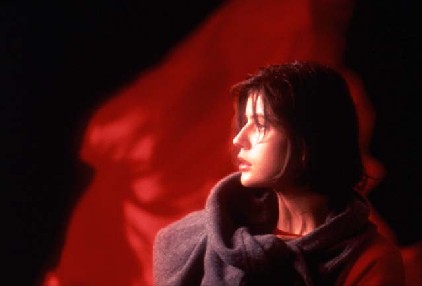
Last edited by Dylan on Sun Dec 24, 2006 4:32 am, edited 1 time in total.
-
zedz
- Joined: Sun Nov 07, 2004 11:24 pm
I think this discussion was briefly rehearsed in some other thread, but this reading also chimes well with the transition between the two parts of the film, with its implications of consciousness transcending death. In the concert scene we move from a point of view shot of Weronika's collapse to that beautiful, unexpected backwards 'flight' away from the dead body and over the audience (POV of W's spirit leaving her body?), to an explicit point-of-view shot from the dead Weronika looking through the glass lid of her coffin, to our second glimpse of Veronique, through the distorting lens of Weronika's glass marble (in this shot the intrusiveness of the 'lens' cues this as a POV shot, even if there is no logical character to 'house' that POV; the nature of the distortion is the clue as to whose POV this is)Dylan wrote:After getting used to the idea for a while, I like the "spirit world" interpretations, and that's really the only possibility that makes sense to me. Weronika's spirit is all-pervading in the French scenes. Let's also note that it's Weronika singing when Veronique first sees Alexandre's reflection in the mirror during his marionette performance. Of course, this doesn't change the fact that Alexandre ultimately appears to be "using" Veronique (as Insdorf notes), but it does eventually lead to the scene with the father (again, the alternate ending is richer because it somewhat confirms Weronika's presence, and it's more emotional).
-
Dylan
- Joined: Wed Nov 03, 2004 1:28 am
This crossed my mind as well. What an incredible shot (beautiful and completely unexpected, as you said). Keeping in mind the spiritual presence of Weronika while interpreting "The Double Life of Veronique" is the most satisfying way to go about understanding what's happening in the later scenes...so many ominous elements in the second half suddenly illuminate and connect once you open up this possibility....this reading also chimes well with the transition between the two parts of the film, with its implications of consciousness transcending death. In the concert scene we move from a point of view shot of Weronika's collapse to that beautiful, unexpected backwards 'flight' away from the dead body and over the audience (POV of W's spirit leaving her body?),
Yes, it appears to be the same lens and distortion as Weronika's POV shots, particularly in the concert scene when she's looking at the orchestra and the conductor.(in this shot the intrusiveness of the 'lens' cues this as a POV shot, even if there is no logical character to 'house' that POV; the nature of the distortion is the clue as to whose POV this is)
-
dadaistnun
- Joined: Thu Nov 04, 2004 12:31 pm
Regarding Preisner, there is this compliation of pieces from Decalogue, DLoV, Three Colors, and the Requiem
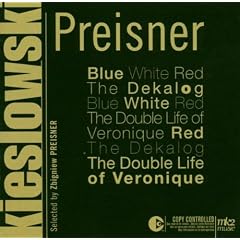
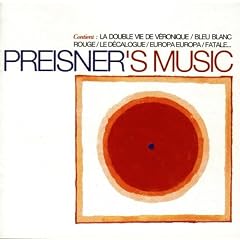
but there is also the album Preisner's Music which is actually a live concert recording and also serves double duty as a 'hits' compliation of sorts (it's got the concertos from DLoV and Blue, the bolero from Red, the tango from White). It was actually recorded in a salt mine. Well worth picking up if you've already got the soundtrack albums.
His score for Malle's Damage is excellent as well, sort of in the mood of the quieter, non-tango moments of White.
but there is also the album Preisner's Music which is actually a live concert recording and also serves double duty as a 'hits' compliation of sorts (it's got the concertos from DLoV and Blue, the bolero from Red, the tango from White). It was actually recorded in a salt mine. Well worth picking up if you've already got the soundtrack albums.
His score for Malle's Damage is excellent as well, sort of in the mood of the quieter, non-tango moments of White.