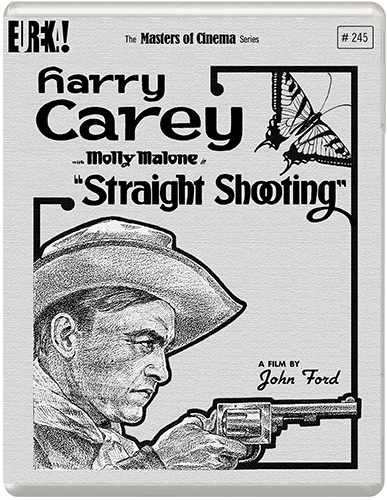
tag gallagher wrote: Sat Jun 27, 2026 10:27 pm
Re pistolwink's cringe. However common foreground objects were in the 1910s, and in Ford in later years, STRAIGHT SHOOTING is the only surviving footage from Ford's Universal years (1917-21) in which he employs them -- until JUST PALS for Fox in 1920. Why is it pretentious to point out how interestingly they're used here? If pistolwink has citations on the topic of foreground objects, I'd appreciate his sharing them. Perhaps I'm as myopic as he accuses me of being, but I've for decades been puzzled why no one but me talks about Ford and foreground objects, which to me is a beautiful aspect to Ford which I wish to share, even at the risk of provoking violent cringes. Francis Ford uses them frequently and perhaps Jack Ford was more influenced by him in his first ambitious movie than in the dozens that followed..?
I would never contest that Ford is a remarkable visual stylist and that this is evident even in his earliest films (albeit not as consistently as in his later ones, as you might expect). But the examples you use in those video essays to illustrate his compositional uniqueness—including placing various items closer to the camera to "frame" characters in depth—are basically bog-standard strategies for creating visual interest, including percieved depth in the image. (An example of a composition from
Straight Shooting that
does look "advanced," even outré, for 1917 is the one of the two main characters in the doorway, shot from a high, slightly oblique angle. That one provoked audible gasps at the rep screening I attended.) Such strategies are mentioned and often illustrated in most cinematographic manuals and such in the era and later. I could look for specific citations if you desire them but pick up almost any early book about cinematography, or early issues of
The American Cinematographer (which admittedly begins in the 1920s) or even retrospective interviews with silent-era cinematographers and you'll probably find stuff of this kind. On top of that, you see very sophisticated such strategies in the work of many other American and European directors of the 1910s (Griffith is kind of notable for seldom utilizing such techniques, just one reason his 1910s–1920s films look particularly idiosyncratic placed next to other American films of the period). David Bordwell, Yuri Tsivian, Lea Jacobs, Ben Brewster, and others have written about this a lot. (I happened to watch one example recently, from Evgenii Bauer's
Twilight of a Woman's Soul; some images from the film
here. Bauer was admittedly a bit of an outlier in the baroque things he did with depth compositions.)
Anyway, my cringe was less a response to your analysis specifically as it was with a broader tendency it seemed to instantiate, something unfortunately common to auteurist writing about film, which is to attribute something that was really part of a group style or trend, to the particular genius or invention of an individual director. That's not a dismissal of auteurism at all, just a desire for writers to be more careful and concrete and specific about a particular filmmaker's contributions. I know you've knocked the book
The Classical Hollywood Cinema elsewhere, and I don't think anyone would claim it's exhaustive or infallible, especially over 40 years on from its writing, but one thing it contributed was a more precise understanding of what Hollywood films and filmmaking held in common. This—along with work by other writers—helped permit a more nuanced understanding of where a particular film and filmmaker's work might have "sat" within—or outside of—the range of typical options (including, for instance, composition in depth).
This is a deep cut, but I remember someone on this board, probably 15–20 years ago, pointing out that some of the visual ideas people typically attribute to Douglas Sirk were actually part of the "house style" of Universal "A" pictures of the 1950s and are found in other films shot by Russell Metty. That isn't the same thing as saying Sirk was a copycat or a journeyman, since Sirk's films are more exciting and sophisticated than most other Universal films of the era. But it does mean that if we're going to start to understand why that's the case, we need to more precisely distinguish his contributions.