My Doctoral Thesis supervisor, Andy Medhurst, was announced as writing a BFI TV Classics on Coronation Street, which two decades later still hasn’t appeared!
Anyway, as a recommendation, Tony Dalton’s biography Terence Fisher: Master of Gothic Cinema is very good, and pretty much a must for Fisher / Hammer fans. My only real issue with it is that his post Curse of Frankenstein films are gathered thematically rather than chronologically, which makes more sense for an auteurist approach than a biographical one. Apart from that, this makes a very readable book, particularly valuable for his pre-gothic work (including his pre directorial work). There’s also a fascinating chapter on films that never were, apparently Frank Herbert asked him to direct an adaptation of Dune, and Milton Subotsky tried to get him to direct 3D versions (presumably using the system that didn’t work for I Monster) of Dracula and The Man Who Laughs. Now there’s an interesting prospect…
Also, I previously mentioned Wayne Kinsey’s massive multi volume history of Hammer. He’s now up to Volume 3 which is 55-58, the first batch of Gothics. I’ve now read the first volume, which is, a few typos aside, a remarkable feat of research and indispensable for Hammer fans interested in the early years, or indeed anyone interested in low budget film production in the UK in the 30s and 40s. The font size is a tad on the small size, but given everything that’s a minor issue.
The Best Books About Film
-
Matt

- Joined: Tue Nov 02, 2004 4:58 pm
Re: The Best Books About Film
Perhaps not a "best" book, but definitely a fun one: Videotapes From Hell: A Visual History of Cult, Collectible, and Crazy Video Covers. It's like a trip through your old neighborhood video rental store, full of high-quality reproductions of classic horror (and some sci-fi) VHS tape box covers. I saw so many that brought a flood of memories, as well as too many that made me feel old because I remember being an adult when they were released.
Most of my early film education came via cable and via scouring libraries and video rental stores for rare releases. The time I drove to every video store in Columbus, OH to find tapes of The Driller Killer and Daughters of Darkness is still fresh in my memory, so it's a little funny to see how many of these formerly rare, niche tapes have now been released in lavish 4K UHD editions.
Most of my early film education came via cable and via scouring libraries and video rental stores for rare releases. The time I drove to every video store in Columbus, OH to find tapes of The Driller Killer and Daughters of Darkness is still fresh in my memory, so it's a little funny to see how many of these formerly rare, niche tapes have now been released in lavish 4K UHD editions.
-
domino harvey

- Dot Com Dom
- Joined: Wed Jan 11, 2006 6:42 pm
Re: The Best Books About Film
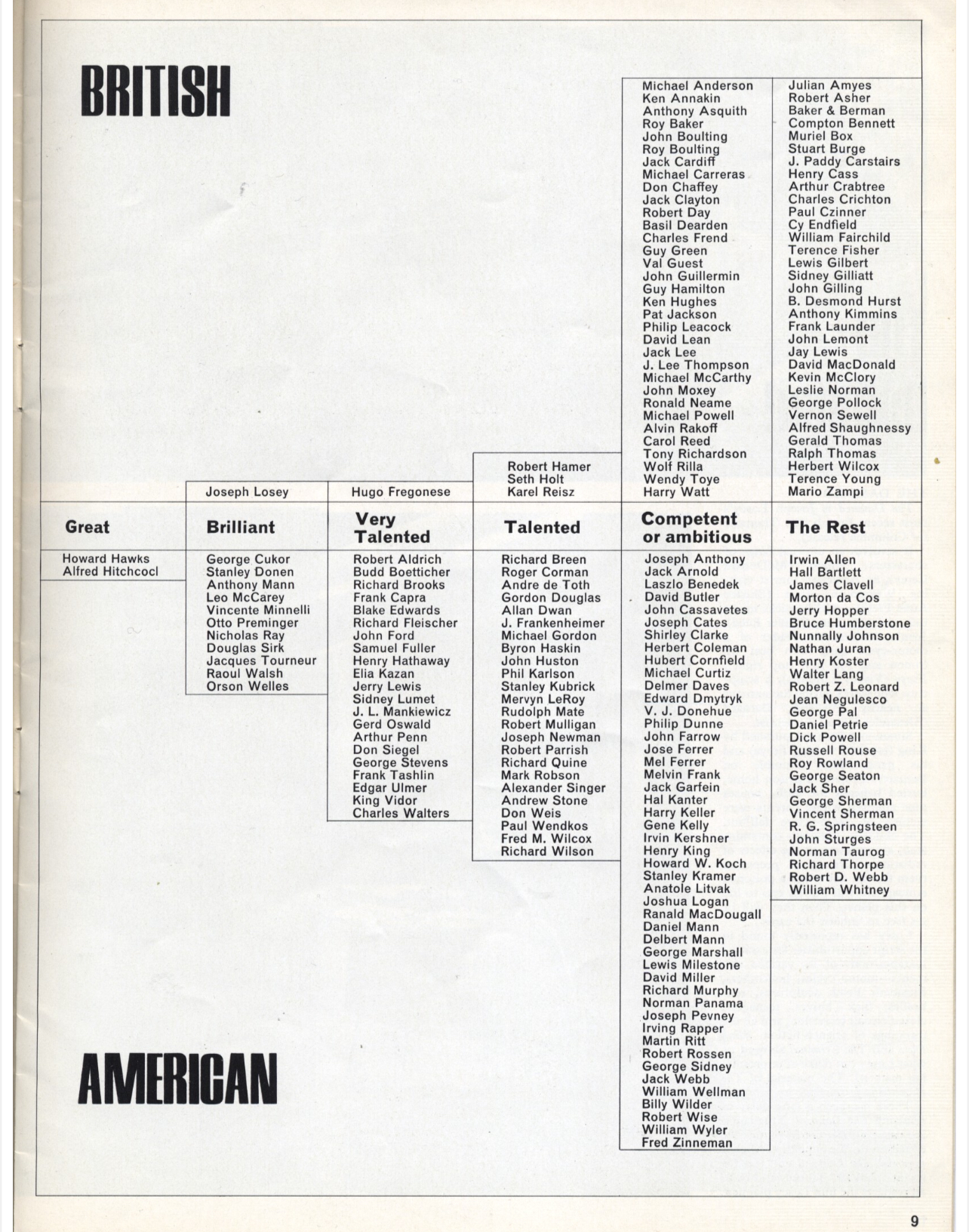
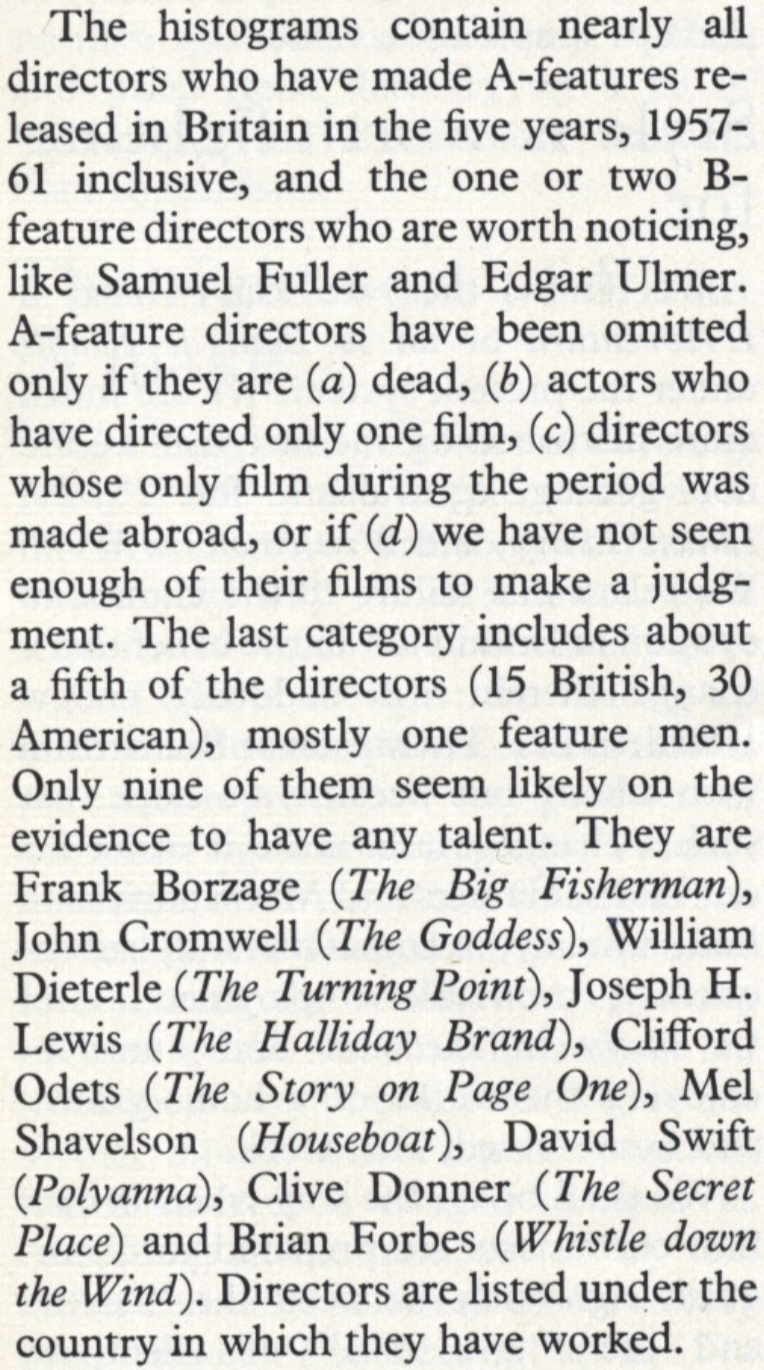
“The talent histogram” from the first issue of Movie (1962)
The issue also contains a hilariously overblown diatribe against the first and second new wave of British films coming out of Woodfall etc as a way to stir shit in the UK and get attention— I suspect it worked, because even I was like “This is too much”
The issue also contains a hilariously overblown diatribe against the first and second new wave of British films coming out of Woodfall etc as a way to stir shit in the UK and get attention— I suspect it worked, because even I was like “This is too much”
-
MichaelB

- Joined: Fri Aug 11, 2006 10:20 pm
- Location: Worthing
- Contact:
Re: The Best Books About Film
The inclusion of Frank Launder and Sidney Gilliat amongst the presumably talent-free "the rest" makes me wonder what criteria were being applied. I mean, they were always seriously underrated by the critical fraternity, most likely because many (though certainly not all) of their films could be classified as mere "light entertainment", but doing this well, and consistently over a period of several decades, demands real skill of a kind that isn't often fully appreciated.
Put it like this: when you watch a Launder & Gilliat film, you are at the very least pretty much guaranteed a script of above-average wit (they're disproportionately well known for writing The Lady Vanishes, but that's a good example), some first-rate performances (they were the first to properly recognise the peculiar genius of Alastair Sim), something impeccably crafted and, almost without exception, hugely entertaining. The idea that they lack talent is so barking mad that it's not even offensive—it's just utterly wrongheaded.
Put it like this: when you watch a Launder & Gilliat film, you are at the very least pretty much guaranteed a script of above-average wit (they're disproportionately well known for writing The Lady Vanishes, but that's a good example), some first-rate performances (they were the first to properly recognise the peculiar genius of Alastair Sim), something impeccably crafted and, almost without exception, hugely entertaining. The idea that they lack talent is so barking mad that it's not even offensive—it's just utterly wrongheaded.
-
domino harvey
- Dot Com Dom
- Joined: Wed Jan 11, 2006 6:42 pm
Re: The Best Books About Film
This comes at the end of the aforementioned screed against British cinema (signed by VF Perkins, arguably the most talented of the Movie critics, but assigned to the full editorial board) but it focuses more on the sins of then-current names like Dearden, Richardson, Clayton, Green, and Schlesinger, with Reisz getting some patronizing praise, and Seth Holt (I’ll save you a google search: the director of Taste of Fear) being sold as a potential fresh and important new voice (this one truly is just trolling, Perkins doesn’t even seem to like the movie he’s using as an example to argue in favor of his talent!)
-
Jonathan S
- Joined: Sat Jun 07, 2008 7:31 am
- Location: Somerset, England
Re: The Best Books About Film
As I've mentioned before, Victor loathed virtually all British films, at least during the decade or so I knew him from 1979. He provocatively claimed something to the effect that John Krish's The Elephant Will Never Forget was the only really good British film. He wasn't even that keen on Hitchcock's British work (though Hitch was among his favourite directors); we did study some of them with him but he invited Charles Barr to put a more persuasive case for them, including The Lady Vanishes.
My impression was that Victor thought British cinema was too staid. He couldn't believe that a film with a title like Madonna of the Seven Moons could turn out, in his view, to be so dull. He did appear to enjoy the flippant verbal humour in some British pictures, not necessarily comedies (I remember a private discussion of In Which We Serve in that context).
I wasn't in touch with Victor during his last 20 years, so he might have changed his mind. I found he was always willing to listen to argument and he encouraged me to write about David Lean though he detested his films. That Movie polemic was published when he was still in his twenties and probably at his most dogmatic. It doesn't reflect his gentle and thoughtful personality (at least in the later period when I knew him) but then I suppose most people present themselves differently through the written word, especially in a professional context.
My impression was that Victor thought British cinema was too staid. He couldn't believe that a film with a title like Madonna of the Seven Moons could turn out, in his view, to be so dull. He did appear to enjoy the flippant verbal humour in some British pictures, not necessarily comedies (I remember a private discussion of In Which We Serve in that context).
I wasn't in touch with Victor during his last 20 years, so he might have changed his mind. I found he was always willing to listen to argument and he encouraged me to write about David Lean though he detested his films. That Movie polemic was published when he was still in his twenties and probably at his most dogmatic. It doesn't reflect his gentle and thoughtful personality (at least in the later period when I knew him) but then I suppose most people present themselves differently through the written word, especially in a professional context.
-
Never Cursed

- Such is life on board the Redoutable
- Joined: Sun Aug 14, 2016 4:22 am
Re: The Best Books About Film
God, Michael Powell in the "competent or ambitious" column. I know he committed career suicide by this point, but one might think his 40s movies would have bought him enough goodwill to avoid being classed in the same category as his former cinematographer. I am also curious as to which Roger Corman and Allan Dwan movies made it over to the UK in the 50s and 60s.
Cahiers du Cinéma has a similar feature in its 54th issue where they provide mini-bios of many Hollywood directors with its own, sometimes pithy commentary.
Cahiers du Cinéma has a similar feature in its 54th issue where they provide mini-bios of many Hollywood directors with its own, sometimes pithy commentary.
-
domino harvey
- Dot Com Dom
- Joined: Wed Jan 11, 2006 6:42 pm
Re: The Best Books About Film
“Best known or most recent” films for those two, from the intro:
Corman: the Pit and the Pendulum, the Fall of the House of Usher
Dwan: Sands of Iwo Jima, Slightly Scarlet
Corman: the Pit and the Pendulum, the Fall of the House of Usher
Dwan: Sands of Iwo Jima, Slightly Scarlet
-
MichaelB
- Joined: Fri Aug 11, 2006 10:20 pm
- Location: Worthing
- Contact:
Re: The Best Books About Film
I'm a British cinema specialist; of course I know who Seth Holt was!domino harvey wrote: Tue Feb 03, 2026 2:22 pm and Seth Holt (I’ll save you a google search: the director of Taste of Fear)
In fact, he absolutely should have been highlighted, because although he died much too young at the age of just 47 and didn't get the opportunity to really spread his creative wings as a director, he was identified as a major talent even back in the days when he was a mere editor-turned-producer at Ealing Studios in the 1950s. And both Taste of Fear and The Nanny are among Hammer's more distinctive productions of the 1960s.
-
Jonathan S
- Joined: Sat Jun 07, 2008 7:31 am
- Location: Somerset, England
Re: The Best Books About Film
I don't think Powell was reappraised, at least in the UK, until the mid-1970s.Never Cursed wrote: Tue Feb 03, 2026 3:50 pm God, Michael Powell in the "competent or ambitious" column. I know he committed career suicide by this point, but one might think his 40s movies would have bought him enough goodwill to avoid being classed in the same category as his former cinematographer....
In The Sunday Times Guide to Movies on Television, published in 1973 (critically worthless, like its American equivalents, but useful as a barometer of at least Establishment taste then), most of P&P's 1940s films are dismissed or very mildly praised. It used a rating system of one to three ticks for good films and one to three crosses for bad ones.
Blimp, I Know Where I'm Going, Black Narcissus and The Small Back Room all get a grudging one tick, mostly for the actors but:
A Matter of Life and Death (one cross): "Extravagantly awful 1946 charade about RAF flyer going to heaven, told not as a comedy but as a serious, ludicrous drama..."
The Red Shoes (one cross): "Dreadful plot..."
-
MichaelB
- Joined: Fri Aug 11, 2006 10:20 pm
- Location: Worthing
- Contact:
Re: The Best Books About Film
This was my Sight & Sound capsule review of Seth Holt's little-seen directing debut, Nowhere to Go (1958):
I also volunteered to do the commentary for Indicator's Taste of Fear, but Kevin Lyons had already been hired—although I edited and mixed the end result and he did a superb job, so I didn't mind in the least.This appears to be the first commercial release in any video medium of Ealing Studios’ penultimate film. While it’s admittedly no masterpiece, it’s been surprisingly neglected given numerous points of genuine historical interest, not least the respective directing, screenwriting and screen acting debuts of Seth Holt, Kenneth Tynan and Maggie Smith. Even at the time the Monthly Film Bulletin commented that its cynicism, fatalism and downbeat ending were “strangely unfamiliar in the British cinema”, and in retrospect it points the way towards the more celebrated Stanley Baker vehicles Hell is a City (1959) and The Criminal (1960) and much else thereafter.
Far more openly inspired by hardboiled American and French thrillers than anything in the company’s back catalogue, former editor and producer Holt consciously set out to make “the least ‘Ealing’ Ealing film ever made”. Accordingly, it starts with an eight-minute, almost dialogue-free prison breakout followed by a lengthy flashback in which George Nader’s smooth-talking Canadian conman Paul Gregory blithely rips off Bessie Love’s heiress after sweet-talking his way into her trust. But once the preliminaries are out of the way, the film enters more intriguing territory as Gregory falls in with Smith’s cynical debutante, who for reasons only hinted at by her enigmatic smile (the script gives few clues) is the only person to stand by him after an accidental killing makes him persona non grata even in the criminal underworld.
Dialogue, cutting and visuals (all low angles and louring shadows on ceilings) are admirably crisp, and one unmistakably ‘Ealing’ touch is that the London locations are highly recognisable without ever becoming overly touristy. Other pleasures include counterintuitive casting (avuncular authority figure Bernard Lee as a ruthless criminal), the only film score by jazz trumpeter Dizzy Reece, and some agreeably black comedic touches in the vein of Holt’s former boss Alexander Mackendrick: before talking to Gregory, Lionel Jeffries’ pet shop owner gruffly informs a small boy “You know what’s the matter with this fish of yours? He’s dead”.
-
Maltic

- Joined: Sat Oct 10, 2020 5:36 am
Re: The Best Books About Film
You also have to wonder just how familiar the Movie critics could be with all those directors by 1962. For example: In Robin Wood's article on Cat People and I Walked with a Zombie from 1972 (reprinted in Personal Views), Tourneur seems to be a relativelty recent discovery for him ("I was beginning to wonder what Tourneur was doing outside of Andrew Sarris' pantheon").
-
Never Cursed
- Such is life on board the Redoutable
- Joined: Sun Aug 14, 2016 4:22 am
Re: The Best Books About Film
Do they say anything at all about Peeping Tom?Jonathan S wrote: Tue Feb 03, 2026 4:49 pm Blimp, I Know Where I'm Going, Black Narcissus and The Small Back Room all get a grudging one tick, mostly for the actors but:
A Matter of Life and Death (one cross): "Extravagantly awful 1946 charade about RAF flyer going to heaven, told not as a comedy but as a serious, ludicrous drama..."
The Red Shoes (one cross): "Dreadful plot..."
-
Jonathan S
- Joined: Sat Jun 07, 2008 7:31 am
- Location: Somerset, England
Re: The Best Books About Film
Yes, the Sunday Times Guide liked Peeping Tom - two ticks - "a cult film, ahead of its time in questioning just who the voyeur is - the killer or the viewer... technical brilliance." But Tales of Hoffmann ("a heavy slog") gets two crosses.
I remember Victor Perkins being amused by the Guide's disparaging review of Party Girl (Ray being his favourite director):
"Standard Nicholas Ray (one of the more overrated directors)... He manages to reduce a promising script (gangsters and G-Men in 1932) and some fine performers (Lee J Cobb, Cyd Charisse) down to the level of the rest of the cast (Robert Taylor, Kent Smith, John Ireland). But there may still be enough excitement for a wet evening." (One tick)
VP was tickled by the idea that Ray had a harmful - rather than elevating - influence on the project.
I remember Victor Perkins being amused by the Guide's disparaging review of Party Girl (Ray being his favourite director):
"Standard Nicholas Ray (one of the more overrated directors)... He manages to reduce a promising script (gangsters and G-Men in 1932) and some fine performers (Lee J Cobb, Cyd Charisse) down to the level of the rest of the cast (Robert Taylor, Kent Smith, John Ireland). But there may still be enough excitement for a wet evening." (One tick)
VP was tickled by the idea that Ray had a harmful - rather than elevating - influence on the project.
-
domino harvey
- Dot Com Dom
- Joined: Wed Jan 11, 2006 6:42 pm
Re: The Best Books About Film
More than even the legend of Johnny Guitar that eventually supplanted it, Party Girl is def the Ray film that had almost unfathomable cachet among the Cahiers (and thus Movie) crowd around its release. Anyone dissing Ray in the 70s is clearly aligning themselves against the legacy of the Young Turks et al
-
Red Screamer

- Joined: Tue Jul 16, 2013 4:34 pm
- Location: Boston, MA
Re: The Best Books About Film
Though it’s also worth noting that Godard’s review of Party Girl is itself fairly mixed, dedicating a lot of space to giving reasons why he’s defending it and Ray so fervently despite his acknowledgement of the film’s flaws.
This reminds me of the funny genealogy in which (ravenous cinephile) Georges Perec specifically makes fun of Godard’s / Cahiers’ praise of Party Girl and its color cinematography in Les Choses : une histoire des années soixante only a handful of pages before the passage that Godard in turn put in voiceover for Masculin Féminin’s celebrated moviegoing scene. Perec’s novel was the hot new thing at the time so I’m sure Godard’s response wouldn’t have gone entirely unnoticed by savvy moviegoers.
This reminds me of the funny genealogy in which (ravenous cinephile) Georges Perec specifically makes fun of Godard’s / Cahiers’ praise of Party Girl and its color cinematography in Les Choses : une histoire des années soixante only a handful of pages before the passage that Godard in turn put in voiceover for Masculin Féminin’s celebrated moviegoing scene. Perec’s novel was the hot new thing at the time so I’m sure Godard’s response wouldn’t have gone entirely unnoticed by savvy moviegoers.
-
hearthesilence

- Joined: Fri Mar 04, 2005 8:22 am
- Location: NYC
Re: The Best Books About Film
I know others have recommended Herzog on Herzog, but what are Werner Herzog's best books - ones he completely authored as a book, not collections or transcriptions of a conversation? I've been reluctant to read any until now and I've seen some complaints about him recycling ideas or stories across some titles, but is there at least one that's worth diving into if you're only going to read one?
-
Grand Wazoo

- Joined: Thu Jun 21, 2007 6:23 pm
Re: The Best Books About Film
Conquest of the Useless and Of Walking In Ice are the two I'd recommend.
-
cantinflas

- Joined: Sat Dec 08, 2007 5:48 am
- Location: sydney
Re: The Best Books About Film
Yeah they're great and what I like about them is that you can just pick them up and read random passages. If you've never seen it his Minnesota Declaration is a good place to start as it sums up his stance.
I haven't read it yet but presumably his memoirs Every Man for Himself and God Against All would be the comprehensive one to get. I do wanna pick up The Future of Truth eventually too but as you said hearthesilence I've hesitated on these because a lot will be recycled from his interviews over the years.
As an aside, a number of years ago he started raving about The Peregrine by J. A. Baker whch I found brilliant and basically Herzog before Herzog.
I haven't read it yet but presumably his memoirs Every Man for Himself and God Against All would be the comprehensive one to get. I do wanna pick up The Future of Truth eventually too but as you said hearthesilence I've hesitated on these because a lot will be recycled from his interviews over the years.
As an aside, a number of years ago he started raving about The Peregrine by J. A. Baker whch I found brilliant and basically Herzog before Herzog.
-
Stefan Andersson
- Joined: Thu Nov 15, 2007 5:02 am
Re: The Best Books About Film
2021 book about Věra Chytilová, Autorka neklidu (Author of Unrest), ed. Zbyněk Vlasák:
https://www.kviff.com/en/news/3435-laun ... -chytilova
https://www.kviff.com/en/news/3435-laun ... -chytilova
-
Dr Amicus

- Joined: Thu Feb 15, 2007 2:20 pm
- Location: Guernsey
Re: The Best Books About Film
Can I have some recommendations please for books on horror, or the cinematic fantastica in general, from the last 20 years or so. I’m interested in catching up with key academic texts since I finished my PhD and teaching in 2005.
-
The Curious Sofa

- Joined: Fri Sep 13, 2019 10:18 am
Re: The Best Books About Film
I'm just scratching that itch and ordered Screaming and Conjuring: The Resurrection and Unstoppable Rise of the Modern Horror Movie by Clark Collins which got great reviews and deals with the modern horror film, starting with Scream. Not sure it counts as an academic text though.
I gave up on Feeding the Monster by Anna Bogutskaya after few chapters, its mostly plot summaries of horror movies and TV shows she watched, with very little real insight. Not sure why that got so much attnetion.
I gave up on Feeding the Monster by Anna Bogutskaya after few chapters, its mostly plot summaries of horror movies and TV shows she watched, with very little real insight. Not sure why that got so much attnetion.
-
Stefan Andersson
- Joined: Thu Nov 15, 2007 5:02 am
Re: The Best Books About Film
Joseph McBride on the reprint of Persistence of Vision:
https://wellesnet.com/persistence-of-vision/
https://wellesnet.com/persistence-of-vision/
-
domino harvey
- Dot Com Dom
- Joined: Wed Jan 11, 2006 6:42 pm
-
domino harvey
- Dot Com Dom
- Joined: Wed Jan 11, 2006 6:42 pm
Re: The Best Books About Film
In 1969, Grove Press started a line of film scripts (different from the earlier Evergreen series) that did double duty as readers of contemporary press and critical reaction along with source material, if applicable, and ephemera related to the film, plus a ton of frame blow ups. Truly a Criterion Collection (ahem, or how it once was) approach to publishing scripts (one that the Rutgers series two decades later carried on, in part)
But I cannot find any source of how many films received this treatment. These are the only four I know of:
L’Avventura
Les quatre cents coups
Masculin Feminin
Rashomon
Is that it? I sure hope not, these things are incredible! The Godard one alone is a masterclass on what a book version of a deluxe boutique film release could be
But I cannot find any source of how many films received this treatment. These are the only four I know of:
L’Avventura
Les quatre cents coups
Masculin Feminin
Rashomon
Is that it? I sure hope not, these things are incredible! The Godard one alone is a masterclass on what a book version of a deluxe boutique film release could be