The Indian films I’ve seen from this year, ranked, part two of two. Some musical highlights in the links.

 10. Arth / The Meaning (Mahesh Bhatt)
Want to feel terrible? Consider the treatment of
Parveen Babi, the doe-eyed Bollywood actress often cast as a headstrong, independent modern woman. (She won me over when she breaks
during “My Name is Anthony Gonsalves” in
Amar Akbar Anthony.) Behind the scenes she had been diagnosed with paranoid schizophrenia and moved between a series of volatile, well-publicized relationships (some confirmed, some rumored) with sometimes married colleagues. One of those was with Mahesh Bhatt, a struggling director who initially saw Babi as a social climbing opportunity, but then fell in love and left his wife and child to enter a three-year affair with the actress. When Babi’s state started deteriorating in the midst of an exhausting schedule filming several concurrent high-profile projects (including Ramesh Sippy’s
Shaan) and Bhatt heard suggestions of electro-shock therapy to accelerate her treatment and get her back to work, he ran away with her so she could take the time she needed. (One director whose films waited on her recovery publicly called her mental illness “a hoax” and alerted government tax authorities in case she tried to leave the country.) When, decades later, her body was found after having starved to death and went unclaimed in the morgue, Bhatt paid for her internment and last rites.
That last part’s according to Bhatt (and contradicted by
her biographer). He never rose to prominence while dating Babi, but turned the affair into an industry after it was over. (“I am the first to admit that I am like a roadside leper selling his wounds,” Bhatt
told a journalist. “I make money from my humiliations.”) He has directed two films, produced another, and produced a web series all based to some extent on the relationship. 2006’s
Woh Lamhe..., made a year after Babi’s death and directed by Bhatt’s nephew, makes everything look like a perfume ad, including the Babi character’s suicide attempt; as she dies of complications from that, she implies she’s sacrificed herself for his career, calls herself “a poisonous woman,” and glowingly tells him, “My baby is a star.”
Arth was Bhatt’s breakthrough and it concerns guess what. A struggling director (Kulbhushan Kharbanda – the villain in
Shaan!) leaves his wife (Shabana Azmi) to have an affair with a famous and unstable actress (Smita Patil.) It launches like it’s going to be the portrait of a man agonizing between a needy, nagging spouse and a needy, crazed mistress, but before you can say, “Ciao, Federico!” the film realigns and rightly pitches him as the destabilizing element. It becomes a story of a wronged woman rebuilding her life. If the Babi affair was good marketing,
Arth promotes itself as an act of contrition.
Not an act of understanding. One of the reasons for all the dish above is that I’m unsure
Arth can exist away from its support. It’s fine. It is a solid parallel cinema drama. It has enough raggedy visual style to set it apart from Bollywood product, though it cannot wholly escape melodrama and dramatic soap opera stingers. Its songs are diegetic performances by a teddy bear troubadour. It may have represented an important cultural step forward in the woman’s picture in India; many of its heroine’s choices still satisfy. It’s a well-regarded movie, won some awards, was a surprise box office hit. But for a work purportedly personal it is thin. I don’t think Bhatt (or Azmi) ever tried to find out how his wife spent her days. Going by what’s on screen, most people spend their lives waiting in lobbies for other people to show up. The most dramatic lives are lived away from the central triangle.
Arth also works as an act of beatification and beautification. On screen, at least, Bhatt holds his wife on high. (Not incidentally, does not allow her to dirty herself there.) By the end she’s laying hands on people. Azmi looks resplendent in her suffering, radiant in forgiveness. She won both the National Film Award (the first of three consecutive wins) and Filmfare Award (ridiculously
beating herself out three times over) for this performance; she can find vulnerability and resilience in a character who has always feared instability and look great doing it. Her two scenes with Patil – who has little time to fill out her complicated character, goes a bit Lady Macbeth – are electric, but then the two actresses (both Shyam Benegal discoveries) were already professional rivals.
Which again brings up Parveen Babi and Mahesh Bhatt and matters of respect. Babi was very much alive when
Arth was released, and still working in a very public industry that had a small stable of name stars. So this same year, Smita Patil, who plays a character based on Parveen Babi, appeared with Babi in
Namak Halaal (see below); they are only in two shots together, in one are kept on opposite sides of a room. And Shabana Azmi, who plays a wife whose husband leaves her for by a character based on Parveen Babi, appeared with Babi in two films.
Here they are sharing a dance number in a
Charlie’s Angels-inspired action film. And in
Yeh Nazdeekiyan (below) she plays a wife whose husband leaves her for by a character played by Parveen Babi.
Bhatt says he told Babi not to see
Arth (
“It’s not good for you.”) and no one is sure if she ever did. But after its release she suffered another breakdown and left the industry for good.

 11. Namak Halaal / Loyal Servant (Prakash Mehra)
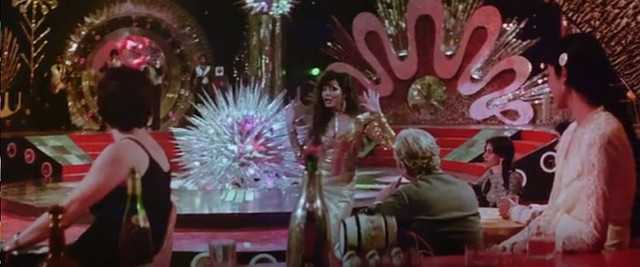
Mehra’s previous film was solemn and dire, so this lighter masala comes as some relief. It’s bogged by a strenuous melodramatic set-up and plot mechanics about which no one could care; could lose an hour, easy. And Mehra's so unconcerned with consistency or clarity or focus that it may be an accident when everyone on screen is on the same page. But when it triples down on not taking things seriously there’s fun to be found.
Plot’s basically small-town Amitabh Bachchan buffooning. Here he is
repatriating Peter Sellers’ Party gag (with some blackface instead of the brownface). Eventually he buffoons in service of big city hotel magnate (and long lost childhood friend, natch) Shashi Kapoor. I think it’s their last outing as co-stars and they have a blast being silly. The set designers do as well.
You should find something to enjoy among the musical numbers. Do you like things
wet?
Spiky, shiny, and awkward? Or crave the feeling of having
an “I Feel Love”-shaped earworm carved into your brain?
The full movie’s
on YouTube with optional English subs.


 12. Pokkuveyil / Twilight (Govindan Aravindan)
After the death of his father, a young man wanders (or perhaps only his mind does) as friends (who may or may not exist) representing physical life and career, political involvement, and art and love fall away. His loneliness echoes through the natural world to the sound of an endless jam session, livened by the occasional memory or hallucination, leadened by aimlessness. Aravindan's abstract meditation on isolation and madness is typically gorgeous (Shaji is again his DP) and slow cinema devotees should dive in; it has its fans and won its awards. I often felt united with the character and the creators in waiting for something to happen while alone in my impatience. Easily the least of the four Aravindan films I’ve seen.
 13. Bazaar (Sagar Sarhadi)
“To hide his sins and crimes, [man] has made customs and rituals.”
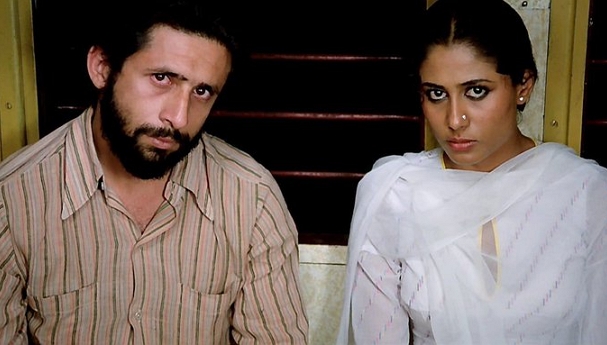
In the historic trading city Hyderabad, once-regal families sell their daughters into surreptitious prostitution to avoid the indignity of work (“In our family, we keep servants. Lowly people do jobs.”), poor families sell their young daughters in marriage to wealthy visitors so they can afford to pay for someone to marry their older daughters. Najma (Smita Patil, her last appearance on this year’s list, I promise) escaped to become the kept woman of a man with a well-off father, but has returned to facilitate a purchase that will provide him the funds to start a business and marry her.
Sarhadi is a credited writer on Yash Chopra’s
Kabhi Kabhie and
Silsila, two romances I love, and though
Bazaar is a different beast at least on the level of conception it includes complicit and tragic cycles and echoes. Yet it gets thinner instead of deeper, repeating rants, hinging on a silly misunderstanding. This is Sarhadi’s first film as a director and it can be a stilted mess. The coverage doesn’t cut, there’s lots of Editing Aargh.
Here’s a scene with a fine song and set-up: Najma’s brother has asked the girl he wants to someday marry to entertain his sister’s party; she sings a song about impossible love for him, but of course draws the attention of Najima’s lecherous client; meanwhile everyone else is contemplating their own histories of missed connections with each other. Sarhadi stages it in a dull static circle, sometimes follows the flow of feelings around and across it, zooming in and out, but will also crassly cut to close-ups – sometimes to the same face you’ve just zoomed out of, sometimes to an abstract series of faces. (I also like
"Karoge Yaad To Har Baat", but the visuals are scenery.)
Mid-film he interjects shots of women “up for auction” and you wonder at their provenance; feels both bracing and in bad taste.
Naseeruddin Shah plays a poet long infatuated with Najma, and both the character and the actor are out of control. The poet’s allowed to tag along and comment on the action to the point of insufferability; when he lectures her on ethics, he carries the umbrage of the jilted lover. It always feels like this film is yelling at the wrong people.
Bazaar is available for streaming with optional English subtitles
on YouTube.

 14. Grihajuddha / Crossroads (Buddhadeb Dasgupta)
Giant corporations with lots of money may be up to bad things! Bengali parallel cinema would-be thriller (which competed this year
in Venice) about a steel company’s debilitating reach into a community it now commands righteously mourns ideals smothered by self-interest and bought-and-paid-for nihilism. But the backbone of the obvious story is feeble investigative journalism and the heart is a Woman Who Has to Make a Moral Choice Between Two Men and this movie’s too clumsily conceived to distinguish itself. Dasgupta tries to keep things crisp – film’s under 90 minutes – but there’s plenty of dead air. Dasgupta shows some visual sense early, crushing figures into narrow alleys and hallways; but he also does a lot of things senselessly. There are numerous abrupt, random dolly moves. A 360-degree pan fills screen space while someone reads a letter. Goutam Ghose pops in to provide some energy as a football goalie/thug.
Kundan Shah’s
Jaane Bhi Do Yaaro would cover some of the same ground as this (including the deployment of “We Shall Overcome”) in a more winning satirical way the next year.
Grihajuddha is available for streaming with optional English subtitles (and a lot of annoying on-screen advertising)
on YouTube.

 15. Nikaah / Marriage Contract (B.R. Chopra)
Until 2017(!), Shariat law in India allowed Muslims to divorce their wives by screaming, "Talaq!" at them three times.
This is what that felt like, according to this film:
A man and woman divorced in such a way could be re-married, but not until the woman fist married a different man, consummated that marriage, then got divorced again. The object of this, as explained in this movie, was to keep men from taking "the venom of divorce" lightly and rattling off the triple talaq during every fight. (Perhaps they should have looked to
Candyman, not
Beetlejuice.) The practice is called Nikah halala and seems like it should be worked into ridiculously plotted movies as often as amnesia and evil twins.
B.R. Chopra wants to make a point about a woman's powerlessness at being kept married only by man's whim. There's a ponderous three-minute narrated opening over artwork of (sometimes naked) women about how they shape our lives and how they're seen and how they need to be remembered as human beings, but I'm not sure he's the one to make this point.
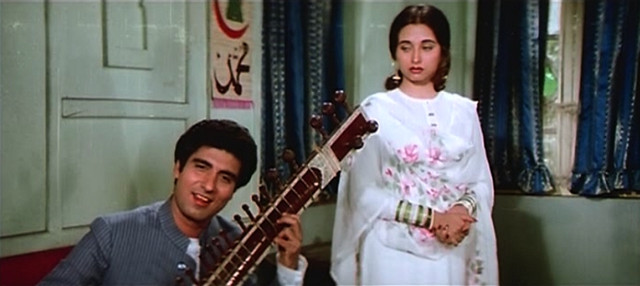
For instance: The relative hero of this movie is someone who saves the heroine from being assaulted at her workplace by her boss. He then tells her to smile more, hires her away, and on her first day of employment takes her to his house. There, he introduces her to the sitar he has named after her.
In some ways things shake out okay at the end. There's a tirade of self-recrimination on the part of the two male leads, both of whom have you longing for a third option from the start. An "I choose me" moment is abandoned on its cusp, and you wonder what happened to this woman's inner life after she graduated college. The best thing about the movie is how glum Salma Agha looks when presented with her supposed second chance, and there is a delicious stretch while that second chance rings aptly (and amusingly) hollow; but then of course Chopra tasks Agha with smiling more. The men, of course, get the last word.

 16. Yeh Nazdeekiyan (Vinod Pande)
Marc Zuber is a flirty, married ad exec with a history of short, meaningless affairs… until he meets model Parveen Babi, for whom he leaves wife Shabana Azmi. This is not a terrible infidelity drama, and It gets right things
Arth gets wrong. Zuber and Azmi’s marriage feels lived-in, complicated, like Pande and the actors put work into it. People have lives. And senses of humor. The film has slight fun playing images of the affair against images of the cornball ads Zuber oversees.
But it also feels cookie-cutter in ways
Arth avoids. It is not afraid to lean into a trite moment. It leers where
Arth gawked. Everyone somehow becomes less a person as this goes on. Babi’s character does a 180 into desperation early. Azmi’s is magically selfless, and her new life involves music so the film can work some songs in. (Nothing of note, and we have to weather renditions of “Evergreen” and “Feelings.”) The movie looks flat. And while
Arth gets you to nod along righteously at its end,
Yeh Nazdeekiyan stubs its toe badly gout the door. I mostly included it to compare with
Arth and was surprised how many similarities there were; a better movie than both these lies somewhere between them.
This was Vinod Pande’s second film in an infidelity trilogy, I’ve no intention of chasing down the others. But I wonder if the clustering of those,
Arth, and
Silsila is a reflection of anything larger. When talking of Basu Chatterjee’s early ‘70s work,
Barnouw and Krishnaswamy posed that to generations that were starting to find ways to connect outside traditional arranged marriages, indie romantic comedies “represented a romantic avant-garde… constituted a how-to genre.” These particular infidelity dramas all take place to some extent within film/media environs and feature financially comfortable characters (
Arth does make a point to contrast class situations and move between those worlds), so they may be purely self-interested and their appeal lurid. But perhaps a decade after the exhilaration of independent romance, an audience also needed affirmation when things didn’t work out.
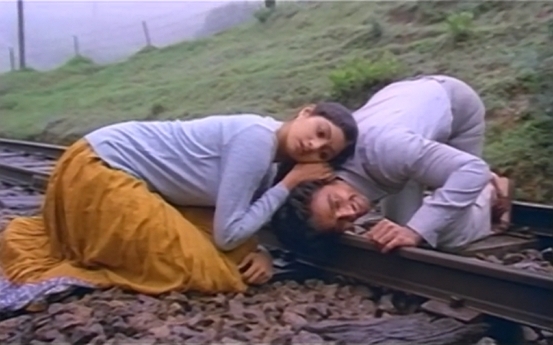
 17. Moondram Pirai(Balu Mahendra)
A young woman (Sridevi) suffers head trauma that erases all but her earliest memories and makes her think she’s seven years old. Her parents send her to an institution for treatment, but of course she gets diverted to a brothel. There, a virginal schoolteacher (Kamal Haasan) is drawn to her. He “rescues” her, but instead of taking her to the police or a hospital or trying to find out anything about her, he takes her home. He raises her as his child and dreams of marrying her, all while her parents are out looking for her.
It’s a little like
Poor Things, if
Poor Things was all about the Ramy Youssef character, and Bella was stuck alone with him the whole film, and her brain maxed out at seven years old and she spoke with a babydoll voice, and instead of fantastical production design you got some nice scenic photography. So maybe it’s more like
50 First Dates meets
Spider Baby.
And it played best for me as an Adam Sandler comedy about male infantilism. The teacher lives next door to his mother, who babysits while he’s at work. He fends off the advances of his elderly employer’s much younger wife. (
Her wet dream is one of the movie’s best musical sequences.) Much time is devoted to watching the teacher and the woman play like they’re both seven-year-olds and that’s catnip to the actors. But Sridevi’s convincing enough that whenever Haasan puts his Daddy Cap back on it gets gross. The film’s mix of innocence and perversion never stopped erring toward the latter, especially when it insisted on the former.
(Did not help matters that whenever he said something along the lines of, “I’ve got to go,” the subtitles instead read, “I’ll make a move.”)
Sounds the sort of intriguing curio you’d discover through the
Psychotronic Video Guide, but it is instead a much beloved, award-winning “romantic drama” that ran for almost a full year in one of the largest Tamil-speaking cities. Either there is an entire region in India that needs to register on a watch list or I need to be less easily appalled. It’ll get a second chance soon, unfortunately; the same director and cast remade this in Hindi as
Sadma and that was already in my 1983 pile.
The songs can have a pleasant ‘70s soft rock vibe:
”Vaanengum Thanga”,
” Kanne Kalaimaane“,
"Poongaatru Puthithaanathu".
A fuzzy version of
Moondram Pirai is available for rent
on Amazon Prime.

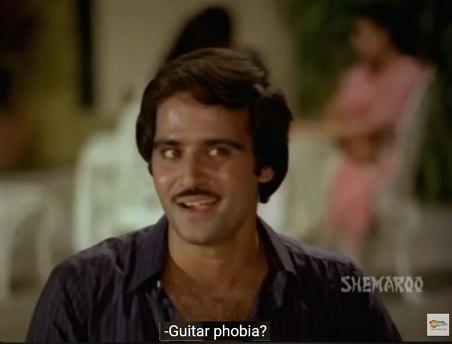
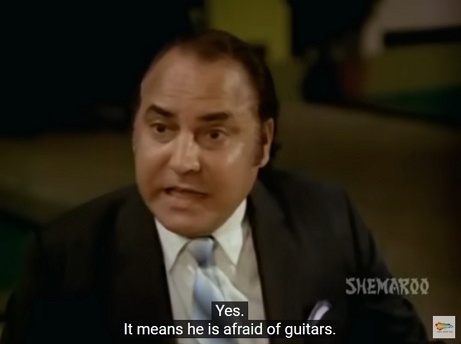 18. Disco Dancer (Babbar Subhash)
While Ridgemont High freshman Stacy Hamilton was staring up at graffiti that read, “DISCO SUCKS,” half a world away Subhash and writer Dr. Rahi Masoom Reza were manufacturing evidence.
Disco Dancer is the story of Jimmy (Mithun Chakraborty), a street performer whose childhood was marred by an injustice. Now tapped for stardom, his heart is filled with song… and vengeance! And the desire to have his mother’s fingers in his mouth! Stock footage crowds love him! After an angry field hockey team slightly bruises Jimmy’s legs, will he be able to perform at the local International Disco Festival?
This movie was a phenomenon. It is the
second-highest-grossing film in the history of the Soviet Union. Suck it, Tarkovsky. M.I.A.
reworked one of its
songs onto her best album. It may have inspired
a Devo track.
It is often plainly terrible, as formulaic as some people think disco. I like disco (Nana Love
4vs) and was sad to have both my high and low hopes dashed by work from the
They Just Didn’t Care school of filmmaking. Enjoyably silly things happen, but they are often borne from laziness. Witness
Jimmy’s breakthrough performance wherein he manhandles a heckler (whom he will later find out is a figure from him childhood and then marry, of course) and enthralls a quarter-filled room with such legendary dance moves as rolling around on the floor, falling to the floor and letting people poke you, grabbing your earlobes while doing squats.
Saturday Matinee Fever at best. (The reaction shots from the club manager are priceless.) Chakraborty’s single impressive dance move involves swinging his hips and crossing his legs in such exaggerated fashion that you feel fight scenes were added to butch him up.
You’ll note the heckler in that clip defends herself by just standing there. There’s a lot of just standing there in
Disco Dancer, including a bizarre, uncomfortable climax in which a traumatized Jimmy just stands there on stage while concerned figures from his life try to coax him out of his trauma and affirm his
titular role. It’s akin to “The Trial” from
Pink Floyd – The Wall or a condensed journey to enlightenment from
Tommy, only it goes on forever and stays resolutely static and internal.
The real tragedy of
Disco Dancer is that there is not more SAM. SAM is the disco dance king Jimmy unseats and also of course the son of the film’s archvillain. (The archvillain’s death is magnificently dumb.) SAM is loud and arrogant in gesture and word, SAM speaks about himself in the third person. Here is SAM (and his crew, who of course do most of the work) performing
"Koi Yahan Nache Nache," which you’ll recognize as The Buggles’ “Video Killed the Radio Star.” They almost completely forget the chorus until SAM reminds them.
Disco Dancer is
on YouTube with optional English subtitles. You probably shouldn’t, but you know you will.
 Unranked:
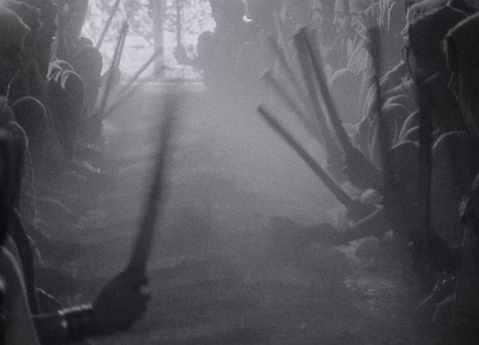
“Tobacco Embers” (Yugantar Collective)
Unranked:
“Tobacco Embers” (Yugantar Collective)
Did not have any narrative films by female directors on this list, a good reminder that the documentaries by the feminist Yugantar Film Collective and the subsequent work of member Deepa Dhanraj are
streaming on The Criterion Channel. This
documentary short covers the first strikes by female workers in the hundred-year history of the Nipani tobacco factories. While union meeting particulars aren’t captivating, the growing sense of confidence and solidarity through the short are. (1981’s
”Maid Servant” was more impressive to me as the strike's logistics seem daunting.)
“Chakkar Chanduka Chameliwala” (Niranjan Thade, as N. C. Thade )
The winner of this year’s
National Film Award for Best Experimental Film was a film student’s thesis project and.. it feels very much like a student film, down to the We Know One Girl of it all. It’s an initially cute piece about a picked-on boy slipping in and out of fantasies that finds time to dip into a musical number and a soft drink ad parody. Fine soundtrack, locations. The version
on YouTube does not have subtitles for its spare dialogue, but it’s a shock it’s on YouTube at all. The director would write and direct his first feature thirty years later.
1978 -
1980 -
1981 - 1982 (
1,2)