The few Indian films from this year I’ve seen so far, ranked, with the caveat that my exposure to Indian film has been very limited:

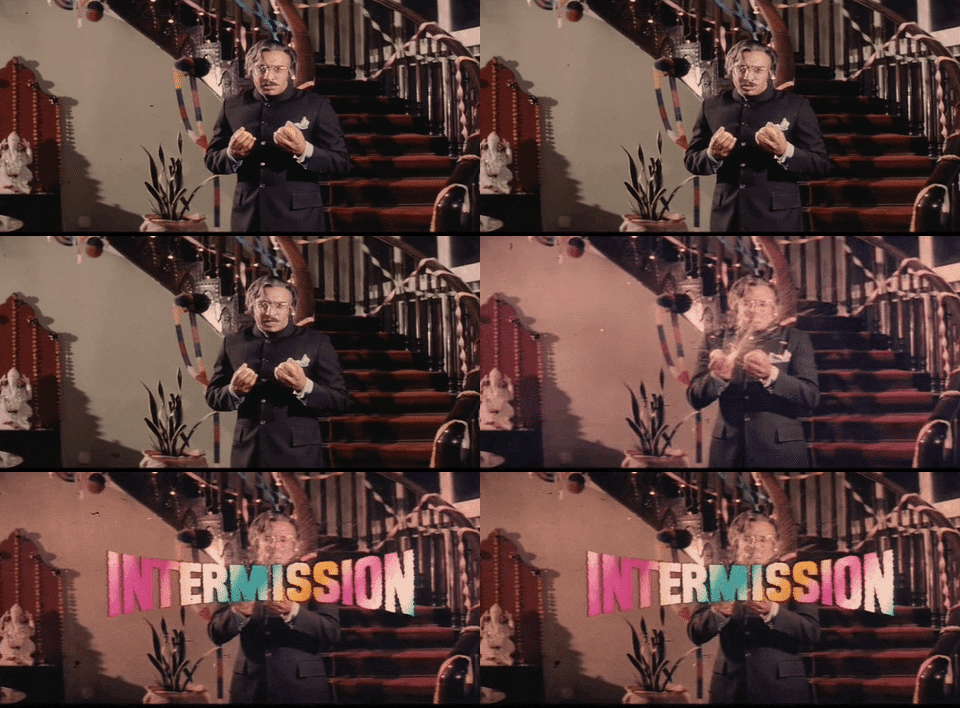
 1. Satyam Shivam Sundaram (Raj Kapoor)
A great, mad, big-budget melodrama about madness. Rajeev, an engineer with the heart of a poet who “cannot tolerate any form of ugliness,” goes to work at a dam near a small village and falls for Roopa, a priest/entertainer’s daughter whose nickname was “Unlucky” even before a childhood accident left her face disfigured. The adult Roopa is gifted with an exquisite playback singer, a voluptuous body she keeps on constant display (“outgrown all her clothes,” catty village elders say – but it’s sound exploitation, her way to draw attention away from her scars), and phenomenal posture. She’s not trying to seduce the attractive newcomer, but he falls for her voice and her body. And of course her inherent goodness. And perhaps the part of her face she never lets him see.
The melodramas further down this list have problems sustaining information management over their run time; secrets remain unnaturally hidden while diversions clog proceedings. One of the things that makes
SSS great is how brazenly it flaunts its single, thin deception; Raj and Roop keep close proximity, and her efforts to conceal her scars can entail
Austin Powers-style obstructions when she could simply do Veronica Lake. Becomes clear early on they both depend on this delusion. Raj could seem especially cruel and shallow, and the film title (which translates as “Truth, Godliness, and Beauty,” hammered at us by narrated preamble) suggests inner beauty will win out. But he is shown to be desperately, psychotically averse to physical aberration, so just becoming a better person and accepting the 5% of Roopa’s body that’s less than perfect is not a ready option. It doesn’t make him more likable, but Roopa’s own self-hatred, desperation, and inherent goodness (thankfully, never impossible saintliness) incline her to join him in a relationship that requires unsustainable schizoid existences.
And because Kapoor has made his movie convincingly mad, I was inclined to join them as well, worried at every casual threat that might shatter their delusion. Colors are almost always goosed, as if the viewer is suffering a stroke or tumor. Sometimes cinematographer Radhu Karmakar just slaps striped colored filters over the lens; it’s all unreal, and it always works one way or another. Kapoor seems to have made his name as an actor, directing ten scattered features over 37 years , but (amidst the standard-issue tracking shots punctuated by zooms, a plague on these films) he can summon some emphatic visuals (there’s a magnificent motif involving a bell) and has a great sense of pacing. (Kapoor edited, as well.) His movie also finds, unlike so many others of this ilk, an action climax organic, thrilling, and meaningful.
Everyone is so focused on the scarring that no one seems to ask, “Is it a good idea for an engineer at that giant new dam to marry someone whose nickname is ‘Unlucky?’”
The staging of most of the ‘70s Bollywood musical numbers I’ve seen has left me disappointed, but the fantasy song
"Chanchal Sheetal Nirmal Komal" at least lets the set designer go nutzoid. It’s a little bit
An American in Paris in withdrawal, a little bit
Alice in Wonderland goes to
Carrie’s prom, and a lot a lot. Why can’t a set have breasts on the ceiling and dry ice volcanoes gushing a half-dozen colors?
(I don’t know the original aspect ratio, but my 1.33:1 Shemaroo DVD seems a lot more natural than the 1.85:1 in that YouTube clip. The colors are more vibrant as well.)
Some people will find
SSS too silly, phony, and thin to hold too much praise, but I found its shamelessness and its commitment to the depth of its characters’ delusion rich, captivating. Even points or turns with which I quibbled were made to work. It’s not interested in explanation or analysis, there’s room for the viewer there. It’s got elements of folklore – the curse, the prince, the siren’s song—and horror. Unlike
The Phantom of the Opera, we’re given view of Roopa’s scars from the start, encouraged to accept them; like the best monster movies it’s a love story and like the best love stories it’s a monster movie, we see monsters everywhere, and throughout this I was kept wondering for whom the pitchforks and torches would come and who might bear them.
Loved this.

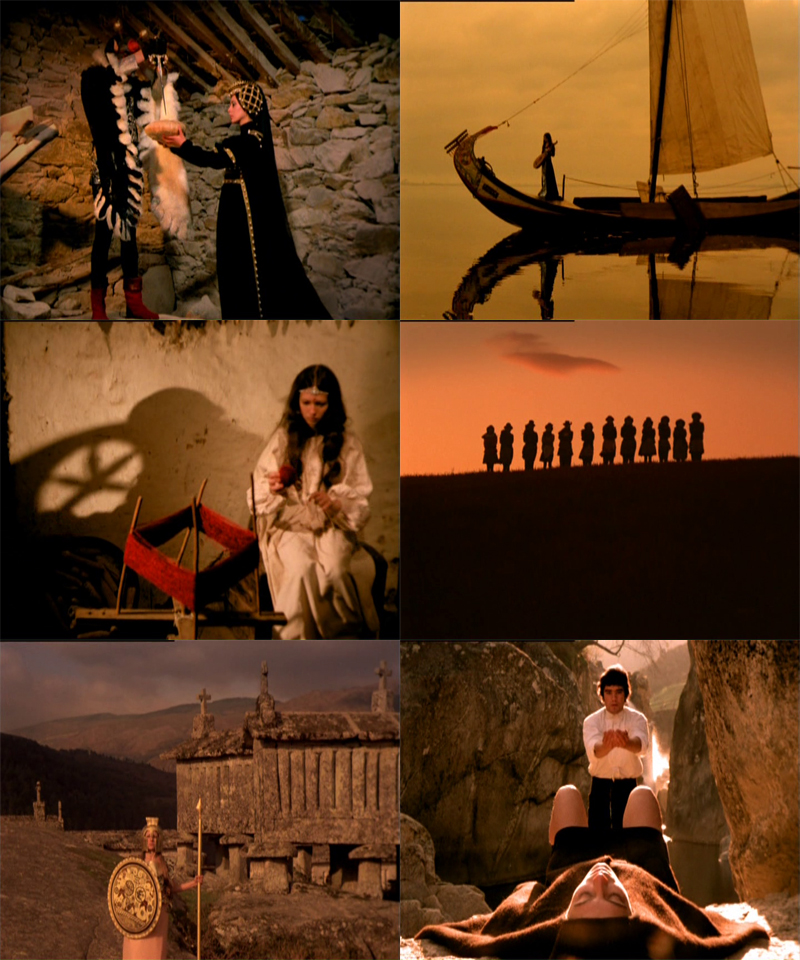
 2. Kondura (The Sage from the Sea) (Shyam Benegal)
Also great, a saner man would have lead with this drama. Benegal’s
Bhumika was one of my orphans last month – if I never go back and post about those, at least know I meant to! – and this is less formally ambitious, very different, and perhaps more profoundly resonant. (Benegal has a
long-dormant thread here, deserves more attention.)
Parashuram, a young brahmin, a newlywed and a younger brother, desperate for respect in his family home and his town, brashly runs away from home and encounters the mystical Kondura(*), a spirit of unknown nature. He’s given a gift, warned it might be burden or boon. On returning home, he starts to explore his relationship with the spiritual world and finds his relationship with his community changing.
(*) The only thing more unfortunate than the movie’s realization of Kondura, which is very Old Testament prophet-meets-Borat in a swimsuit, is the disastrous subtitling on the Eagle DVD.
I was recently bemoaning movies about faith-based ambiguity that weren’t
The Rapture and then along comes this to show me what-for. What makes
Kondura work so well is that Parashuram is largely confused and afraid of the new world to which he seems to have access and is worried about the purpose and nature of Kondura’s gift. His moments of certainty seem dangerous, even to him – which isn’t to say he doesn’t enjoy them. Though he seems to shed interest in others’ respect as he gains it, there is an entitled willingness to accumulate power. And there is a frankly sexual nature to his visions – Kondura has ordered him to stay celibate – and the power men hold over women’s bodies is both a recurring theme and central to Kondura’s gift.
Benegal builds the community and supporting roles by showing a variety of reactions to Parashuram from those around him and a variety of motivations for those reactions. But Parashuram has set himself apart from them from the start, and though he confides in his wife when he can find a way to articulate his new world – making her also confused and afraid, and afraid of him – he is fundamentally alone. Benegal introduces him dwarfed against some phenomenal landscapes. This isn’t another Chosen One narrative; it more closely resembles those great myths where everything may or may not be fate or the will of the gods, but man will suffer and suffer guilt anyway.


 3. Thamp̄ (Govindan Aravindan)
1978 was the only year India’s National Film Awards did not name a Best Picture, but it limits the number of awards a film can receive to three, and Thamp̄ was recognized for Direction, Cinematography, and the Best Film in its Regional Language (“For its cinematic virtuosity and defiance of all narrative traditions of film making.”)
Quality gap, here. The following are all Bollywood melodramas:

 4. Muqaddar Ka Sikandar (Prakash Mehra)
“This one,” said the woman working the returns desk at my library, “was sad.”
It was sad! But I was also sad it refused to take its own advice and stay sad. “Reject happiness,” says a stranger in a cemetery. “Embrace sorrow. Happiness is unfaithful. It is there for some days and then leaves. But sorrow remains with you.”
There is a lot of story in this, a lot a lot, but everything boils down to crossed wires and unrequited loves that represent crossing class barriers. Amitabh Bachchan – who has starred in at least 90% of the Bollywood films I’ve seen, and took three of the five Best Actor nominations at 1978’s Filmfare Awards – is a former street orphan named Sikander, obsessed with winning the love of a woman from a wealthy family that took him in but wrongly acc… A lot a lot.
Bachchan can do the haunted soul well, can sometimes do the entitled charmer winningly; he goes for both here, one wearing the mask of the other. But he doesn’t exude craft or craftiness, so – especially in a script where “clever” schemes are always simple set-up/a-ha! result – his approach can feel like Whatever This Scene Requires. And
MKS is very much an "If you don't like the weather, wait five minutes" kind of film. You can rationalize it as way to express the mask of a man who's supposedly built an empire on snitching (a questionable idea the plot mostly abandons): You make fast friends and fast enemies, acclimate instantly, your sense of paranoia always keeps everyone conveniently just around the corner. The movie’s melodramatic shifts do make a pair of fake-outs more effective. And I treasure the sequence where the brutish Dilawar, who considers himself an honorable man of love and vengeance, turns himself in to the police just to violently escape again.
But I am by nature a wallower and I resent the movie for not allowing Bachchan's character time to do so. Even when it told me it wouldn’t! "Whenever Sikandar feels sad and wants to stay alone, you go there soon," says his occasional comic relief sidekick. Life doesn't let you alone, even when it makes you be alone. I admire how the film let young Sikandar be annoying, unlikable, and still sympathetic; older Sikandar Bachchan sells the big vulnerable glycerin-teared moments, and it's some kind of triumph that Sikandar's desperate estrangement-based self-enforced loneliness rings true, sad, and also pathetic. But every time I started to enjoy the story the storytelling would get in the way. Unless a movie's going to lean into expressive ridiculousness, you can’t whiplash between suicides (“Life was already filled with poison,” four stars), action fits, instant character/conflict dumps.
Muqaddar Ka Sikandar does, at least, send you out of its first half with an excellent citrus burst.
This was the year’s
highest-grossing Indian film, the third highest-grossing of the decade.

 5. Main Tulsi Tere Aangan Ki (Raj Khosla)
How easy change could be, how difficult it is.
The set-up: A ketchup factory-owner (with Severus Snape looks, but not vibes) rescues runaway prostitute Tulsi and they fall in love; aware of the stigma she would bring to his house, she encourages him to marry the respectable Sanjukta instead.
Tulsi isn’t just a hooker with a heart of gold (born in a brothel, she somehow seems unaware that a
nautch girl might ever have to sleep with customers), she’s a saint, an ideal the film hopes is as infectious as
her song. The main character turns out to be Sanjukta, though not allowed to speak for her first three scenes; she represents the potential and limitations of change. She and her son are allowed to struggle with shades of selfishness (Sanjukta can be very proud and cruel about her own sacrifices) and prejudice, while Tulsi and her bastard son are only allowed faults that can be preyed upon.
Two-dimensionality doesn’t do the lower-classed “good” characters any three-dimensional favors. And it complicates the movie’s argument for societal change that, while attempting to depict cycles of behavior, the film makes everyone’s good and bad traits look inherited.
The songs are fine, and for a while everything moves briskly enough(*); but the plot builds all its complications on an easily shared secret and the second half collapses utterly, devolves into an under-cranked and under-umpired polo match action climax.
Main Tulsi Tere Aangan Ki took Best Film at 1978’s Filmfare Awards; It probably should have won Best Chutzpah. When one character demands for the Nth time to know The Secret, he’s instead told: “The truth is, a few things in life are so beautiful that they cannot be revealed before time.” What’s Hindi for “I’ll get back to you on that?”
(*) I am amazed by a lot of these Bollywood films’ approaches to time management. They very efficiently ellipsize by brusquely starting new scenes with, “Six months ago, when we met…” or a gaggle of suddenly aged children, then spend the bulk of the saved time on redundant or uselessly extended dialogue scenes and random, tonally incongruent subplots. Like they get all their work done by noon and look up at the clock and realize they’re going to have to stay until 5PM anyway.
 6. Trishul (Yash Chopra)
He who forsakes love for ambition must reckon with vengeance!
I liked Chopra’s
Deewar and fell like a sucker for his
Kabhi Kabhie, but this – 1978’s
second-highest grossing Indian film – was a huge letdown. Amusing story tendencies from
KK– the interest in real estate development, quarries filled with random explosions, precious nicknames for young women (before “Pinky,” now “Bubli”/”Bubbly”) – were quickly buried by annoying tics. The zoom happiness, the under-cranked action, the cookie-cutter conflicts and faux-clever plotting. Surely no one has ever thought of… beating up their enemies, before!
Bachchan’s choice of choker was more interesting than any of his revenging, all the darkness and suffering mostly decorative. Taken as piffle,
Trishul has its moments. Driving to a fight in an ambulance is a keen signature move. But this is filler.









 The roughest, toughest, and most terrifying western of the year stars an adorable little lamb. Ringing Bell is all about violence begetting violence with innocence destroyed and the lead character’s search to become that which hurt him. Ostensibly a children’s film, and I think I must have seen a dub of it on VHS, this short feature forefronts these and other mature themes to devastating effect.