Spoiler
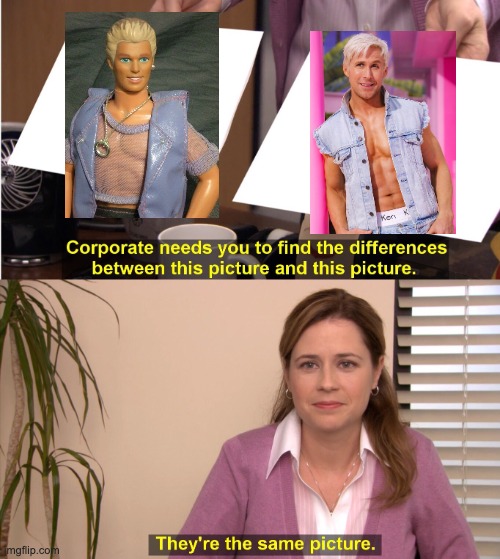





I'm having a hard time imagining a good Barbie movie. Maybe I'm just short on imagination.Never Cursed wrote: Wed Jun 15, 2022 9:07 pm Yeah, whoever came up with the idea for the underwear deserves an immediate Costume Oscar. Don't exactly have the highest hopes for this one in spite of the pedigree, but these first looks are tempting

Translation: this is going to be exactly like The Lego Movie, in that it’ll be 100% safe, brand-approved “satire” with some bullshit faux-progressive social commentary thrown in to seem respectable and "with it" (despite the ultimate goal being to sell more toys, no matter how creatively Gerwig and Baumbach try to push that brief). It's going to be absolutely wretched, and I'm probably going to end up seeing it anyway for some reason.Margot Robbie wrote:Now, can we truly honor the IP and the fan base and also surprise people? Because if we can do all that and provoke a thoughtful conversation, then we're really firing on all cylinders.




Man, that's not the Ken I remember, but then again it's been decades!

As the parent of an eight year old girl, I've seen a *lot* of Life in the Dreamhouse, and yes, Mattel has no issue with poking fun at themselves, often to pretty hilarious effect.domino harvey wrote: Thu Jun 16, 2022 1:41 pm someone linked elsewhere a compilation of clips from a recent animated Barbie series and I kid you not, there were some legit funny moments that were far better than I expected.

Why, it's only the best selling Ken doll in Mattel historyhearthesilence wrote: Thu Jun 16, 2022 2:41 pm Man, that's not the Ken I remember, but then again it's been decades!
Oh wow, I never knew any of this, but then again, I wasn't exactly paying attention to the news back then and didn't know anyone who had one. I'm not sure what the distribution model is, but if it was only around for one year, it's pretty damn impressive that it became the best-selling Ken doll in history. (Maybe it's by annual sales and not total sales?)senseabove wrote: Thu Jun 16, 2022 4:08 pmWhy, it's only the best selling Ken doll in Mattel historyhearthesilence wrote: Thu Jun 16, 2022 2:41 pm Man, that's not the Ken I remember, but then again it's been decades!Spoiler
(who is totally not wearing a cock ring for a necklace)
To be clear, I’m not saying I’m disappointed; I think it’s fair to expect the best possible version of this project to have a low ceiling, and we all know that it is impossible for it to escape the brand-approved brief.domino harvey wrote: Thu Jun 16, 2022 1:41 pm I mean, do you expect a licensed movie to spend two hours mercilessly berating the IP? Who would be the audience for that? People who hate Barbie already hate Barbie, they don’t need a movie to feed that. What realistically could you expect for this project that is better than what you describe?
I don’t see any reason to expect the worst given the talent of all involved. I think Mattel has some self-awareness and a sense of humor— someone linked elsewhere a compilation of clips from a recent animated Barbie series and I kid you not, there were some legit funny moments that were far better than I expected.

I don’t recognize that. Given the scale of moviemaking unless you’re doing it at the complete margins like a Brakhage or your example of very underground Haynes there will always be a lack of independence whether it be financial, state impediments as in socialist Europe, what your latest box office indicates, and so on.furbicide wrote: Fri Jun 17, 2022 4:08 am I presume that all of us at least in some way place value on artistic independence, and recognise that adhering to someone else’s financial goals corrodes that integrity, just as it is corroded in journalism or politics when sponsors are dictating what you can say or do.

What is your actual point, tho'? All you end up saying here is that there's a difference, but give no indication of what makes this difference meaningful or interesting.furbicide wrote: Sat Jun 18, 2022 6:51 am Working for a big production studio or seeking state funding involves compromises and financial imperatives, sure. But I trust we all acknowledge the fundamental difference between a) being a journalist doing work for a for-profit newspaper like The New York Times and b) writing stories aimed at boosting a newspaper’s sponsor’s reputation or helping them sell stuff. It is absolutely crucial to not only acknowledge but vigorously protect that difference.
I’m also not trying to say that one is always pure and that the other is always bad; plenty of directors have worked on TV ads and done interesting things with that medium. We don’t need to take a black-and-white view of that divide to acknowledge that what Gerwig and Baumbach have signed up for here is fundamentally different from what most other filmmakers – including those working on big studio films – are doing when they take a project on.
I guess you could put it another way: artworks are like weeds growing through capitalism’s footpath; the weeds might be cracking the concrete or might not be, but at least they’re not reinforcing it. You can’t look at freshly laid cement and say it’s the same thing.


I mean... Margot Robbie is famous, so she's at least slightly interesting than most other basic white women.Black Hat wrote: Sat Jun 25, 2022 3:44 am The fact that she deleted her letterboxd account is hilarious.
Like, that's something that could potentially make you seem interesting, or even cool.
That said, she is the most basic white woman on the planet so, par for the course.
As someone who took every every course in the Film Studies department of my alma mater, trust me, touting a Letterboxd is anything but a first-class ticket to coolnessBlack Hat wrote: Sat Jun 25, 2022 3:44 am The fact that she deleted her letterboxd account is hilarious.
Like, that's something that could potentially make you seem interesting, or even cool.
That said, she is the most basic white woman on the planet so, par for the course.