Here’s the 90s sans unavailable films, and Deville’s final two in the aughts:
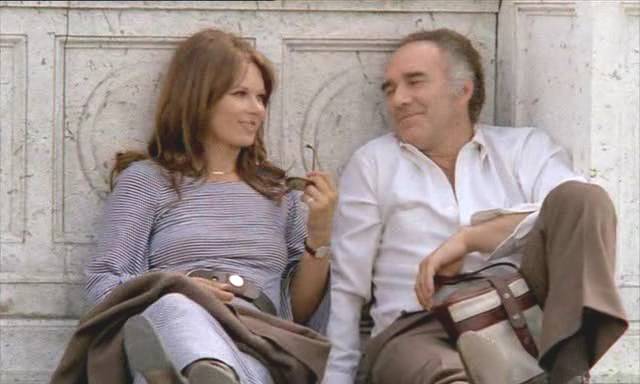
Nuit d'été en ville (1990)
An appropriate follow up to
La Lectrice that could be viewed as a companion film. This eliminates the former’s imaginative narrative style to highlight the same themes, placing the story in a single space over a single night, with a single relationship. The big difference this time around (beyond setting conditions) is that Deville is digging deeper, and more specific, than the vast net he cast over the entire ocean of social dynamics in his last entry. Here he chooses to analyze the psychology of how two individuals battle, succumb, and negotiate in their attempts to achieve harmony in their union. We watch these two people role playing over the course of the evening, and
finally collapsing in bed at the end of it all, seemingly accepting the irony that their quest is simultaneously both impossible and yet necessary to hope for and put forth effort to secure- because of human nature, yes, but also philosophically, like Sisyphus and his stone.
I think the film may argue that this harmony is not hopeless if one negotiates expectations to not aim at fully “knowing” another. With a new goal and acceptance of the individual’s place in a social world, always wanting but never able to achieve total connection with another, it becomes possible on a subjective level to achieve a connection through a willingness to bare ourselves authentically.
That the two lovers begin the film naked whilst playfully talking, put clothes on during their self-conscious attempts to know one another as defenses go up and down, and end half-naked again on the bed, in the same place but having gone through this experience together, bodies apart without the full-blown passion of the beginning yet smiling contently, is indicative of the process of bearing oneself naked to another to achieve momentary harmony or understanding.
While certainly expanding on
La Lectrice in a few worthy thought-provoking areas, this was more fun to analyze than to watch. As much as I love the chamber relationship drama done well, this was more interesting when Deville chose to penetrate the mind with more abstract and playful means in his last feature. Still, this is a fascinating film that deserves to be seen.
Toutes peines confondues (1992)
I couldn’t help but think of Sophie’s kittenish exclamation in
Adorable menteuse, “That’s so hard-boiled!” in jest, while watching Deville craft a crime film 30 years later that’s so hard-boiled it’s practically solid rock. Watching Deville take a sexy Shakespearean tale and inject his slick stylistic tricks was entertaining, especially noting his choice of camera placement and lighting. Toward the end of my viewing, I couldn’t help but think of Deville as an ‘old master’ by this point, gracefully infusing his auteurist traits into a film that on the surface doesn’t scream “Deville.” I enjoyed this for its simple pleasures, which was just what the doctor ordered after the psychological and philosophical charge exuded from his last two social deconstructions. However this isn’t exactly light fare, and the two final scenes before the actual final shot
Antoine’s ride to his death as an affectionate, beautiful moment between two men; Jeanne rhetorically telling Vade, “What does it matter as long as it helps us?” as she replaces him with her dead husband by providing him with the physical object his jacket, and in the process giving herself to him sexually as the jacket was covering her bottom half leaving her naked in more ways than one!
are so perfect in their tragic authenticity that I feel compelled to re-evaluate the entire film through a more humanistic lens; which, let’s face it, screams “Deville.”
 La maladie de Sachs (1999)
Deville pours his heart out to create a deeply affecting experience. Every ounce of love and resentment toward his fellow man is on display in this comedy-drama about a small town doctor. This is a serious film stuffed with strikingly funny moments, or vice versa, but this is not the kind of humor Deville primarily exhibits- rather it’s the kind of “funny” that is only funny because of how real it is. Again this meditates on social dynamics but not as densely as previous efforts, for there is a lightness amidst the drama - a kind of Albert Brooks style of tackling the misanthropic individual forced to live amongst other human beings. The film’s premise is humorous itself because the misanthrope is the town doctor, an aide to the people; and also all the more serious because he is a doctor, with suffering patients all around him providing some very powerfully striking emotional moments. An appropriate film to make toward the end of a career, and lifetime, of exploring the joke of human interaction, as Deville stops exploring and turns to simply meditate on what he’s found.
The waitress people-watching Bruno and Pauline, attempting to ‘know’ them through judgment, expressing contempt and affection simultaneously, saying in the end: “They piss me off, but I only have them, so I take care of them” seems a perfect simplification of Deville’s humanistic outlook.
As the film goes on, it morphs into something greater. Deville takes this as an opportunity to move his focus slowly from relationships between people to the individual’s relationship to life itself, including death as a part of life, in ways he (surprisingly) hasn’t done before.
The story Sachs tells about his father dying: “[the watch] never stopped, but he died anyway” is incredibly moving, as is his speech near the end about why he doesn’t want to have children, the inverted Buddhist anti-acceptance of life as suffering, and of course the hopeful ending as a new “beginning.”
I absolutely loved this film, and although it doesn’t feel like a ‘Deville film’ on the surface (he’s aborted most of his stylistic flourishes, perhaps deliberately so as not to distract from the film’s intended impact), I connected strongly with the places he decided to go and would rank this quite high within his collected works.
Un monde presque paisible (2002)
You know Deville can do it all when he’s able to make a very grave subject (a story about people trying to rebuild their lives post-holocaust) balanced with the style of humor he hasn’t touched since the 80s, pertaining to the character in both physical comedy and dialogue. This is a serious film, but the cast’s, particularly Simon Abkarian‘s, mannerisms provide just the right amount of quirks to lighten the mood without offending the severity of the drama. Deville shows his old chops at being a director of actors in an ensemble again, as they all work together to create such well-realized characters who can move between serious and comic moods with ease, as people do in real life, despite the situation they find themselves in.
That Deville is able to transition moods between a fantasy story causing a child to hold an authentic smile on camera eliciting a response of pure joy, to a scene of people talking about a child dying and how one copes with such a loss, without coming across as forced or melodramatic, is a testament to his greatness.
Deville continues to focus on new themes after his last feature, this time on the importance of memory to individual and collective groups, as well as spotlighting the ever-present thematic touch of interpersonal difficulties, with perspectives clashing on how to cope with tragedy and circumstance together and apart. Another late period treasure.
Un fil à la patte (2005)
For his final film. Deville returns to the spitfire comedy, this time more of a farce and pumping with a bit too much energy. The camera stays in constant motion, which is usually a good thing, but here the approach can be dizzying in a sloppy, jarring manner- at times bordering on found footage/cinéma vérité levels, like an episode of
The Office on speed. However, after the first 20 minutes or so, this becomes less and less frequent, and there’s a lot that works. The actors were a delight, especially Emmanuelle Béart, who joins the list of actors-I-didn’t-know-had-comedic-skills-‘til-Deville-showed-me, and she appears to be having a blast in the part. Deville’s script is solid and there are laughs had due to witty lines as well as appropriately over-the-top performances, physical comedy, and gags aplenty. Some of them work and some don’t, but there are enough shoved in there to create a fun little movie. This was entertaining overall, but the unbalanced, unfocused attention to characters didn’t pay off the way Deville’s occasional, intentionally uneven style typically does. It’s nice to see the director end with another erratic comedy, even if the pieces don’t fit together as smoothly. While I may have liked his last two features more than this, it’s comforting to watch Deville leave behind the deep existential reflection pieces for his final outing, returning to his roots by passionately basking in fun, playful cinema.