World of Glory (Roy Andersson)
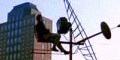
Having a reliable job, a loyal family, fine restaurants at which to dine, lavishly designed places of worship to remind you of the glories of the universe, corporations that genuinely care about you, facilities to care for your ailing parents when they reach a certain age, and well-kept gardens to house their remains when they're gone—why, it's all almost enough to keep a guy from screaming out in eternal agony most of the time.
A Sense of History (Mike Leigh)
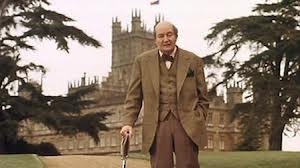
This nice old rich guy is kind enough to give us a walking tour of his estate. That was very thoughtful of him, he didn't have to do that.
Premonitions Following an Evil Deed (David Lynch)
Ingenious skirting of the rules of the Lumière project, wherein directors were challenged to make a film with an antiquated camera that technically could have originated a hundred years earlier. Through careful planning and staging, Lynch's single-take shot fits five separate scenes onto the 50-second film reel, cumulatively hinting at something incredibly sinister almost entirely through reaction shots. If you called this Lynch's best film of the decade, I wouldn't correct you.
Study of a River (Peter B. Hutton)
Hutton makes everything he shoots look ravishing and timeless. This time it's a river.
Let Forever Be/Sugar Water (Michel Gondry)
Take your pick between the ultra-cool '90stastic Chemical Brothers video and the slowburn timewarpy Cibo Matto one.
The Films of Stan Brakhage
Brakhage made more than 100 films during the '90s, the most prolific period for his lovely, later hand-painted style. Re:voir put out a VHS a while ago containing a lot of great examples, only a few of which made their way onto Criterion's Blu-ray set. Very nice, though admittedly a lot of them sort of run together. A couple of standouts are the well-known Black Ice and Stellar, which use a similar step-printing process to very different effect. In contrast, Commingled Containers and Plato's Cave find beauty in the natural world, the first thinking small while the second looks up at the skies, hopelessly overwhelmed, until eventually being distracted and captivated by the magical dance of a gathering dust storm. Finally, I wonder if anyone is considering voting for the gorgeous 18-part, 50-minute Persian Series as a single film. If so, it would seem to be a similar situation to Histoire(s) du cinema, where it's categorized as a 2000s film since that's when most of it was released.
Bouquets 1-10 (Rose Lowder)
Discussed as my spotlight title here.
Horizontal Boundaries (Pat O'Neill)
It's easy to take image stability for granted—imagine how movies would look if there were nothing keeping adjacent frames from bleeding over onto each other, leaving you constantly trying to find your bearings amid the new, fluid geography of the projected image. Though as O'Neill shows, that might actually be an improvement. (Note: IMDb categorizes this film in the 1990s, whereas the director's website places it in the following decade. I believe this is one of those cases where the finished product includes a soundtrack that was not present during the film's first screenings. Unless anyone has solid evidence to suggest that the IMDb information is wrong, the film is eligible for this list.) Also recommended from this decade is Coreopsis, which is another strong entry in the canon of scratched film, here achieving the appearance of flickering neon lights in the film's most kinetic moments.
EDIT: I think it's true that "the finished product includes a soundtrack that was not present during the film's first screenings" but as far as I can tell those first screenings were in 2003, so IMDb is way off.
Rules of the Road (Su Friedrich)
Obsessively following someone's make and model of car around is technically not stalking them, and also gives you an excuse to blast out some embarrassingly catchy tunes.
Side/Walk/Shuttle (Ernie Gehr)
Creative camera angles simulate the wondrous transposed cityscapes of Christopher Nolan's dreams.

Outer Space (Peter Tscherkassky)
Barbara Hershey being endlessly tormented by an obsessive demonic presence in The Entity is nothing compared to the terror of being a celluloid character unable to escape your frame. Get Ready has the same general idea and is nearly as good, though it's only a minute-long advertisement for a film festival, and so is permanently relegated to overshadowed status.
Alone. Life Wastes Andy Hardy (Martin Arnold)
Arnold's cinema seems devoted to drawing out the subliminal, base desires that went suppressed during Hollywood's golden age (as well as some that were clearly never there to begin with). I don't view this as a slight against the old guard—why would Arnold spend so much time with this footage if he didn't have some fondness for it, and what would be the point of drudging up unfashionable material only to make fun of it?—so much as a commentary on the degree to which modern cinema (which would never hesitate to make such things explicit) has warped from its origins. Or I dunno, maybe he just thinks incest is funny. In any case, the main thing I love about this film is the texture of the soundtrack as it stutters back and forth through the optical printer.
Home Stories (Matthias Müller & Dirk Schaefer)
Throwaway housewife scenes from numerous classic Hollywood films are strung together to create a melancholic and occasionally horrifying view of the purgatory of daintily waiting for your man to return home.
Blight (John Smith)
Smith remixes interview snippets from people being kicked out of their homes to make room for a highway into an evocative lamentation about urban decay. Also recommended from this decade is The Kiss, which is a pretty clever joke about the uncertainty principle. Both of these and much more are available on a great director's set from Lux in the UK.
Gnats (Guy Sherwin)
Also recently available from Lux: Sherwin has been working on his series of short 16mm B&W films since the 1970s. Each of the films takes just a few minutes to focus on some seemingly inconsequential scene from life, but approaching it with all the wonder and inventiveness of a cinematic pioneer. For example, this film simply features gnats buzzing around the camera in a futile attempt to seek shelter from the onslaught of film grain.
Hotel E (Priit Pärn)
So Europe seems like a fun place, where everyone is either pretending to be American or trying to appease their inky rotting pig overlords. Serious advice: If you ever start having dreams that resemble what happens behind the dark door in this film, seek medical help.
Fugue (Georges Schwizgebel)
Presumably the only reason that Schwizgebel hasn't caught on like M.C. Escher is that you can't put a moving image on a T-shirt.
Billy's Balloon (Don Hertzfeldt)
There's nothing quite like the feeling of sitting together as a family and bonding over mutual appreciation of stick children being tortured by inanimate objects. Much of Hertzfeldt's other work gets a little too dark to have quite the same intergenerational appeal, though Ah, l'amour never hurt anyone.
Balloon (Ken Lidster)
And then as a matter of karma, here it is the balloon that gets tortured, leaving its slavishly gullible little girl owner to try and rescue it, thus prolonging the circle of abuse.
The Wrong Trousers (Nick Park)
AKA the one with the penguin.
Lost Motion (Janie Geiser)
Children's dolls animated to live depressing, sordid, and frightening lives, all set to a deliciously sickly dirge of a score. Available on Other Cinema's Anxious Animation disc.
The Comb (Stephen & Timothy Quay)
If the Quay brothers themselves are reticent as to the meaning of this film, how am I supposed to fare any better? Well actually, it seems pretty straightforward to me: your every involuntary action is dictated by deteriorating doll people that live inside the vast caverns of your body. I must admit, I had my suspicions!
Food (Jan Švankmajer)
This film conflicts with The Comb in that we are supposed to believe that the hollow of the human body contains fully functioning dumb waiters for the delivery of food to others (nice try, Švankmajer), but if you can get over that part, the rest of the film generally makes complete sense.