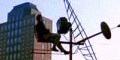
Is it just a coincidence that the heterogenous elements that make up this tour de force of visual non sequiturs all seem to begin with M? Mormons, Mounties, Mediums, Magicians, Murderers, Mechanics. . . The less you think about Barney's films the better they work, and this for me was the best of the Cremaster cycle.
You forgot Metalheads, and I agree with you on this being Barney's best film. Didn't quite make my list though.
Andre Jurieu wrote:Great list zedz, but is this just your actual list of films you voted for or a list of films that didn't make the cut? I'm asking because Close Up (#12) and Satantango (#78) did make the final list.
Yeah, I did my whole top twenty (Wrong Trousers made it too) - then only did the genuine orphans in the subsequent posts.
Gregory wrote:Very discouraging list for me. Of mine, 36 of 50 did not make the top 100. For me, the list seems dominated by US films that are well made and enjoyable (in most cases) but are shallowly entertaining, not something that will mean a lot to me over my lifetime on a profound level.
Yep. Most of the 'darlings' lists submitted here - even the ones which have next to nothing in common with mine - seem to be more credible, substantial and interesting than the master list.
Gregory wrote:Below is a partial list of my choices that did not make the list. It's difficult for me to try to do any justice to these and what they mean to me (and I'm not sure if anyone really cares what I voted for and why) so I'll simply list them without any defense.
Dreams (Kurosawa, 1990). . .
A very respectable list, and I for one would be fascinated to read your defence of Dreams. When it came out I found it a crushing disappointment (albeit a photogenic one) and have never been inclined to revisit it. What's your take on it?
Yes, thanks Zedz for your lists. You've re-kindled the memory banks of films that I had seen but not placed for a few years. We must also keep up the fight for Terence Davies. I emailed JM this week in regard to the BFI/C4 work (which I've done every 12 months for the past few years) with the reply "I'm afraid we have no plans for any Davies films at this time". Since the BFI no longer reply on the matter, our only hope seems to lie with the MOC wrangling a deal somewhere down the line.
I just want to mention a few of my 25 misses, for what it's worth:
The Pillow Book (Peter Greenaway, 1996): Perhaps his most erotic offering yields nothing in its quest to fuse text and image. A Great Day in Harlem (Jean Bach, 1995): a documentary about a photograph of musicians that makes you want to listen to them talk all day. Special edition coming in January. Big Night (Tucci & Scott, 1996): a little American indie that serves up the trials of immigration, fifties consumer culture, and a long wait for Louis Prima. Gas Food Lodging (Allison Anders, 1992): She hasn't really topped this finely etched tale of a mother and her daughters in New Mexico. The impact of Mexican cinema on a teen's development is beautifully done. Beseiged (Bernardo Bertolucci, 1998): It thought it was BB's best of the decade by a large margin--the beautifully shot interiors of a Roman villa are still in my mind. Time Regained (Raul Ruiz, 1999): What zedz said. Maybe more filmmakers need to read the likes of Proust before trying to tell their less ambitious and less interesting stories. My Voyage to Italy (Scorsese, 1999): He gives away the plots of Italian classics and all I want to do is go watch every one of them because he does so much more. Criterion: do the missing Rossellinis! Hamlet (Branaugh, 1996): He filmed every word; his most visually striking work and his most restrained acting. Atonement for Much Ado. When We Were Kings (Leon Gast, 1996). Mann's Ali biopic is fine, but the real deal is here in a doc. using 1974 footage from the Zaire fight with Foreman. Doesn't have to work at all to let the personality (and the adulation) shine through. Smoke Signals (Chris Eyre, 1998): Wry script that captures the complex points of view from Indian country in both unsparing (John Wayne comes in for it) and subtle ways. Mississippi Masala (Mira Nair, 1991): Not Salaam Bombay! but a surprisingly dislocating look at colonialism and prejudice stretching from India to Uganda to the American South couched in a "typical" interethnic romance. Prospero's Books (Greenaway, 1991): Not all of it works for me, but the sheer ambition in taking the very text of The Tempest into multi-dimensionality is startling. No R1 DVD yet.
And a few more: Exotica, Night on Earth, Angels & Insects, Un Coeur en Hiver, The Grifters, Flirting, Mediterraneo (just for a lark), your basic 90s arthouse fare.
zedz, that's a banquet of a list. Thanks for that.
denti alligator wrote:Now I'm curious, zedz. What were your numbers 22, 23, 27, 28 and 33? Then we'll have a complete list.
Lessons of Darkness, Beau travail, Ashes of Time, Safe, The Wind Will Carry Us.
I've only just noticed that The Thin Red Line fell off my list owing to some word processing quirk (it was there when I started ranking them, but now it's nowhere to be seen). It deserved to be in the top 50 - probably my favourite big Hollywood film of decade - but it looks like it didn't need my vote.
I also momentarily panicked that Heddy Honigmann's extraordinary documentary Crazy had suffered a similar fate, but then I realised that it had ended up in the noughties after consulting imdb.
The big regret this time was Peter Cohen's The Architecture of Doom: one of the all-time-great essay films. It was in my 90s top ten originally, but then imdb redated it to 1989 after I'd finished my 80s list, so it ended up in limbo.
Manny and Lo (directed by Lisa Krueger): This little knockout is surprisingly creative and unpredictable. Magical, raw and sensitive all at once. About two young sisters on the run from their foster homes, breaking in empty model homes and the story takes a major detour when Lo discovers that she's 7 months pregnant. Gorgeously directed and sadly not recognized as widely as it deserves. Please do watch this film.
scotty wrote:
Mississippi Masala (Mira Nair, 1991): Not Salaam Bombay! but a surprisingly dislocating look at colonialism and prejudice stretching from India to Uganda to the American South couched in a "typical" interethnic romance.
Yes! This is a fine list, lots that I like and several that I own, but I'm especially glad to see this one get some recognition. The way the threads are interwoven (especially how Mina's father goes from young idealist to guarded middle aged father out of his Uganda experiences and how he gets past that scar and faces things squarely) is deeply moving.
This is coming very, very late for no good reason. In the event than anyone's still thinking about the 1990s, here are some, but not all, of my much-loved films that didn't get the love on our collective 90s list. Several other of my darlings have been defended quite admirably already, including Dream Of Light, Nenette et Boni, and Sink or Swim, so I'm leaving them off. Also note my disappointment that Clueless didn't make our list, but I won't go into lengthy detail on that one – just know that it was high, high up on my list.
(1) The Last Bolshevik (Marker, 1992)
I'm not entirely alone in my esteem of this one - Howard Hampton also named it the best film of the 1990s in Artforum. Ostensibly a movie-letter from Chris Marker to friend and filmmaker Alexander Medvedkin, the end result is a complex essay film that weaves something of a mythology of Medvedkin's life that serves as a parable of the history of Soviet Union, as a broader portrait of the role of the Left in the 20th Century struggle, and as an example of the struggle to reconciling art and politics. And it feels like an elegy for the end of idealism. It's difficult for me to rank Marker's films on value terms, but I've often gone on record calling this the most accomplished work of Marker's career.
(11) The Match Factory Girl (Kaurismaki, 1990)
Iris, an anti-Amelie if there ever was one, works a menial job in (surprise, surprise) a match factory and lives with her sternly conservative and television-numbed parents. Despite painful shyness and a plainness amplified in the film to the point of grotesquerie, Iris looks for love each weekend at a local dancehall. She misinterprets a one-night stand as the beginning of a committed relationship, and suffers abuse after dismally excessive abuse from a disinterested suitor, a disinterested family, and a disinterested world. And then she reaches for the rat poison. Kaurismäki's preference for muted acting, minimal dialogue, and casual pace perfectly compliments the sheer monotony of the film's cruelty. A comedy of the blackest hue, its audience earns the right to laugh after completely exhausting its capacity for empathy.
(15) South (Akerman, 1999)
I'm a total geek for Chantal Akerman, and her recent batch of documentaries are just amazing. In this one, Akerman talks to people affected by a racially motivated hate crime in a small Texas town. The sensitivity of Akerman's approach and the careful aesthetic and journalistic choices made not only deliver a documentary approach best complimenting the subject, but also shows a clear and serious consideration of the moral and political trappings of documentary and ethnography. At the finale of the film, a camera mounted in the back of a truck, facing backward, follows the road on which James Byrd Jr. was dragged to death. The scene plays without commentary or editing, and after everything we've already heard, it's utterly harrowing. Anyone looking to make additions to their 00s List rental list, may I recommend Akerman's similar From The Other Side?
(23) The Mirror (Panahi, 1997)
School lets out and little Mina's mother isn't there to pick her up. Mina is confident she can make her way home on Tehran's public transportation system, but boards the bus in the wrong direction. Turning to strangers for help only compounds her confusion. Kiarostami collaborator Panahi takes Iranian neorealism to its naturalist limit when, at the forty-minute mark, his young star turns to the camera and screams that she's had enough. Abandoning the shoot, “real-lifeâ€
Excellent taste. Match Factory Girl made my list (but not top 50) along with Drifting Clouds - one of Kaurismaki's best films, but one of his least appreciated. Ditto with your top two Rohmers: it's amazing how the director can be so in tune with his young protagonists in Summer's Tale, isn't it?
Angel at My Table (Jane Campion)
Besieged (Bernardo Bertolucci)
Barton Fink (Coen Brothers)
Bitter Moon (Roman Polanski)
Breaking the Waves (Lars von Trier)
Bridges of Madison County (Clint Eastwood)
Calendar (Atom Egoyan)
Dead Man (Jim Jarmusch)
Eyes Wide Shut (Stanley Kubrick)
Goodfellas (Martin Scorsese)
Heat (Michael Mann)
The Insider (Michael Mann)
L.A. Confidential (Curtis Hanson)
Little Women (Gillian Armstrong)
Lost Highway (David Lynch)
Naked Lunch (David Cronenberg)
Pulp Fiction (Quentin Tarantino)
Pump Up the Volume (Allan Moyle)
Ruby in Paradise (Victor Nunez)
Safe (Todd Haynes)
Saving Private Ryan (Steven Spielberg)
Schindler's List (Steven Spielberg)
Shawshank Redemption (Frank Darabont)
Sheltering Sky (Bernardo Bertolucci)
Short Cuts (Robert Altman)
Sweet Hereafter (Atom Egoyan)
Sweetie (Jane Campion)
Thin Red Line (Terrence Malick)
To Sleep With Anger (Charles Burnett)
Unforgiven (Clint Eastwood)
White Hunter, Black Heart (Clint Eastwood)
OTHERS:
King of New York (Abel Ferrara)
My Own Private Idaho (Gus van Sant)
Four Little Girls (Spike Lee)
Trust (Hal Hartley)
Dogfight (Nancy Savoca)
Frankenstein Unbound (Roger Corman)
Begotten (E. Elias Merhige)
Defending Your Life (Albert Brooks)
Jerry Maguire (Cameron Crowe)
Groundhog Day (Harold Ramis)
The Underneath (Steven Soderbergh)
Good Will Hunting (Gus van Sant)
Contact (Robert Zemeckis)
Spanish Prisoner (David Mamet)
Reservoir Dogs (Quentin Tarantino)
Happiness (Todd Solondz)
After Dark, My Sweet (James Foley)
The Apostle (Robert Duvall)
Dances With Wolves (Kevin Costner)
The Grifters (Stephen Frears)
JFK (Oliver Stone)
The Doors (Oliver Stone)
The Hot Spot (Dennis Hopper)
Husbands and Wives (Woody Allen)
Jacob's Ladder (Adrian Lyne)
Straight Story (David Lynch)
Deep Cover (Bill Duke)
DECADE'S MOST NOTABLE DIRECTORS:
Jane Campion
Clint Eastwood
Atom Egoyan
Abel Ferrara
Stanley Kubrick
David Lynch
Terrence Malick
Michael Mann
Martin Scorsese
Steven Spielberg
Quentin Tarantino
SPECIAL MENTION:
Coen Brothers, Gus van Sant, David Cronenberg, Charles Burnett, Spike Lee, Roman Polanski, Frank Darabont, Curtis Hanson, Hal Hartley, Robert Zemeckis, Jim Jarmusch, Todd Haynes, Victor Nunez, Bernardo Bertolucci, Steven Soderbergh.
BEST FOREIGN-LANGUAGE FILMS OF THE 1990'S:
The Actress (Stanley Kwan/Hong Kong)
Beyond the Clounds (Michelangelo Antonioni, Wim Wenders/Italy/Germany)
A Brighter Summer Day (Edward Yang/Taiwan)
Chungking Express (Wong Kar-wai/Taiwan)
City of Sadness (Hou Hsiao-hsien/Taiwan)
The Convent (Manoel de Oliveira/Portugal)
Double Life of Veronique (Krzysztof Kieslowski/Poland/France)
Dream of Light (Victor Erice/Spain)
Europa, Europa (Agnieszka Holland/Poland/France)
Irma Vep (Olivier Assayas/France)
The Killer (John Woo/Taiwan)
L'America (Gianni Amelio/Italy)
Les Amants du Pont Neuf (Leos Carax/France)
No, or the Vainglory of Command (Manoel de Oliveira/Portugal)
Rhapsody in August (Akira Kurosawa/Japan)
Stolen Children (Gianni Amelio/Italy)
Story of Qiu Ju (Zhang Yimou/China)
Three Colors: Red, White, Blue (Krzysztof Kieslowski/France)
Vive L'Amour (Tsai Ming-liang/Taiwan)
White Balloon (Jafar Panahi/Iran)
Wild Reeds (Andre Techine/France)
DECADE'S BEST FOREIGN-LANGUAGE DIRECTORS:
Gianni Amelio - Italy
Agnieszka Holland - Poland
Hou Hsiao-hsien - Taiwan
Wong Kar-wai - Taiwan
Krzysztof Kieslowski - Poland
Andre Techine - France
Lars von Trier - Denmark
Edward Yang - Taiwan
Zhang Yimou - China
Abbas Kiarostami - Iran
Manoel de Oliveira - Portugal
Immeasurably disturbing that no one voted for The Color of Paradise for the 1990s list. Just typing the words "the Color of Paradise" made me start crying. One of the most saddest and profoundly beautiful films ever. Really.
The film was like Tex-Mex Eisenstein suped up on comic books. Pure, wondrous iconography- like opera. The politics were subversively dead-on. Rodriguez didn't waste a single frame on cheap character development or pop psychology (which I found incredibly refreshing). Depp delivers one of the most efficient performances I've ever seen.
This list includes some great films. But since 2/3rds of my top 50 didn't make the top 100, I'll not so much defend them (nor am I sad or panda-like) as recommend them.
I was a bit surprised that there weren't more non-WKW asian films. I'd especially recommend Morita's Mohou han [Copycat Killer], my number 1 pick, a satirical detective thriller which brilliantly evolves into a psychological portrait and then into a philosophical discussion, all the while maintaining an oddball tone unique to Morita.
I was surprised not to see more Kiyoshi Kurosawa. I had Kaïro [Pulse] at number 3, Akarui mirai [Bright Future] at 15, and Doppelganger at 29.
Apparently one of my loves, Arnaud Desplechin, is either unseen or unliked around here. I had Esther Khan, despite its minor flaws, at number 5, Rois et reine [Kings and Queen] at 10, and Léo en jouant 'Dans la compagnie des hommes' [Leo Stars in "In the Company of Men"] at 12, but none of them cracked the top 100.
Japanese extreme art films, I thought, might have appealed to enough sub-cliques here to make the list, but neither Sono's Jisatsu circle [Suicide Circle], my number 6, nor, less surprisingly, Miike's MPD Psycho series, my 48, made the list. I was most surprised not to see Fukasaku's Battle Royale, my 27, somewhere in the top 100.
Some great Thai films made the list, but not one of my favorites, Sartsanatieng's Fa talai jone [Tears of the Black Tiger], my number 11.
My new favorite Korean director, Im Sang-soo, was shut out. I had his Geuddae geusaramdeul [The President's Last Bang] at number 13 and his Baramnan gajok [A Good Lawyer's Wife] at 38. And the first Hong Sang-soo movie I actually liked, Keuk jang jeon [A Tale of Cinema], didn't make the list either.
A poster in the other thread lamented to absence of Spike Like. I had his huh-larious Bamboozled at 16.
Is Todd Solondz unloved? No Palidromes [18] or Storytelling [45]?
And, though not surprised, I am disappointed to see Sokurov's stunt film, Russian Ark, on the list, but not his unbelievably strange Otets i syn [Father and Son], my number 19.
Lynne Ramsay's Morvern Callar was my number 20. Other Euros missing from the compiled listed include Ozon's Gouttes d'eau sur pierres brulantes [Waterdrops on Burning Rocks], 21, Philibert's doc Être et avoir [To Be and To Have], 30, Bellocchio's Buongiorno, notte, 41, and Belvaux mostly interesting formal experiment, Trilogy.
I quite liked Avary's Rules of Attraction, 32, and Clark's Bully, 33.
And these days I prefer Vinterberg - Dear Wendy, 34, and It's All About Love, 46 - to von Trier.
If I were in a pissier mood, I'd bash a few of the movies that did make the list. The inclusion of History of Violence, Lost In Translation, Adaptation, City of God, Almost Famous, Memento, The Pianist, Sideways, Lord of the Rings, The Dreamers, Munich, I Heart Huckabees, AI, Requiem for a Dream, Saraband, and Unbreakable all tickle or disturb me to various extents.
backstreetsbackalright wrote:Philibert's To Be And To Have was my #12 pick. And at least two other people must've voted for it, as it actually nabbed the #39 position.
'Twas my #19.
My darlings:
3. Spartan (Mamet) Mamet's finest film to date, imo. No-one, I mean no-one, seemed to care! What gives? This is a masterpiece.
4. Play (Anthony Minghella). Yes, that Minghella. But this is a short film to behold! Filmed as part of the Samuel Beckett on Film series, this 16-minute version of Beckett's great play will leave you breathless (it certainly leaves the actors breathless). I've watched it countless times.
6. Camera (Cronenberg). As a much-loved supplement to one of our Criterions, I'm surprised this didn't make it. Certainly finer than Spider or History of Violence. And only 6 minutes long!
14. Good-bye Lenin! (Becker) Charming German film about the fall of the Berlin Wall. Lovely. Didn't people like this, despite its sentimentality and Ostalgie.
15 Gerry (Van Sant). I loved this. Better than Elephant, imo. Why didn't this make it?
18. Capturing the Freedmans (Andrew Jarecki) This movie left a profound impression on me. Fine documentary filmmaking that put us in a very uncomfortable position, and leaves you there.
22. Secretary (Steven Shainberg). Maggie Gyllenhaal =P~ I could watch that woman all day. Ok, so the movie has its problems (strange normative Hollywood-y ending), but Spader is terrific and did I mention Maggie? Yes, she's a looker.
25. State and Main (Mamet) Another fine Mamet in a weird comedic vein. Really great performances, really great writing.
26. Wallace & Grommit and the Curse of the Were-Rabbit (Nick Park). Is this as good as the last two shorts? No. Is it good, though? It's hilarious and absolutely brilliant. Cracking good time you'll have. Don't stop. See it now!.
27. Les Revenants (Robin Campillo). "If Tarkovsky returned as a zombie..." someone at imdb wrote. Well, it's not that good, but it's good. Nice twist on a tired genre.
33. Bright Leaves (Ross McElwee). More of a docu on filmmaking than on tobacco. Funny, moving, and all that.
34. Nine Queens (Fabián Bielinsky). I love a good con-film, and this one's terrific.
35. Kung Fu Hustle (Chow). Guilty pleasure. So over the top I couldn't help but love it.
37. On the Occasion of Remembering Turning Gate (Hong Sang Soo). Subtle and powerful. Words escape me here. See it.
40. Crimson Gold (Jafar Panahi). Kiarostami screenplay about a sad pizza delivery man and a botched jewelry heist. Terrific.
41. Cecil B Demented (John Waters). Hilarious spoof on movie industry and the indie sub-industry. Hey, I'm the "Spielberg Terrorist," aren't I? Oh, and did I mention it's got Maggie in it =P~ ("Suicide for Satan!")?
42. Heist (Mamet). yes, I like Mamet. And I like heist films. And I like Gene Hackman. Why wouldn't I love this film?
43. Zoolander (Ben Stiller). Another guilty pleasure. Ben Stiller's best comedic performance and Owen Wilson's best comedic performance. There you have it.
47. The Piano Teacher (Haneke). Fine adaptation of difficult novel. Hard to watch, though.
48. The Ring (Gore Verbinski). Guilty pleasure # 3. Yes, I liked it better than Ringu.
49. Tale of Two Sisters (Ji-woon Kim). I was genuinely scared, so it makes the list. Plus, it's beautifully shot.
50. Memories of a Murder (Joon-ho Bong). Great serial killer flick, with some not-so-expected stuff that transform this one beyond that genre.
First I'm extremely happy with Tropical Malady being ranked this high - in the top ten!
Some of my choices didn't make the cut:
The Return - I was very surprised that it didn't receive enough votes. Thought it was much loved on this forum.
Friday Night - a very attractive little film from Claire Denis, certainly not in the same league as the masterwork Beau Travail. I haven't seen L' Intrus yet but if I did, then it would most definitely appear on my list.
La Cienaga - Lucrecia Martel joins the the group of brilliant female filmmakers working today (Varda, Denis, Ramsey, de Van, Coppola, etc). More people need to see her astonishingly beautiful La Cienga which I prefer to her recent The Holy Girl.
Come Undone - Lifshitz's becoming one of my favorite filmmakers. Sensitive, simple but complex. Emotional, so true to life.
Wild Side - Lifshitz again. davidhare describes this film the best: it firmly moves from "gay" cinema to "queer" cinema, to an even more universal "outsider" cinema. Very rare to find a filmmaker who could this with ultimate success, grace, intelligence and passion.
In My Skin - a wildly fascinating study of one woman's self-mutilation and auto-cannibalism. Superbly realized by the grossly under-appreciated Marina de Van.
A fine list this time, so most of my darlings were superseded by their own siblings (I can't feel too bad for Outerborough if Decasia (Decasia!) made the list) or were so obscure they never really had a chance.
6. Come Into My World (Michel Gondry, 2002)
Gondry's masterpiece, and one of the all-time-great short films. This is also perhaps the greatest example I've yet seen of the limitless potential of CGI. Rather than replicating in a more convenient form traditional spectacle (casts of thousands, space battles, monsters etc.), Gondry here uses it to enhance reality (the actual choreography he's documenting is all the more remarkable for the computer-generated spin it's given) and imagine impossible alternative realities – in this case one in which time is both linear and looped. For those who haven't seen this amazing piece, it involves a continual motion controlled 360 pan around an intersection as Kylie Minogue walks along, singing the title song. In the background, various vignettes take place (a domestic row, a couple smooching, a parking warden issuing a ticket). After a minute or so, Kylie gets back to where she started, and the pan continues. This time, however, she's joined by all of the imagery we saw on the first pass, so she's followed by a second Kylie, passes twin parking wardens issuing multiple tickets, or two identical couples occupying the same park bench, and so on. Then we go on a third pass (three Kylies, three couples etc.) – and a fourth. Gondry's genius lies in how he choreographs all of this activity across time. The dozens of figures never occupy the same part of their world (so we have four parking wardens surrounding the poor car, rather than any overlapping wardens), and even interact with one another. Kylie number two picks up a package that Kylie number one drops, for example. In the most dazzling feat – so impressive I get a feeling of elation every time I see it – four Kylies all dance around one another as she swings around a lamp post: one swings left, another ducks right under the first one's arm, another steps out of the way to avoid colliding with her future self. Oh, and it's all synchronised to the song, so we have from time to time a chorus of Kylies (remember this is one Kylie at different points of a single four minute take) singing the song's chorus (and backing vocals) into the camera. This movie has to be seen to be believed.
11. Outerborough (Bill Morrison, 2005)
A brilliant, hypnotic assemblage / deconstruction of a very early train movie (p.o.v. shot crossing the Brooklyn Bridge), orchestrated for a split screen. When this kaleidoscopic kind of filmmaking works, it takes the top of your head off.
13. Crazy (Heddy Honigmann, 2000)
Honigmann definitely needs to be better known. She's one of the greatest active documentarians, and this film stands in for a fantastic body of work documenting the human cost of war (and other political upheavals). The dead simple premise here is a series of interviews with people who have been in battle zones (soldiers, UN peacekeepers, Red Cross nurses). They relate their experiences, then select a piece of music that evokes those experiences for them, then we watch them listen to the music they've chosen – in real time. There's quite a variety, from classical music to Guns & Roses' unspeakably awful rendition of Knockin' on Heaven's Door. The sequence that gives the film its title is one of the most powerful things I've ever experienced in a cinema.
15. Vendredi Soir (Claire Denis, 2002)
Given the quality of the list, I'm mildly surprised this didn't make it. One of Denis' lightest films, but it still has depths of mystery hardly any other filmmaker can plumb. And it's one of the most sublime tone poems of the last quarter century.
19. Hukkle (Gyorgy Palfi, 2002)
Brilliant, funny and inventive from minute to minute, but this is also a stunningly original narrative film – so artfully constructed you don't even realise there is a narrative (let alone what it is) until towards the end.
20. On the Occasion of Remembering the Turning Gate (Hong Sang-soo, 2002)
Not as perfect as Virgin Stripped Bare (or Kangwon Province), but second-tier Hong trumps first-tier output of almost any other director.
22. Unknown Pleasures (Jia Zhang-ke, 2002)
Jia's second best film (after The World), in my opinion, but again, that's more than enough.
23. 40 Shades of Blue (Ira Sachs, 2005)
The great neglected masterpiece of last year. Rip Torn has never been better, and Dina Korzun's performance is a minimalist miracle. Where are all those Cassevetes fans now that they're needed?
24. Lifeline (Victor Erice, 2002)
Ten magical minutes that fully justify three hours of portmanteau patchiness. Erice's images are more luminous and evocative than ever, and he manages to imply an entire world with grace and economy.
26. The Decay of Fiction (Pat O'Neill, 2002)
Pat O'Neill documents the ghosts that inhabit the abandoned Ambassador Hotel. This dreamy rumination on history, myth and collective memory enlists impeccable optical technique to elaborate a simple, resonant idea: the simultaneity of multiple time periods, of fact and fiction, life and death. O'Neill expertly superimposes characters seemingly recalled from venerable films noirs (but actually carefully reenacted in black and white) onto contemporary colour tracking shots through the derelict hotel. The synchronization of the two layers within the image is incredibly precise, even when they're travelling at different speeds, and the aura of temporal discontinuity is marvellously enhanced by the soundtrack's mélange of dialogue and music from old movies, real and imaginary. In this film, the actual history of an LA monument becomes indistinguishable from the fading memories of the movies that co-opted it.
31. Bright Leaves (Ross McElwee, 2003)
A delightful shaggy smoking dog story, in which McElwee expertly interweaves American social history, family stories, and the Hollywood fantasies that unite them.
34. Ydessa, the Bears and etc. (Agnes Varda, 2004)
A sharp, playful piece of art criticism that suggests Varda is the world's youngest septuagenarian
35. The Missing (Lee Kang-sheng, 2003)
Lots of love for Tsai on show, which is great to see. Followers really need to track down this gem. In this film the ubiquitous Hsiao-kang makes his own Tsai film – nearly as good, but even more emotionally direct.
Probably the most unusual narrative film I saw last year, and one of the few contemporary films that seems to take a dramatic lead from Bresson and, even more surprising, from Dreyer's Gertrud, with its affectless frontal presentation. The film also includes one of the most eccentric film performances I've ever encountered, but it all works beautifully.
39. Electric Dragon 80,000V (Sogo Ishii, 2001)
The best superhero movie ever made. Dragon Eye Morrison takes on Thunderbolt Buddha against the sparking Tokyo skyline. Otherwise: pretty much indescribable; completely unforgettable. How about: Tsukamoto and Suzuki take a ride together in a matter transmitter, then take a huge amount of speed and make a film as a valentine to John Zorn.
40. Donnie Darko (Richard Kelly, 2001)
As noted before, the disdain for this surprised me. I found it a smart and nostalgic puree of 80s trash cinema. All of the discussion around the recut version (which I've avoided), however, indicates that Kelly has removed the delicate ambiguity that I thought was the film's strongest point, and suggests that he may have had no idea what he was doing after all!
42. Japon (Carlos Reygadas, 2002)
I'm a bit ambivalent about this film, and there are parts of it that clunk badly, but the high points (that final drunken tracking shot, for example) are very high indeed.
43. Vibrator (Hiroki Ryuichi, 2003)
A highly original odd couple story, with the vibrancy and inventiveness of 60s Godard.
44. Sisters in Law (Florence Ayisi / Kim Longinotto, 2005)
Another neglected documentarist (Longinotto, that is), and another film standing in for an entire body of work.
45. South of the Clouds (Zhu Wen, 2003)
A deceptively simple film that gets more intriguing as it goes along. Sort of like Hong Sang-soo doing Kafka. Includes one of my favourite dream sequences.
46. Memories of Murder (Bong Joon-ho, 2003)
A reminder of just how good straight genre filmmaking can be. I found this far more impressive than the techno-flash designer nastiness of Park Chan-wook.
49. In the Dark (Sergey Dvortsevoy, 2004)
Yet another neglected documentarist. Dvortsevoy is one of contemporary cinema's great minimalists. This magic hour documents the everyday life of an old blind man and his very cantankerous cat.
Some more films worth cherishing:
The House of Mirth (Terence Davies, 2000) - fourth decade in a row in which this great director is shut out. Sigh. The Child (The Dardennes, 2005) – an odd omission, given the high ranking of The Son Green Bush (Warwick Thornton, 2005) – terrific Australian aboriginal short Star Guitar (Michel Gondry, 2001) – another CGI apotheosis from Gondry and cinema's latest (last?) great train film Comedie de l'Innocence (Raul Ruiz, 2000) – a great Bunuelian mindfuck Divine Intervention (Elia Suleiman, 2002) Le Souffle (Damien Odoul, 2001) Crimson Gold (Jafar Panahi, 2003) The Last Train (Aleksey German, 2003) – awesomely bleak pitch-black comedy Gerry (Gus Van Sant, 2002) The Sun (Aleksandr Sokhurov, 2005) Father and Son (Aleksandr Sokhurov, 2003) Springtime in a Small Town (Zhuangzhuang Tian, 2002) The Return (Andrey Zvyagintsev, 2003) – very surprised this was overlooked. Short memories? Lilya 4-Ever (Lukas Moodysson, 2002) The Hardest Button to Button (Michel Gondry, 2003) Los Angeles Plays Itself (Thom Andersen, 2003) Since Otar Left (Julie Bertucelli, 2003) Va Savoir (Jacques Rivette, 2001) - Rivette's best in a long time - deceptively fluffy The Circle (Jafar Panahi, 2000) Atanarjuat, the Fast Runner (Zacharias Kunuk, 2001) .tibbaR (Leo Wentink, 2004) – wry and deeply uncanny reverse motion bunny sex Maria Full of Grace (Joshua Marston, 2004) The Lady and the Duke (Eric Rohmer, 2001) Wings of Hope (Werner Herzog, 2000) Tony Takitani (Ichikawa Jun, 2004) Late Bloomer (Shibata Go, 2004) - ultra-grungy pseudo-exploitation film that prods the open sore of unconscious prejudice with grubby fingers A Small Life (Michael Heath, 2000) The Orphan of Anyang (Wang Chao, 2001) Kandahar (Mohsen Makhmalbaf, 2001) Touching the Void (Kevin Macdonald, 2003) Hero (Zhang Yimou, 2002) – probably the biggest surprise among the non-inclusions. I'm no Zhang fan (Riding Alone for Thousands of Miles is in the running for the worst film of the decade, in my opinion), but this was pretty impressive. Aren't we blasé? Whisky (Juan Pablo Rebella / Pablo Stoll, 2004) Duck Season (Fernando Eimbcke, 2004) Little Fish (Rowan Woods, 2005) – somewhat generic, but you can't ignore the career-best performances from Blanchett, Weaving, Henderson (and probably Neill) Osama (Siddiq Barmak, 2003) Fat Girl (Catherine Breillat, 2001) – the hatred of Breillat must run real deep if this didn't get a nod, Criterion endorsement and all. Otesanek (Jan Svankmajer, 2000) State and Main (David Mamet, 2000) – the best screwball comedy since After Hours Camel(s) (Park Ki-Yong, 2002)
I'm with you zedz, on enjoying the group list. On another day, in another mood I might have joined you in picking Friday Night, Unknown Pleasures, or Donnie Darko. Wish I was as enthusiastic as you about Hukkle, 40 Shades of Blue, the Decay of Fiction, the Missing and Memories of Murder. The rest I'll try to track down.
Here's my own list of darlings.
2. The Company
In serious contention as my favorite Altman film, period. I'm no dance aficionado but for two hours I felt like one. I haven't seen more beautiful digital photography.
3. The Subconscious Art of Graffiti Removal
A short piece that satirizes art theory and shows off some of the more interesting corners of Portland, OR.
5. The Joy of Life
Lodged somewhere on the border between fiction and documentary, it's “justâ€
Last edited by Brian Oblivious on Sat Oct 13, 2007 10:13 am, edited 5 times in total.
Brian Oblivious wrote:24. Papillon d'Amour
I don't know much about Nicholas Provost, but I find the concept and execution of this simple extrapolation from Rashomon ingenius.
I'm not sure it would have made my list, but I must confess to having completely forgotten about this profoundly beautiful film.
I put Man on Fire at #25 on my list. Because it's the facist flipside of Bring Me the Head Of Alfredo Gracia and does nothing to disguise its intentions.