dad1153 wrote:I had no idea coming in that it was re-enactment of just the final moments in the life of Joan of Arc. The short running time should have clued me in there wasn't enough time for a rousing epic based on the most famous exploits of the mythical figure behind the legend.
If after seeing the Dreyer you still have a residual interest in seeing a rousing epic based on the exploits of the mythic figure, I storngly recommend Marco de Gastyne's La merveilleuse vie de Jeanne d'Arc, made essentially at the same time as Dreyers film in France. The two films are excellent compliments to one another-- everything that the one is not, the other is. In other words the Gastyne is a wonderfully executed, grand scale telling of Joan's life. I don't know how you'd neccessarily go about getting your hands on a copy of this film, since the last home video edition of it was a seacam VHS... but if you can find your way to it, you wont be let down.
HerrSchreck wrote:If after seeing the Dreyer you still have a residual interest in seeing a rousing epic based on the exploits of the mythic figure, I storngly recommend Marco de Gastyne's La merveilleuse vie de Jeanne d'Arc, made essentially at the same time as Dreyers film in France. The two films are excellent compliments to one another-- everything that the one is not, the other is. In other words the Gastyne is a wonderfully executed, grand scale telling of Joan's life.
Or I could just settle for Luc Besson's "The Messenger" with Milla Jovovich. ](*,)
HerrSchreck wrote:If after seeing the Dreyer you still have a residual interest in seeing a rousing epic based on the exploits of the mythic figure, I storngly recommend Marco de Gastyne's La merveilleuse vie de Jeanne d'Arc, made essentially at the same time as Dreyers film in France. The two films are excellent compliments to one another-- everything that the one is not, the other is. In other words the Gastyne is a wonderfully executed, grand scale telling of Joan's life.
Or I could just settle for Luc Besson's "The Messenger" with Milla Jovovich. ](*,)
So as not to sound so very US-centric I should add that ITN is also performing live accompaniments to screenings in London (Portobello Film Festival, Sept. 11) and Mexico City (Teatro de la Ciudad de Mexico, Oct. 1).
I downloaded In the Nursery’s soundtrack to Joan of Arc a while ago (thanks to Tommaso for mentioning that it had been released) and last night I finally got around to playing it alongside the film. As I mentioned earlier in this thread, I’m not a fan of Einhorn’s accompaniment, and even now I would still say that the best companion to this film is silence – but ITN’s work here is extremely impressive, and light years ahead of Einhorn’s intrusive pomposity.
As usual with their scores, it’s great mood music, showing a real sensitivity to the shifting tones in the film. This is evident from the opening trial scene, where the score moves from the maudlin sentiment of Joan reminiscing tearfully about her mother, into the mounting terror as the judges mobilise against her. Low rumblings, vaguely rattlesnake-ish sounds, and drum beats evoke the assault-from-all-angles to which Joan is being subjected, but also convey the sense that this assault is, at this stage, not much more than an irritation for her. At times the music suggests voices filtering through to Joan from a great distance, through the blissed-out haze she has enveloped herself in. This is a story about the spirit overcoming the flesh, and ITN are peculiarly suited to its needs: their music seems to operate on a higher plane than the frenetic action on-screen, which is exactly what Joan’s spirit is doing.
At times this becomes a bit of a problem. For instance, I think the much later scene where Joan accuses her judges of having been sent by Satan to torment her – remember how she turns to each group and denounces them, prompting them to stand up in outrage, and the camera keeps panning frantically across their faces – requires something really jarring and intense from the accompaniment (if it must be accompanied at all), but here the score is curiously limp. There are a few occasions when ITN seem to have lulled themselves into a trance, and like Einhorn (but in a different way) they actually detract from the intensity of the images.
At other times, though, they rise to the challenge of these fiercer moments very well: the torture chamber scene is especially good, and best of all is the final reel of the film. Here the score really comes into its own, and I’d say the ending was at least as moving and terrifying on this viewing as it ever has been before – maybe a little more so, but this is so dependent on the mood of the viewer. ITN do pull out the church organ and bells in the climax, which is an obvious thing to do and might have fallen into some of the same pitfalls as Einhorn’s score, but somehow they pull it off; they give everything an edge that stops it from being cheap and sentimental. I was left feeling really overwhelmed.
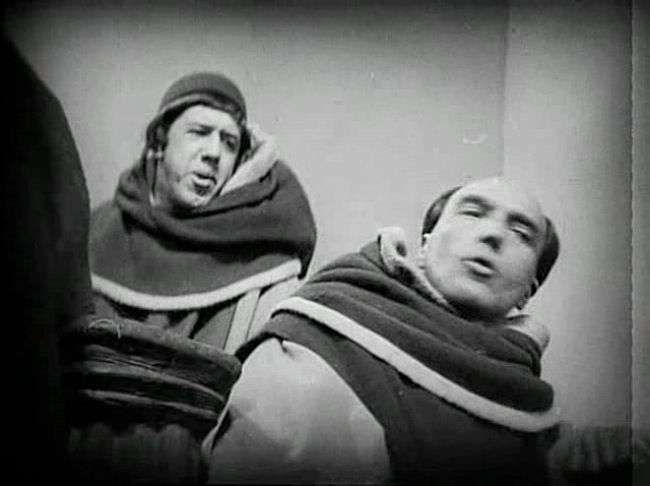
And it doesn't need saying again, but what a film this is. So astonishing to see a narrative built almost entirely around human faces framed in unusual ways, from unusual angles, and seen with such unprecedented, unmerciful, and totally unflattering intensity. I guess it’s appropriate for a film that’s all about spirit transcending flesh that the camera seems so often to be trying to isolate heads and erase bodies – so much of the imagery is about Joan’s face aspiring upwards, away from this mass of writhing earth-bound serpents who are coiling about her. It must be wonderful to see it on a big screen, preferably from the front row, so I’ll try and get down to London in September; thanks to John Cope for the tip!
Sloper, I haven't gotten round to hearing the ITN cd of the score, so does it play completely synchronous with the film (well, more or less) like "A page of madness"? In any case, your description sounds intriguing (not that I ever doubted that the brothers would deliver a great job), and I really wish for some UK company finally releasing this on dvd, with the score. Or that someone is doing a custom affair like swo's "Page of Madness" avi...
I started it when the first text about the manuscript appeared; I think Dreyer intended the film to begin here, without any credits. It synchronised very well throughout, although there were a few moments where I thought it was a bit off so paused either the film or the music accordingly. As I said, the score is sensitive to small shifts in tone, but this being ITN a slight mis-match between image and score wouldn't be as fatal as in the case of, say, a Carl Davis-scored slapstick comedy. If someone were able to put the two together that would be very worthwhile, I think.
One thing that occurred to me while watching this again, and which I had meant to bring up before, was how much I wish silent film accompanists had the courage to leave a bit of silence on the soundtrack, to let the images breathe a little. It's as if they're afraid the viewer will think there's something wrong and start banging the television with a hammer. For instance, In the Nursery score the recantation scene in Joan with very insistent, repetitive percussion, which isn't fatally inappropriate, but I couldn't help feel that a bit of tense quiet, or just a very low hum, would have suited this scene much better. The only instance I know of where a score actually goes dead quiet is Pierre Oser's score for Michael: there are two moments of silence (the second longer than the first) in the scene where Switt and Michael exchange dirty looks by the fireside. A brilliant touch in one of the best silent film scores there is.
With Criterion having a presence at ATP America and Portishead curating there, it seems likely it might be featured there as well ... which might augur well for its appearance on an eventual Blu-Ray.
(Lots of hypothesizing and no actual facts there, mind.)
With Criterion having a presence at ATP America and Portishead curating there, it seems likely it might be featured there as well ... which might augur well for its appearance on an eventual Blu-Ray.
(Lots of hypothesizing and no actual facts there, mind.)
I've been REALLY hoping that this score would wind up on the Joan reissue, ever since Criterion mentioned the Bristol show on their site last year. The promo video they put out about the project looked really amazing.
With Criterion having a presence at ATP America and Portishead curating there, it seems likely it might be featured there as well ... which might augur well for its appearance on an eventual Blu-Ray.
(Lots of hypothesizing and no actual facts there, mind.)
I've been REALLY hoping that this score would wind up on the Joan reissue, ever since Criterion mentioned the Bristol show on their site last year. The promo video they put out about the project looked really amazing.
I've got my ticket to the show almost soley because of this showing of The Passion of Joan of Arc. Well that and Doom. And Harvey. This will actually be my first time watching the film so I'm guessing it will be an amazing experience or I'm being a damn fool.
I caught this projected digitally last night and it was, of course, magnificent... however I noticed Michel Simon's name in the credits and I was almost driven to distraction for a while trying to figure out which of the guards/judges he was! The earliest film I've seen him in is Boudou, so maybe he just looks much different at this early date? Can anyone help me out with this? I own the dvd, so if someone could perhaps point out a scene he figures prominently in, that would be awesome! Thanks!
Gaumont said in April is was restoring the film for a new master. I can't imagine they wouldn't be the first to release their own remaster, so I wonder what was the source for this German release?
Regardless, I'll be eager to see the special features. I've longed for a release of the original paired with the Lo Duca version, which was from the 2nd negative and is entirely comprised of alternate takes and angles.
Either that is a typo, or they're showing it at a slower speed. As I'm sure you're well aware, silent films were shot at non-standard speeds, and there is frequent disagreement over the correct projection speed (Metropolis is a particular bone of contention, with arguments for 18 FPS to 24).
The print discovered in the 1980s, and restored by Gaumont IS the directors cut, a print of his original first edit. It is the definitive cut, and anything longer, with added extant footage from one of the later re-edits would be contrary to his vision, and certainly something I would oppose if indeed correct.
I actually wondered about that myself, but who knows what Gaumont or Arthaus have done. I haven't watched the CC for ages, but I can't remember that I found it running too fast. I guess we'll all have to wait for some reviews. At least it would be good to have an alternative soundtrack to the Einhorn one. I just doubt that they care to release the In The Nursery soundtrack, which of course would be the very best choice.
If any silent warhorse is a sitter for the multiple soundtracks option, it's this one, since it's already attracted the attention of a number of weird and wonderful composers / musicians. Haven't John Cale and Nick Cave both 'done' Joan?
Interesting you mention soundtracks. Adrian Utley, who wrote a new score for the pic last year, was photographed in CC's offices not long ago, which Criterion posted on their facebook. We all took that to be a pretty strong implication they're working on a new edition, and it will have multiple soundtracks. The more the merrier, as long as they leave Voices of Light alone. It's one of the finest pieces of music I've heard. Period. And it'd break my heart if for some reason it was excluded from the new edition!


 ](*,)
](*,)