1914 Italy B&W 123 Min.
Directed by Giovanni Pastrone
From the cover:
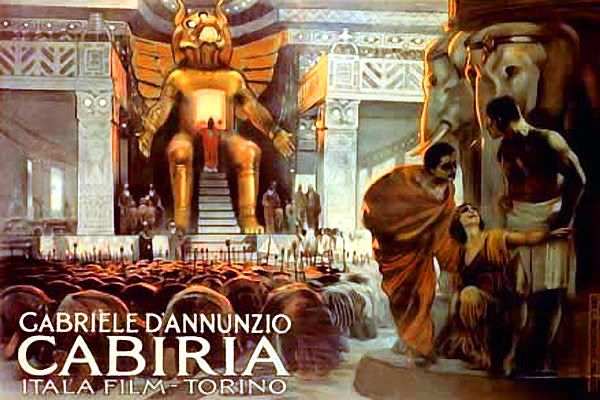
Inspired by grand opera and Italy's imperialist victory in the Libyan War (1911-1912), the Italian movie industry produced dozens of historical epics in the period just before World War I. The most influential and successful of these was CABIRIA, the visually spectacular film which set the standard for big-budget feature-length movies around the world and opened the way for D.W. Griffith and Cecil B. De Mille.
The story concerns a girl -- Cabiria -- who is separated from her parents during the Punic Wars in the Third Century B.C. In her odyssey through the world of ancient Rome, she encounters the eruption of Mt. Etna, capture by pirates, the barbaric splendor of Carthage, human sacrifice and Hannibal crossing the Alps. With meticulous care given to costume and set design, CABIRIA was shot in North Africa, Sicily and the Italian Alps.
This Kino edition was mastered from a premiere quality 35mm print at the correct projection speed. The piano soundtrack, performed by Jacques Gauthier, is adapted from the original 1914 score.
. . . . . . . . . . . . . . .
Following the screening of a restored print of Cabiria -- utilizing footage from a number of different prints from a handful of film museums and private collections -- that brought the film almost back to its original running time of 3+ hours, Roger Ebert wrote a rapturious appraisal that also happened to mention a forthcoming Criterion DVD. This was three years ago, and it was largely responsible for my own postponement of viewing the Kino disc, which I had had on my shelf for a while even then. Since there has been little further substantiation of a Criterion release, I decided to finally view the Kino release, and my reaction at seeing this truncated version was not much different from Ebert's at seeing the restored print.
At the time of its initial release, Cabiria surely must have been seen as something akin to the eighth wonder of the world. The Italian producers did a massive marketing campaign to promote the film, and spared no expense in building an aura of "super artistic masterpiece" around the film. Gabriele D'Annunzio was brought in after the completion of the film to write the intertitles, securing the film a sense of high literary quality in the eye of the public, and the renowned Italian composer Ildebrando Pizzetti was commissioned to write the score for the tour-de-force sequence taking place inside the Temple of Morloch.
The scope of the film, and sheer sense of ambition, is awe-inspiring, even when seen today. The story (as described in Kino's liner notes above) moves from one astonishing set-piece to another -- The eruption of Mount Aetna early on with the vivid depiction of the destruction wreaked on the Sicilian civilization; the before-mentioned religious rituals inside the Temple of Moloch with fire-breathing idols and human sacrifice; Hannibal and his armies marching across the snowclad slopes of the Alps (with at least one elephant); the defeat of the Roman fleet in the siege of Syracuse at the hands of Archimedes ingenious sun-reflectors(!); the sacking of Carthage by the Romans; and it goes on and on. Many scenes involve hundreds, if not thousands of extras, garbed in beautifully realised costumes, and placed inside incredibly large and detailed sets. And, on top of that, the film boasted a number of technical advances. There are many process shots combining miniatures with live action, and almost imperceptible split screen shots. Above all, the camera moves like it never moved before -- slow, subtle tracking shots in scores of scenes that carefully move in on and reframe characters in closer shot, or pan laterally along a group of characters, and more elaborate setups that take the viewer on a journey across the hall of a temple or banquet to zero in on a group of people, and then in the next shot moves backward away from them. The effect is fantastic in creating a sense of three-dimensionality within the large sets, and it helps to create a stronger sense of identification with the larger-than-life characters. In all these ways, Cabiria sets itself apart from any number of other epics from this period that are accessible to us on DVD -- Last Days of Pompeii, Salaambo, Dante's Inferno, Anthony and Cleopatra (all interesting films, but nowhere near as accomplished or engaging as Cabiria).
A Criterion release of the longer and more complete restoration (or any release of this version by whatever label) would be fantastic news. In the meantime, the Kino disc is a fine way to experience the film.
Some stills from the DVD are located in the screen captures thread.