zedz, I am not sure if you mean best-represented on R1, or best-represented anywhere. In any event, there is a release of Punishment Island out in Japan (if not oop) with English subtitles, released by Toho. The quality is quite good as I recall, and the price not exorbitant (apx. 4500 yen). I can post some stills later in the week, if you are interested.zedz wrote:Even though Shinoda is probably the best-represented New Wave director, that just makes the missing titles that remain (e.g. Punishment Island) all the more frustrating.
1960s Discussion and Suggestion (Lists Project Vol. 2)
-
Scharphedin2

- Joined: Fri May 19, 2006 11:37 am
- Location: Denmark/Sweden
-
zedz

- Joined: Sun Nov 07, 2004 11:24 pm
Great news - thanks a bunch. I tend to assume that any Japanese release of a film I want won't have English subtitles!Scharphedin2 wrote:zedz, I am not sure if you mean best-represented on R1, or best-represented anywhere. In any event, there is a release of Punishment Island out in Japan (if not oop) with English subtitles, released by Toho. The quality is quite good as I recall, and the price not exorbitant (apx. 4500 yen). I can post some stills later in the week, if you are interested.
-
Cold Bishop

- Joined: Wed May 31, 2006 1:45 am
- Location: Portland, OR
Are the full screen ratio I see on these correct?Lemmy Caution wrote:Charulata (1964) and Mahapurush (1965) are available on Dvd from Bollywood Films, with English and assorted European subtitles.zedz wrote:Abhijan
Is this really the only 1960s Ray readily available?
Unfortunately, I'm way behind in watching Indian films, and haven't gotten to them yet.
Maybe the 60's list-project-thang will act as a kick in the backside.
But I've got piles and piles to watch.
-
Scharphedin2
- Joined: Fri May 19, 2006 11:37 am
- Location: Denmark/Sweden
Screen captures from the Japanese release of Punishment Island posted here. I apologise that the captures do not reflect the correct aspect ratio. There are (white) subtitles in English.
I also have to briefly gush about Mikio Naruse's Her Lonely Lane or A Wanderer's Notebook, which I had the privelege of seeing on a copy of a very old and worn video last night.
The film portrays the life of author Fumiko Hayashi, who provided Naruse with the literary material for many of his excellent films. Hideko Takamine stars, and it is one of the great film performances, and one of the great depictions of an artist's life that I have seen.
Hayashi is first seen peddling in the streets with her mother and father; they measure out their existence from meal to meal, and living more or less as vagrants. Abandoned by the love of her youth, Hayashi stays behind in the city, when her parents decide to try their luck in the country. Work is hard to come by, and Hayashi is not particularly well suited for any of the routine jobs that she manages to land. Gradually she drifts into a life as bar hostess, while nurturing a love of reading and writing at night by the flicker of candlelight.
She turns down the affection and proposal of marriage of a neighboring widower, and then gives herself to a would-be poet, who turns her head, but soon drops her in favor of a more glamorous and prosperous woman. Later she takes up with another writer, who suffers from consumption and is jealous of her ability to write. Slowly, she manages to have some short stories published, and we see her toward the end of the film on her way to literary fame.
Bridging the episodes of Hayashi's life that make up the film are Takamine's readings of selections from the author's poems and stories.
This life of misery, which Hayashi lived and immortalised in her writing, would appear to be one long monotonous journey colored grey. But, as one of the characters say, her writing is like a dust bin stirred with a stick, and its contents poured on the ground, only, even amongst the dust can be found real beauty. So too in Takamine's performance -- there are so many subtle nuances and changes in the look of her eyes, the way she casts her head and carries herself from scene to scene that, almost imperceptibly, we witness the development of this woman, as the life experiences slowly pile up on top of her. By the end of the film, the distant and indignant young woman has transformed into a worthy - if stoic and resigned - older lady. Hardly any make-up is used to achieve this, it is all in the performance.
I also have to briefly gush about Mikio Naruse's Her Lonely Lane or A Wanderer's Notebook, which I had the privelege of seeing on a copy of a very old and worn video last night.
The film portrays the life of author Fumiko Hayashi, who provided Naruse with the literary material for many of his excellent films. Hideko Takamine stars, and it is one of the great film performances, and one of the great depictions of an artist's life that I have seen.
Hayashi is first seen peddling in the streets with her mother and father; they measure out their existence from meal to meal, and living more or less as vagrants. Abandoned by the love of her youth, Hayashi stays behind in the city, when her parents decide to try their luck in the country. Work is hard to come by, and Hayashi is not particularly well suited for any of the routine jobs that she manages to land. Gradually she drifts into a life as bar hostess, while nurturing a love of reading and writing at night by the flicker of candlelight.
She turns down the affection and proposal of marriage of a neighboring widower, and then gives herself to a would-be poet, who turns her head, but soon drops her in favor of a more glamorous and prosperous woman. Later she takes up with another writer, who suffers from consumption and is jealous of her ability to write. Slowly, she manages to have some short stories published, and we see her toward the end of the film on her way to literary fame.
Bridging the episodes of Hayashi's life that make up the film are Takamine's readings of selections from the author's poems and stories.
This life of misery, which Hayashi lived and immortalised in her writing, would appear to be one long monotonous journey colored grey. But, as one of the characters say, her writing is like a dust bin stirred with a stick, and its contents poured on the ground, only, even amongst the dust can be found real beauty. So too in Takamine's performance -- there are so many subtle nuances and changes in the look of her eyes, the way she casts her head and carries herself from scene to scene that, almost imperceptibly, we witness the development of this woman, as the life experiences slowly pile up on top of her. By the end of the film, the distant and indignant young woman has transformed into a worthy - if stoic and resigned - older lady. Hardly any make-up is used to achieve this, it is all in the performance.
-
zedz
- Joined: Sun Nov 07, 2004 11:24 pm
Diary of a Shinjuku Thief
It's hard for me to be objective about this film. As the first Japanese New Wave film I saw, it really tore the top of my head off, and it still has a similar effect on me. What I found / find so amazing about it is the sheer profligacy of its technique and the knottiness of its treatment of its subject (sexuality, crime, revolution, performance): "an unsolvable, solvable mystery". Oshima throws everything up on the screen: black and white (classical studio and grungy verite) and colour (with rogue Roeg reds); documentary footage and highly theatricalised set-pieces - and actual theatre, and street theatre; song inserts (I just know that Kara Juro's 'Ali Baba' song will be rattling around my head for at least a fortnight - "Bero Bero Bero Bero Bero Bero. . .") and intertitles (which can convey suppressed dialogue, interstitial narration, the date and time in major international cities, or local weather reports).
It's almost a compendium of everything Oshima had done up to that point, with significant nods to important colleagues as well (Yoshida-like radical decentring in some passages, for example, but also strong whiffs of Godard and Pasolini). You never know what to expect. The first shoplifting scene is delivered through hand-held, highly mobile documentary camera work, in amongst the crowds; the second through Violence at Noon-style fragmentary montage. The scene in which Birdey and Umeko spy on Toura through fake rain features a hypnotic series of slow zooms out; the meeting with the sex therapist combines shaky, up-close, hand-held (i.e. 'documentary') footage containing audible camera noise with more distanced, statically-mounted (i.e. 'staged') footage. The whole film wriggles around in a no-man's land between documentary and fiction, but in a completely different way to, say, Imamura's A Man Vanishes. Oshima isn't mixing things up to complicate or explore or expose reality, but is co-opting the real to add some gritty texture to his fictional world, and, in some cases, to provide the most direct route to the ideas he's exploring in his fiction.
The film lurches from set-piece to set-piece, but now I can see the clear (if sometimes arbitrary and dream-like) narrative thread that ties them all together. Some sequences have acquired additional significance for me over time. The sequence in which we eavesdrop on members of Oshima's stock company musing about sex, in scanty available light, used to seem overlong, but as I've become more familiar with some of the key figures (e.g. Toura, Sato and Watanabe) it's become considerably more interesting. I still find the Kara Juro sequence at the end of the film one of the less satisfying ones. Maybe because he's punctuated the film all along it's less surprising than other sequences, or maybe I like to think of the bookshop as the focal location of the movie, and it starts to wind down once the characters leave it behind.
Inferno of First Love
Hani's masterpiece has all of the diversity of the Oshima, but it's marshalled with extreme precision into one of the most masterful and muscular pieces of filmmaking of the 1960s. She and He is a great film, but this is in another league entirely in terms of ambition and achievement. The film ventures into some incredibly dark territory (S&M, incest, pedophilia), but miraculously manages to preserve an extreme tenderness and innocence in the treatment of its central couple.
Personally, I'm completely over incest as a literary device, the creakily predictable deep, dark family secret in any film, play or novel with a deep, dark family secret. It's become so hackneyed as a plot device that it often ceases to have any emotional resonance. Well, not here. The glimpses we get of Shun's stepfather exploiting the boy, even if they're just a stray caress, or a disembodied voice calling out to him, are some of the most distressing scenes I've ever seen: they cut right to the heart of the emotional violence of incest, even if they're not conventionally 'explicit.'
No less disturbing are the scenes in which Shun's potential (or are we just projecting this?) pedophilia is skirted. He has befriended a very young girl, and there is some kind of incident in a graveyard. Hani is ambiguous, as the film's visuals slip into Shun's reverie at the crucial moment, but there's a horribly intense close-up of him clasping her tiny hand that dredges up our dread. Shun is seen, and there is a chase, but we never know for sure just how innocent or guilty (or even conscious) he is of the 'crime.' When he masturbates towards the end of the film, one of the elements flashing through his mind is a grotesque vision of naked boys with old-man masks cavorting through the park - a Terayama touch, no doubt, and maybe even more creepy and vertiginous than the earlier shots.
Nanami's S&M session is a walk in the park compared to Shun's walk in the park. The film has a very careful structure that draws its stylistic diversity together. After two early flashbacks (Shun's story and Nanami's) conveyed in a brilliantly fluid combination of styles (pseudo-documentary footage, post-modern confronting-the-camera inserts, point-of-view shots, artful skewed compositions, stills) that suggests a kind of modern impressionism, the film is built around three 'filmic' or 'filmed' episodes associated with three characters. Shun's hypnosis therapy (after the incident with the girl) takes the amazing cinematic form of a film of his subconscious (visible to those in attendance) projected onto smoke. It proves to be as harrowing as every other of the film's dips into Shun's troubled head, but it's a brilliantly conceived sequence. The subsequent episode devoted to Nanami (which, like Shun's session, expands upon a hidden aspect of her character) is the S&M session she engages in, which is being photographed and filmed for subsequent exploitation. Both of these intense sequences are complemented at the end of the film by Daisuke's actual film, a confessional amateur work about his first love, the viewing of which in some way seems to clear the ground for the central couple to progress their relationship. Unless fate intervenes.
It's a simply fantastic film, dramatically compelling and intellectually rewarding, and I haven't even really got into the amazing, surprising shots that pepper it (the unexplained insert of a dog's head before Shun's hypnosis; the startling series of rapid dissolves that adds the psychological punch to what Nanami views from her window at the end of the film).
Calcutta
Not really in contention for my list, but I watched it, and it's from the right decade, so: lots of good material, but the film seemed to be rather unstructured and consequently kept losing momentum. I haven't watched Phantom India yet, but this really did seem like loosely organised outtakes. The sequences with the lepers were the most compelling, but nobody's going to mistake this for The House Is Black.
It's hard for me to be objective about this film. As the first Japanese New Wave film I saw, it really tore the top of my head off, and it still has a similar effect on me. What I found / find so amazing about it is the sheer profligacy of its technique and the knottiness of its treatment of its subject (sexuality, crime, revolution, performance): "an unsolvable, solvable mystery". Oshima throws everything up on the screen: black and white (classical studio and grungy verite) and colour (with rogue Roeg reds); documentary footage and highly theatricalised set-pieces - and actual theatre, and street theatre; song inserts (I just know that Kara Juro's 'Ali Baba' song will be rattling around my head for at least a fortnight - "Bero Bero Bero Bero Bero Bero. . .") and intertitles (which can convey suppressed dialogue, interstitial narration, the date and time in major international cities, or local weather reports).
It's almost a compendium of everything Oshima had done up to that point, with significant nods to important colleagues as well (Yoshida-like radical decentring in some passages, for example, but also strong whiffs of Godard and Pasolini). You never know what to expect. The first shoplifting scene is delivered through hand-held, highly mobile documentary camera work, in amongst the crowds; the second through Violence at Noon-style fragmentary montage. The scene in which Birdey and Umeko spy on Toura through fake rain features a hypnotic series of slow zooms out; the meeting with the sex therapist combines shaky, up-close, hand-held (i.e. 'documentary') footage containing audible camera noise with more distanced, statically-mounted (i.e. 'staged') footage. The whole film wriggles around in a no-man's land between documentary and fiction, but in a completely different way to, say, Imamura's A Man Vanishes. Oshima isn't mixing things up to complicate or explore or expose reality, but is co-opting the real to add some gritty texture to his fictional world, and, in some cases, to provide the most direct route to the ideas he's exploring in his fiction.
The film lurches from set-piece to set-piece, but now I can see the clear (if sometimes arbitrary and dream-like) narrative thread that ties them all together. Some sequences have acquired additional significance for me over time. The sequence in which we eavesdrop on members of Oshima's stock company musing about sex, in scanty available light, used to seem overlong, but as I've become more familiar with some of the key figures (e.g. Toura, Sato and Watanabe) it's become considerably more interesting. I still find the Kara Juro sequence at the end of the film one of the less satisfying ones. Maybe because he's punctuated the film all along it's less surprising than other sequences, or maybe I like to think of the bookshop as the focal location of the movie, and it starts to wind down once the characters leave it behind.
Inferno of First Love
Hani's masterpiece has all of the diversity of the Oshima, but it's marshalled with extreme precision into one of the most masterful and muscular pieces of filmmaking of the 1960s. She and He is a great film, but this is in another league entirely in terms of ambition and achievement. The film ventures into some incredibly dark territory (S&M, incest, pedophilia), but miraculously manages to preserve an extreme tenderness and innocence in the treatment of its central couple.
Personally, I'm completely over incest as a literary device, the creakily predictable deep, dark family secret in any film, play or novel with a deep, dark family secret. It's become so hackneyed as a plot device that it often ceases to have any emotional resonance. Well, not here. The glimpses we get of Shun's stepfather exploiting the boy, even if they're just a stray caress, or a disembodied voice calling out to him, are some of the most distressing scenes I've ever seen: they cut right to the heart of the emotional violence of incest, even if they're not conventionally 'explicit.'
No less disturbing are the scenes in which Shun's potential (or are we just projecting this?) pedophilia is skirted. He has befriended a very young girl, and there is some kind of incident in a graveyard. Hani is ambiguous, as the film's visuals slip into Shun's reverie at the crucial moment, but there's a horribly intense close-up of him clasping her tiny hand that dredges up our dread. Shun is seen, and there is a chase, but we never know for sure just how innocent or guilty (or even conscious) he is of the 'crime.' When he masturbates towards the end of the film, one of the elements flashing through his mind is a grotesque vision of naked boys with old-man masks cavorting through the park - a Terayama touch, no doubt, and maybe even more creepy and vertiginous than the earlier shots.
Nanami's S&M session is a walk in the park compared to Shun's walk in the park. The film has a very careful structure that draws its stylistic diversity together. After two early flashbacks (Shun's story and Nanami's) conveyed in a brilliantly fluid combination of styles (pseudo-documentary footage, post-modern confronting-the-camera inserts, point-of-view shots, artful skewed compositions, stills) that suggests a kind of modern impressionism, the film is built around three 'filmic' or 'filmed' episodes associated with three characters. Shun's hypnosis therapy (after the incident with the girl) takes the amazing cinematic form of a film of his subconscious (visible to those in attendance) projected onto smoke. It proves to be as harrowing as every other of the film's dips into Shun's troubled head, but it's a brilliantly conceived sequence. The subsequent episode devoted to Nanami (which, like Shun's session, expands upon a hidden aspect of her character) is the S&M session she engages in, which is being photographed and filmed for subsequent exploitation. Both of these intense sequences are complemented at the end of the film by Daisuke's actual film, a confessional amateur work about his first love, the viewing of which in some way seems to clear the ground for the central couple to progress their relationship. Unless fate intervenes.
It's a simply fantastic film, dramatically compelling and intellectually rewarding, and I haven't even really got into the amazing, surprising shots that pepper it (the unexplained insert of a dog's head before Shun's hypnosis; the startling series of rapid dissolves that adds the psychological punch to what Nanami views from her window at the end of the film).
Calcutta
Not really in contention for my list, but I watched it, and it's from the right decade, so: lots of good material, but the film seemed to be rather unstructured and consequently kept losing momentum. I haven't watched Phantom India yet, but this really did seem like loosely organised outtakes. The sequences with the lepers were the most compelling, but nobody's going to mistake this for The House Is Black.
-
Steven H

- Joined: Tue Nov 02, 2004 7:30 pm
- Location: NC
Its great to see two of my favorite films getting some attention, Naruse's Her Lonely Lane and Hani's Inferno of First Love. Could two films be any more different?
If you ever want to see something really interesting, Yokoo Tadanori, who played Birdy Hilltop in Diary of a Shinjuku Thief, made some experimental pop art related animated films (which are available at cdjapan). You can also see some of them on YouTube: KISS KISS KISS (1964) and Kachi Kachi Yama (1965). It makes the film that much better to know he's capable of this kind of thing, and it also gives you an insight as to how Oshima used other artists in his films (Adachi Masao in Death by Hanging and student filmmaker Oshima fans in The Man Who Left His Will On Film.)
If you ever want to see something really interesting, Yokoo Tadanori, who played Birdy Hilltop in Diary of a Shinjuku Thief, made some experimental pop art related animated films (which are available at cdjapan). You can also see some of them on YouTube: KISS KISS KISS (1964) and Kachi Kachi Yama (1965). It makes the film that much better to know he's capable of this kind of thing, and it also gives you an insight as to how Oshima used other artists in his films (Adachi Masao in Death by Hanging and student filmmaker Oshima fans in The Man Who Left His Will On Film.)
-
yoshimori
- Joined: Wed Nov 03, 2004 6:03 am
- Location: LA CA
My taste in 60s films (Godard, Antonioni, Fellini, Resnais, Welles, Bresson, Paradjanov, Hitchcock) seems to be pretty canonical, or, maybe better put ... the canon seems to have veered onto the right path for the 60s!
I would recommend a few films not mentioned already and second a couple others:
Two french films blew me away when I saw them at the Cinematheque a decade ago: Thomas, the Impostor (Franju from Cocteau's script; dreamy WWI tale) and Trans-Europ-Express (surgically precise Robbe-Grillet). Of course, there are no available transfers.
I'd "second" the Hani Inferno recs above. This is my probably 3rd favorite film of 1968, after 2001 and Petulia.
I'm not a big Polanski fan, but always found his Cul-de-sac to be hilarious. r2uk-able.
I'm afraid Fellini's Satyricon, 1969, will be neglected. A masterpiece of costume and production design and of extras casting.
1969 also yielded, besides Z and Passion of Anna and the like, two more great Japanese films: Funeral Procession of Roses (Matsumoto, available r2jp) and Shonen [Boy] (oop from japnewwaveclassics).
I would recommend a few films not mentioned already and second a couple others:
Two french films blew me away when I saw them at the Cinematheque a decade ago: Thomas, the Impostor (Franju from Cocteau's script; dreamy WWI tale) and Trans-Europ-Express (surgically precise Robbe-Grillet). Of course, there are no available transfers.
I'd "second" the Hani Inferno recs above. This is my probably 3rd favorite film of 1968, after 2001 and Petulia.
I'm not a big Polanski fan, but always found his Cul-de-sac to be hilarious. r2uk-able.
I'm afraid Fellini's Satyricon, 1969, will be neglected. A masterpiece of costume and production design and of extras casting.
1969 also yielded, besides Z and Passion of Anna and the like, two more great Japanese films: Funeral Procession of Roses (Matsumoto, available r2jp) and Shonen [Boy] (oop from japnewwaveclassics).
-
Michael

- Joined: Wed Nov 03, 2004 4:09 pm
-
zedz
- Joined: Sun Nov 07, 2004 11:24 pm
I don't think Paradzhanov is quite in the canon (yet), but Colour of Pomegranates is likely to top my list, even though I'm unlikely to see it again before close of voting, in the absence of a decent DVD.yoshimori wrote:My taste in 60s films (Godard, Antonioni, Fellini, Resnais, Welles, Bresson, Paradjanov, Hitchcock) seems to be pretty canonical, or, maybe better put ... the canon seems to have veered onto the right path for the 60s!
I think you're right about the 60s canon. It's hard to quibble with those directors (though there are plenty of their 60s films with which I'd gladly quibble), even if there's a wealth of lesser known filmmakers doing work just as good or better.
This has been bumped well down my list thanks to recent arrivals, but it's by far my favourite Fellini of the decade and I'd be pleased to see it get some attention. People should definitely see it before they catch Paranoid Park, just so they can appreciate how flexible Rota's score can be.Michael wrote:Juliet of the Spirits deserves to be mentioned also.
-
Steven H
- Joined: Tue Nov 02, 2004 7:30 pm
- Location: NC
One of my favorite filmmakers of this decade is Okamoto Kihachi, who embodied so many wonderful things about film being a technical master and unique visionary who combined dark humor, war, drama, music, unforgettable character actors, and tenacious editing rhythms to form what became to be known as the Kihachi Spirit! Those who weathered the multi-colored subtitles on the Japan's Longest Day disc became a little bit closer to the man last year thanks to AnimEigo, and hopefully there will be more of that to come in Nov. with Battle of Okinawa. I've gone on and on elsewhere about the brilliance of his earlier comedies (resembling Wilder in The Apartment and maybe Double Indemnity, Germi, early Godard, some say Aldrich) and war films (late DeToth and Mann, all Fuller but spunkier) and of course his samurai stuff. Adventurous, artful entertainment with biting social commentary, and funny as hell to boot.
I'm having issues not putting almost every 60s film I've seen of his on this list (almost because Red Lion and the Zatoichi flick didn't do much for me, especially after something like Age of Assassins.) Even (maybe especially) his truly bizarre Noh musical war satire (seriously) which made almost no money on release (never an indicator of quality, to be sure) is poised to dip its feet in the top 50 pond. Speaking of Age of Assassins, as of now, Oct. whatever 2007, my avatar is Reiko Dan from Age of Assassins, looking mighty sultry, in what might be one of the best entrances in spy film history (even if it's a *mock* spy film.) Needless to say, Nakadai falls for her, or fumbles at least (he's a goof in that flick.)
What *really* takes the cake, however, is his ATG films, Human Bullet (i.e. Suicide Phallus, I'm kidding, but Nikudan is also a play on words like "cock" in english) being the film he tried desperately to get made at Toho but had to go elsewhere (his other ATG stuff in the 70s is also more than worthwhile). As of now this is MIA in english subtitled land (even the underground folks), but lo and behold it seems somebody is working on this because the first six minutes are up at a friend's french film blog wildgrounds.com, and I want everyone to check it out (its like reading the first few pages of a book that you KNOW is going to be good.) I think Geneon would be the go to people since they seem to have control of the ATG catalog, but who knows since all the films had multiple productions co.s investing, video rights are surely a swampy arena (but who cares, somebody just put it out already Criterion? MoC? Yume? Geneon? SecondRun? Kino? Wild Side? Bfi? I don't care). How can a film be even remotely mediocre with an original poster (well, VHS cover art, but its the original poster I swear) like this:
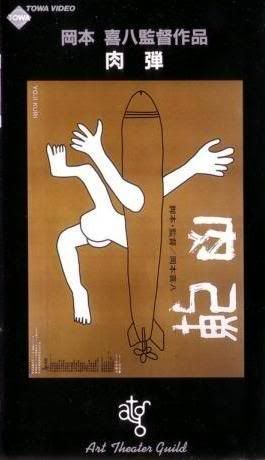
I'm having issues not putting almost every 60s film I've seen of his on this list (almost because Red Lion and the Zatoichi flick didn't do much for me, especially after something like Age of Assassins.) Even (maybe especially) his truly bizarre Noh musical war satire (seriously) which made almost no money on release (never an indicator of quality, to be sure) is poised to dip its feet in the top 50 pond. Speaking of Age of Assassins, as of now, Oct. whatever 2007, my avatar is Reiko Dan from Age of Assassins, looking mighty sultry, in what might be one of the best entrances in spy film history (even if it's a *mock* spy film.) Needless to say, Nakadai falls for her, or fumbles at least (he's a goof in that flick.)
What *really* takes the cake, however, is his ATG films, Human Bullet (i.e. Suicide Phallus, I'm kidding, but Nikudan is also a play on words like "cock" in english) being the film he tried desperately to get made at Toho but had to go elsewhere (his other ATG stuff in the 70s is also more than worthwhile). As of now this is MIA in english subtitled land (even the underground folks), but lo and behold it seems somebody is working on this because the first six minutes are up at a friend's french film blog wildgrounds.com, and I want everyone to check it out (its like reading the first few pages of a book that you KNOW is going to be good.) I think Geneon would be the go to people since they seem to have control of the ATG catalog, but who knows since all the films had multiple productions co.s investing, video rights are surely a swampy arena (but who cares, somebody just put it out already Criterion? MoC? Yume? Geneon? SecondRun? Kino? Wild Side? Bfi? I don't care). How can a film be even remotely mediocre with an original poster (well, VHS cover art, but its the original poster I swear) like this:
-
zedz
- Joined: Sun Nov 07, 2004 11:24 pm
The Testament of Orpheus
How could you not love this film? One of the most enchanting pieces of pure solipsism ever materialised on a cinema screen (it's hard to believe that this was conventionally filmed with a big old clunky movie camera). Cocteau's visual effects are spectacularly conceived and elegantly executed, yet brilliantly simple (mostly variations on reverse motion, dissolves and overcranking), his eye for startling settings acute, and his content more esoteric and personal than ever. It's utterly beguiling and, once you cotton on to the conceit (Cocteau, at the end of his life, bids farewell to the ideas, characters, places and people that were most important to him), very moving.
The Profound Desire of the Gods
It looks like I forgot to comment on this when I watched it a short time back. The first time I saw this was in an anamorphic 16mm print, projected without an anamorphic lens (i.e. with added Sokhurov scrunching). Needless to say, the JNWC disc offered a better viewing experience, but even in compromised form the film completely sucked me in.
Imamura's 60s body of work is much more stylistically and thematically consistent than Oshima's, with each feature from The Insect Woman (allowing for the brilliant sidestep of A Man Vanishes) methodically exploring further possibilities of widescreen composition (in a rather more classical mode than such fellow travellers as Yoshida) and building on a well-defined set of concerns, e.g. women in society, class divisions, sex and incest (an Imamura film without incest would be like a Kubrick film without gurning) - exploitation is the unifying idea.
The Profound Desire of the Gods, in glorious colour, is the last in the series (to be rudely interrupted by the commercial failure of the film), and wraps everything up in a spectacular three-hour bundle. It's an ethnographic, absurdist epic full of dark corners that push you away while luring you forward. The character relations take a while to fathom (and are often off-putting once you do), but the verve of the storytelling relentlessly draws the viewer into the community's web of self-interest and resentment.
If there's such a thing as a genre of Asian "island" films, this film surely occupies a central position in that genre. Before it, we had the melancholy Twenty-four Eyes and The Naked Island; films that followed its example, like Yanagimachi's Fire Festival, Park's To the Starry Island, and even Kim's The Isle, would be much harder-edged and more critically engaged.
The prospect of seeing this film in a forthcoming Eclipse set is heartening, though it more than warrants the serious contextualisation a 'proper' Criterion release could afford.
How could you not love this film? One of the most enchanting pieces of pure solipsism ever materialised on a cinema screen (it's hard to believe that this was conventionally filmed with a big old clunky movie camera). Cocteau's visual effects are spectacularly conceived and elegantly executed, yet brilliantly simple (mostly variations on reverse motion, dissolves and overcranking), his eye for startling settings acute, and his content more esoteric and personal than ever. It's utterly beguiling and, once you cotton on to the conceit (Cocteau, at the end of his life, bids farewell to the ideas, characters, places and people that were most important to him), very moving.
The Profound Desire of the Gods
It looks like I forgot to comment on this when I watched it a short time back. The first time I saw this was in an anamorphic 16mm print, projected without an anamorphic lens (i.e. with added Sokhurov scrunching). Needless to say, the JNWC disc offered a better viewing experience, but even in compromised form the film completely sucked me in.
Imamura's 60s body of work is much more stylistically and thematically consistent than Oshima's, with each feature from The Insect Woman (allowing for the brilliant sidestep of A Man Vanishes) methodically exploring further possibilities of widescreen composition (in a rather more classical mode than such fellow travellers as Yoshida) and building on a well-defined set of concerns, e.g. women in society, class divisions, sex and incest (an Imamura film without incest would be like a Kubrick film without gurning) - exploitation is the unifying idea.
The Profound Desire of the Gods, in glorious colour, is the last in the series (to be rudely interrupted by the commercial failure of the film), and wraps everything up in a spectacular three-hour bundle. It's an ethnographic, absurdist epic full of dark corners that push you away while luring you forward. The character relations take a while to fathom (and are often off-putting once you do), but the verve of the storytelling relentlessly draws the viewer into the community's web of self-interest and resentment.
If there's such a thing as a genre of Asian "island" films, this film surely occupies a central position in that genre. Before it, we had the melancholy Twenty-four Eyes and The Naked Island; films that followed its example, like Yanagimachi's Fire Festival, Park's To the Starry Island, and even Kim's The Isle, would be much harder-edged and more critically engaged.
The prospect of seeing this film in a forthcoming Eclipse set is heartening, though it more than warrants the serious contextualisation a 'proper' Criterion release could afford.
-
zedz
- Joined: Sun Nov 07, 2004 11:24 pm
The Vanishing Corporal
Hardly great Renoir, but a very good film nevertheless. Comparatively straight in its style (at least, compared with The Testament of Dr. Cordelier and Le Petit Theatre de Jean Renoir), but characteristically Renoiresque in its themes and generosity of characterisation.
A Man Vanishes
An extremely impressive film. The second viewing was necessarily lacking the brutal trapdoor shock of the first, but on the other hand it gained in fascination knowing what was coming. The film starts out in impeccable documentary mode as the exploration of the life and circumstances of one of the many ‘missing men' prevalent in Japan at the time (see also Woman of the Dunes). For the first hour, it's an involving enough tour of friends and family, with some mild speculation as to why Mr Oshima disappeared. In the second hour, the film comes to much more closely resemble a serious investigation, as secrets are uncovered, speculations about foul play are aired (as in a particularly intense session with a psychic) and contradictory witnesses come head to head.
The form of the documentary (which has been somewhat peculiar all along, with sound and image running parallel rather than completely in sync) also starts to buckle and bend, as the filmmakers themselves become inveigled in the story (Oshima's fiancee starts to transfer her affections to the interviewer) and odd stylistic incursions seem to bubble up from the film's subconscious (flash-frame flash-forward glimpses of an ominous ritual, for example). This section ends up in a highly charged confrontation between a fishmonger and the fiancee's sister, whom the former claims to have seen with the missing man on several occasions for which she cannot account. The scene grinds on into a fraught stalemate until Imamura breaks the spell with his coup de grace. The remaining twenty minutes of the film pick up the pieces.
I can't say too much more, but this is a one-of-a-kind film I highly recommend.
The Hustler
Another fine, mature early 60s Hollywood film. I wonder whether, in some parallel universe in which ‘New Hollywood' never happened at the end of the sixties, old Hollywood might have grown up all on its own. Amongst the mediocre, bloated musicals, failing epics and lame comedies, there were distinct signs of increasing maturity of subject matter, complexity of tone and technical experimentation in such early 60s films as this one, Psycho, The Apartment and The Manchurian Candidate, even though the architects were such venerable old hands as Hitchcock, Wilder, and Alexander Trauner. Nearly 50 years after he entered the industry, James Wong Howe was creating some of the most radical cinematography of 1966 (hardly a staid years for cinema) in Seconds. Peel away the awful dross of Hollywood in those years, and there's a vital forward-looking cinema buried beneath (and, hey, it's not as if the dross ended in 1970).
Robert Rossen is no slouch, but it's Eugene Schufftan who's the hero of The Hustler for me, bringing the incredible weight of his experience to bear on fresh subject matter. The ‘maturity' of the material is somewhat stage-soiled (but no less valid for that) and there are still the awkward compromises demanded by censorship, but Schufftan turns it into compelling cinema.
Signs of Life
Always an invigorating watch, and maybe it's Herzog's best feature. It's just visually gorgeous, with superb capturing of textures and space (as is often the case, he's got an amazing location to work with), and it's emotionally moving without being dramatically overloaded – the emotion is often subsumed within the visuals, as with the sad and beautiful daytime fireworks display, or the extreme, extreme longshots of an ant-like Stroszek scurrying around the fortifications. Plus, it's got an exquisite score. Even before Popol Vuh (but not, strictly speaking, before Florian Fricke), Herzog had a fantastic instinct for the right music, and he can create startlingly right audio-visual blends out of rather unlikely matches (e.g. Leonard Cohen in Fata Morgana).
Hardly great Renoir, but a very good film nevertheless. Comparatively straight in its style (at least, compared with The Testament of Dr. Cordelier and Le Petit Theatre de Jean Renoir), but characteristically Renoiresque in its themes and generosity of characterisation.
A Man Vanishes
An extremely impressive film. The second viewing was necessarily lacking the brutal trapdoor shock of the first, but on the other hand it gained in fascination knowing what was coming. The film starts out in impeccable documentary mode as the exploration of the life and circumstances of one of the many ‘missing men' prevalent in Japan at the time (see also Woman of the Dunes). For the first hour, it's an involving enough tour of friends and family, with some mild speculation as to why Mr Oshima disappeared. In the second hour, the film comes to much more closely resemble a serious investigation, as secrets are uncovered, speculations about foul play are aired (as in a particularly intense session with a psychic) and contradictory witnesses come head to head.
The form of the documentary (which has been somewhat peculiar all along, with sound and image running parallel rather than completely in sync) also starts to buckle and bend, as the filmmakers themselves become inveigled in the story (Oshima's fiancee starts to transfer her affections to the interviewer) and odd stylistic incursions seem to bubble up from the film's subconscious (flash-frame flash-forward glimpses of an ominous ritual, for example). This section ends up in a highly charged confrontation between a fishmonger and the fiancee's sister, whom the former claims to have seen with the missing man on several occasions for which she cannot account. The scene grinds on into a fraught stalemate until Imamura breaks the spell with his coup de grace. The remaining twenty minutes of the film pick up the pieces.
I can't say too much more, but this is a one-of-a-kind film I highly recommend.
The Hustler
Another fine, mature early 60s Hollywood film. I wonder whether, in some parallel universe in which ‘New Hollywood' never happened at the end of the sixties, old Hollywood might have grown up all on its own. Amongst the mediocre, bloated musicals, failing epics and lame comedies, there were distinct signs of increasing maturity of subject matter, complexity of tone and technical experimentation in such early 60s films as this one, Psycho, The Apartment and The Manchurian Candidate, even though the architects were such venerable old hands as Hitchcock, Wilder, and Alexander Trauner. Nearly 50 years after he entered the industry, James Wong Howe was creating some of the most radical cinematography of 1966 (hardly a staid years for cinema) in Seconds. Peel away the awful dross of Hollywood in those years, and there's a vital forward-looking cinema buried beneath (and, hey, it's not as if the dross ended in 1970).
Robert Rossen is no slouch, but it's Eugene Schufftan who's the hero of The Hustler for me, bringing the incredible weight of his experience to bear on fresh subject matter. The ‘maturity' of the material is somewhat stage-soiled (but no less valid for that) and there are still the awkward compromises demanded by censorship, but Schufftan turns it into compelling cinema.
Signs of Life
Always an invigorating watch, and maybe it's Herzog's best feature. It's just visually gorgeous, with superb capturing of textures and space (as is often the case, he's got an amazing location to work with), and it's emotionally moving without being dramatically overloaded – the emotion is often subsumed within the visuals, as with the sad and beautiful daytime fireworks display, or the extreme, extreme longshots of an ant-like Stroszek scurrying around the fortifications. Plus, it's got an exquisite score. Even before Popol Vuh (but not, strictly speaking, before Florian Fricke), Herzog had a fantastic instinct for the right music, and he can create startlingly right audio-visual blends out of rather unlikely matches (e.g. Leonard Cohen in Fata Morgana).
-
zedz
- Joined: Sun Nov 07, 2004 11:24 pm
Two weeks to go, and I've finally got through the Oshimas:
Boy
The last Oshima of the sixties had previously been nudged out of my list, but seeing it again has probably nudged it back in. Stylistically, it's a much more ‘classical' (or at least moderated) film than many of the ones that preceded it: it's basically linear and all pretty much takes place within a single level of fictional reality, for instance. Nevertheless, it serves as yet another example of Oshima's formal range, with the dominant filmic unit this time being single-shot, fixed-position phrases, with extremely enthusiastic, though sub-Yoshida, placement of action on the frame edges.
In terms of subject matter, the film is as tough as anything else he did at the time. The ‘Boy' of the title is a child exploited in the most ghastly way by his parents, having to hurl himself in front of passing cars so they can extort money from the drivers. It actually harks back to The Sun's Burial in its pointed sordidness and the implication of all of Japanese society in the critique. Not only do the titles run over converted / subverted Japanese flags, the rising sun become a black hole, but Oshima smuggles the flag into the background of scene after scene. Just look at how a Japanese flag appears somewhere in practically every shot that comprises the first motoring-accident sequence, or how that ominous red circle can be faintly made out behind textured glass in the family's apartment about halfway through.
The film explores several modes, from family drama to first-person reverie (in many cases we share the boy's limited or distorted perception of what's going on, and his passive equanimity is what gives the film its huge emotional punch) to semi-documentary. Like many of Oshima's films, it seems to be riffing on actual events, but in an imaginatively radicalised way that goes way beyond neo-realism. Fantastic modernist score as well.
This was the film that first got Oshima serious recognition in the west, and it remains a superb entry point to his challenging, exhilarating body of work. It should also caution us about assuming we know what's going on with film: even at a time in which western eyes were arguably most attentive to world cinema, those amazing preceding works were overlooked.
Boy
The last Oshima of the sixties had previously been nudged out of my list, but seeing it again has probably nudged it back in. Stylistically, it's a much more ‘classical' (or at least moderated) film than many of the ones that preceded it: it's basically linear and all pretty much takes place within a single level of fictional reality, for instance. Nevertheless, it serves as yet another example of Oshima's formal range, with the dominant filmic unit this time being single-shot, fixed-position phrases, with extremely enthusiastic, though sub-Yoshida, placement of action on the frame edges.
In terms of subject matter, the film is as tough as anything else he did at the time. The ‘Boy' of the title is a child exploited in the most ghastly way by his parents, having to hurl himself in front of passing cars so they can extort money from the drivers. It actually harks back to The Sun's Burial in its pointed sordidness and the implication of all of Japanese society in the critique. Not only do the titles run over converted / subverted Japanese flags, the rising sun become a black hole, but Oshima smuggles the flag into the background of scene after scene. Just look at how a Japanese flag appears somewhere in practically every shot that comprises the first motoring-accident sequence, or how that ominous red circle can be faintly made out behind textured glass in the family's apartment about halfway through.
The film explores several modes, from family drama to first-person reverie (in many cases we share the boy's limited or distorted perception of what's going on, and his passive equanimity is what gives the film its huge emotional punch) to semi-documentary. Like many of Oshima's films, it seems to be riffing on actual events, but in an imaginatively radicalised way that goes way beyond neo-realism. Fantastic modernist score as well.
This was the film that first got Oshima serious recognition in the west, and it remains a superb entry point to his challenging, exhilarating body of work. It should also caution us about assuming we know what's going on with film: even at a time in which western eyes were arguably most attentive to world cinema, those amazing preceding works were overlooked.
-
Awesome Welles

- Joined: Fri Apr 27, 2007 10:02 am
- Location: London
Not a recent viewing but I'd like to write a little something about Memories of Underdevelopment (Alea, 1968). I saw the film a year or so ago on a ropey old VHS copy, it has been released in Brazil, I've not taken the plunge due to pricey postage costs. However I have just found an ebay seller who sells the disc for very cheap (which prompts me to mention the film). For those who are wanting to see this film it can be found here.
Sergio, the protagonist of the film, decides to stay in Cuba after his family and wife move to the US after the Bay of Pigs invasion. He is the symbol of decadence, much like a dead bird which he finds in his cage, he drops this bird off the balcony symbolising his separation from his wife (the free, remaining bird). He thinks of himself as European and that Cuba is an underdeveloped nation. The film follows his musings on politics and culture as he womanises.
Played out in a nonlinear narrative we see, with documentary footage, the events of Revolutionary Cuba, the film succeeds in not being propagandistic. Very much influenced by Italian Neo-Realism and the French New Wave, Alea's film has all the spirit and poingnency of those periods of cinema. The film was also influenced by Revolutionary Soviet Montage, the film makes use of accelerated montage in the periods of documentary reflection, one could perhaps interpret this as a comment on those old times using a dated cinematic device as Alea savours the future with long takes and hand held camera of the forward thinking French New Wave.
Reviews; Guardian, NYTimes, Senses of Cinema.
Sergio, the protagonist of the film, decides to stay in Cuba after his family and wife move to the US after the Bay of Pigs invasion. He is the symbol of decadence, much like a dead bird which he finds in his cage, he drops this bird off the balcony symbolising his separation from his wife (the free, remaining bird). He thinks of himself as European and that Cuba is an underdeveloped nation. The film follows his musings on politics and culture as he womanises.
Played out in a nonlinear narrative we see, with documentary footage, the events of Revolutionary Cuba, the film succeeds in not being propagandistic. Very much influenced by Italian Neo-Realism and the French New Wave, Alea's film has all the spirit and poingnency of those periods of cinema. The film was also influenced by Revolutionary Soviet Montage, the film makes use of accelerated montage in the periods of documentary reflection, one could perhaps interpret this as a comment on those old times using a dated cinematic device as Alea savours the future with long takes and hand held camera of the forward thinking French New Wave.
Reviews; Guardian, NYTimes, Senses of Cinema.
-
Dylan

- Joined: Wed Nov 03, 2004 1:28 am
Here's what I've seen so far for the list's project (from what I can recall):
Last Summer- I wrote about this at length in its own thread. It's a great Evan Hunter novel that Frank Perry did a fine job translating into film. Barbara Hershey's character fascinates me, and the central metaphor is terrific in that clear Of Mice and Men fashion. Should definitely be lifted out of obscurity.
The Collector- An interesting, efficiently executed and often surprising thriller with terrific performances from Terence Stamp and Samantha Eggar.
Three- It's nice to watch Sam Waterston and Charlotte Rampling so young, and so good, but this American attempt at expressing loneliness by the means of, primarily, atmosphere and location is ultimately not very memorable. I'm apparently one of a very small number of people who has actually seen it, though.
The Swimmer- As a short story, it's an amazing piece of work...as a film, we have perfect casting, nice photography and a semi-nostalgic Mantovani-esque Marvin Hamlisch score. But damn, that slow-motion montage is one of the cheesiest things I've ever seen - it took me right out of the film. But everything else is well done. I'd recommend reading the John Cheever story over the feature, but the feature does get almost everything right in its translation. I was surprised to read that my favorite scene in the film wasn't directed by Frank Perry, but Sidney Pollack.
Les Biches- I loved and was completely enamored by the two female leads (particularly their bonding in the opening half hour), and the final scene was incredibly suspenseful. I really enjoy Chabrol's unique brand of thriller.
La Collectionuse- Rohmer is rarely noted for making films with beautiful cinematography (particularly from the eighties onward), but this film, shot by Nestor Almendros, is one of the greatest examples of 1.33:1 color photography I'm aware of. Every shot is beautiful, and to me it looks every bit as great as Days of Heaven, if not better. As for most of Rohmer, the characters are intelligent and engaging, the writing consistently and brilliantly perceptive, and the atmosphere very calm and almost chilling. I really liked the ending.
Suzanne's Career- A terrific and very well-written and acted short subject. Better than the other early New Wave shorts I've seen by Rohmer's peers.
The Sandpiper- Beautifully-written love story with Liz Taylor and Richard Burton at the very height of their powers. The beach atmosphere is hypnotic and lovely, the 2.35:1 color photography perfect and Johnny Mandel's classic melody-driven score tops it off. I wish more Hollywood films these days were even close to this in terms of sophistication and writing.
Never on Sunday- It's enjoyably fluffy for the first hour, then it takes a nose dive in the last few minutes, dropping every potentially dramatic plot point in mid air, ending the story as quickly and as unchallenging and 'nice' as possible. Given the plot and the talent involved, it should've been much better, even as fluff. I do love the title song, though (as an aside: the best recording is by Connie Francis, who also sang it at the 1961 Oscar ceremony), and there are some good lines here and there.
The Umbrellas of Cherbourg- Nothing short of a cinematic dream. I just love it everytime I discover a "new" (that is, previously unseen by me) old European masterpiece. The way the music was affecting me all throughout the piece was unbelievable - I was consistently astonished and artistically inspired by the atmosphere, the colors, the characters, the tempo and energy...and I wasn't expecting the story to be so heartbreaking. I'm happy that after years of being a devotee of art house cinema I've finally caught up with this. Hands down one of the truly greatest films of the '60s.
Last Summer- I wrote about this at length in its own thread. It's a great Evan Hunter novel that Frank Perry did a fine job translating into film. Barbara Hershey's character fascinates me, and the central metaphor is terrific in that clear Of Mice and Men fashion. Should definitely be lifted out of obscurity.
The Collector- An interesting, efficiently executed and often surprising thriller with terrific performances from Terence Stamp and Samantha Eggar.
Three- It's nice to watch Sam Waterston and Charlotte Rampling so young, and so good, but this American attempt at expressing loneliness by the means of, primarily, atmosphere and location is ultimately not very memorable. I'm apparently one of a very small number of people who has actually seen it, though.
The Swimmer- As a short story, it's an amazing piece of work...as a film, we have perfect casting, nice photography and a semi-nostalgic Mantovani-esque Marvin Hamlisch score. But damn, that slow-motion montage is one of the cheesiest things I've ever seen - it took me right out of the film. But everything else is well done. I'd recommend reading the John Cheever story over the feature, but the feature does get almost everything right in its translation. I was surprised to read that my favorite scene in the film wasn't directed by Frank Perry, but Sidney Pollack.
Les Biches- I loved and was completely enamored by the two female leads (particularly their bonding in the opening half hour), and the final scene was incredibly suspenseful. I really enjoy Chabrol's unique brand of thriller.
La Collectionuse- Rohmer is rarely noted for making films with beautiful cinematography (particularly from the eighties onward), but this film, shot by Nestor Almendros, is one of the greatest examples of 1.33:1 color photography I'm aware of. Every shot is beautiful, and to me it looks every bit as great as Days of Heaven, if not better. As for most of Rohmer, the characters are intelligent and engaging, the writing consistently and brilliantly perceptive, and the atmosphere very calm and almost chilling. I really liked the ending.
Suzanne's Career- A terrific and very well-written and acted short subject. Better than the other early New Wave shorts I've seen by Rohmer's peers.
The Sandpiper- Beautifully-written love story with Liz Taylor and Richard Burton at the very height of their powers. The beach atmosphere is hypnotic and lovely, the 2.35:1 color photography perfect and Johnny Mandel's classic melody-driven score tops it off. I wish more Hollywood films these days were even close to this in terms of sophistication and writing.
Never on Sunday- It's enjoyably fluffy for the first hour, then it takes a nose dive in the last few minutes, dropping every potentially dramatic plot point in mid air, ending the story as quickly and as unchallenging and 'nice' as possible. Given the plot and the talent involved, it should've been much better, even as fluff. I do love the title song, though (as an aside: the best recording is by Connie Francis, who also sang it at the 1961 Oscar ceremony), and there are some good lines here and there.
The Umbrellas of Cherbourg- Nothing short of a cinematic dream. I just love it everytime I discover a "new" (that is, previously unseen by me) old European masterpiece. The way the music was affecting me all throughout the piece was unbelievable - I was consistently astonished and artistically inspired by the atmosphere, the colors, the characters, the tempo and energy...and I wasn't expecting the story to be so heartbreaking. I'm happy that after years of being a devotee of art house cinema I've finally caught up with this. Hands down one of the truly greatest films of the '60s.
Last edited by Dylan on Thu Nov 01, 2007 10:32 pm, edited 2 times in total.
-
Dylan
- Joined: Wed Nov 03, 2004 1:28 am
One more tonight...
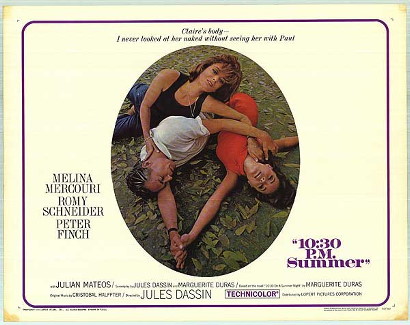
10:30 P.M. Summer (1966) by Jules Dassin.
If you take notice of my selection of films I've chosen this time around to explore from the '60s, you'll see that several I've taken a chance on were, from descriptions one would read before seeing, potentially soothing and atmospheric stories involving a few characters coming together in strange ways in an often sensual or surreal atmosphere (perhaps a kind of thing that's more consistently better pulled off by novelists for literature/short stories than in cinema). Sometimes I'm disappointed, but I never stop searching for the obscure film to find a new expression of this kind of set-up, and 10:30 P.M. Summer is the greatest example of this sort of thing that I've come across in a while. Perhaps this is because it not only comes from a novel, by Marguerite Duras, but the novelist also co-wrote the screenplay.
Now, Jules Dassin. I had only seen The Law and the aforementioned Never on Sunday before this, and was exceedingly unimpressed with both, which to me seemed to try to duplicate the atmosphere/gags/sexiness of an Italian comedy, and not only failing but simply copping out. I haven't seen anything else he's done, but I was a tad wary going into this from seeng those, but from the interesting main title sequence of expressionistically lit hands clapping in the dark, I was hooked and knew this would be something entirely different. Well, it's about as far and away from other Dassin films I've seen as I could've imagined.
The plot begins with three people taking refuge in an overcrowded Spanish hotel the night a murderer is on the loose from killing the woman he loved and her lover. The three are Peter Finch, Romy Schneider and Melina Mercouri. Finch has a close resemblance to Jules Dassin, who in turn looks an awful lot like the novelist Paul Auster. I thought her performance in Never on Sunday, despite the praise it received at the time, was just okay, but Mercouri is wonderful here. Romy Schneider (I needed to see at least one film with her for this list! She's gorgeous!) is seemingly here more for ambiguous sexual display until the importance of her role with the three is revealed in the final act.
The atmosphere of the beginning is like the English-language Antonioni (“Passenger,â€
10:30 P.M. Summer (1966) by Jules Dassin.
If you take notice of my selection of films I've chosen this time around to explore from the '60s, you'll see that several I've taken a chance on were, from descriptions one would read before seeing, potentially soothing and atmospheric stories involving a few characters coming together in strange ways in an often sensual or surreal atmosphere (perhaps a kind of thing that's more consistently better pulled off by novelists for literature/short stories than in cinema). Sometimes I'm disappointed, but I never stop searching for the obscure film to find a new expression of this kind of set-up, and 10:30 P.M. Summer is the greatest example of this sort of thing that I've come across in a while. Perhaps this is because it not only comes from a novel, by Marguerite Duras, but the novelist also co-wrote the screenplay.
Now, Jules Dassin. I had only seen The Law and the aforementioned Never on Sunday before this, and was exceedingly unimpressed with both, which to me seemed to try to duplicate the atmosphere/gags/sexiness of an Italian comedy, and not only failing but simply copping out. I haven't seen anything else he's done, but I was a tad wary going into this from seeng those, but from the interesting main title sequence of expressionistically lit hands clapping in the dark, I was hooked and knew this would be something entirely different. Well, it's about as far and away from other Dassin films I've seen as I could've imagined.
The plot begins with three people taking refuge in an overcrowded Spanish hotel the night a murderer is on the loose from killing the woman he loved and her lover. The three are Peter Finch, Romy Schneider and Melina Mercouri. Finch has a close resemblance to Jules Dassin, who in turn looks an awful lot like the novelist Paul Auster. I thought her performance in Never on Sunday, despite the praise it received at the time, was just okay, but Mercouri is wonderful here. Romy Schneider (I needed to see at least one film with her for this list! She's gorgeous!) is seemingly here more for ambiguous sexual display until the importance of her role with the three is revealed in the final act.
The atmosphere of the beginning is like the English-language Antonioni (“Passenger,â€
-
Dylan
- Joined: Wed Nov 03, 2004 1:28 am
Two more...
In a quick 80 minutes, Demy's Bay of Angels presents a dramatically compelling and fairly realistic examination of gambling addiction, from curiosity to sickness. Although Michel Legrand's score is as wonderful as his music gets, this is the first film by Demy that I've seen that doesn't necessarily float and move like a musical. The characters are well-performed and the overall treatment of the central dramatic situation insightful. While there may some vague feeling that the film doesn't quite go far enough at the end, or is just a little too "climactic" for its own good, one gets the sense that (despite Legrand's lovely musical crescendo) there isn't really any kind of resolution as we fade out, aside from the suspicious emotional spontanaety of the characters.
There's an infectious rhythm and tempo to The Young Girls of Rochefort that's very unique - it feels completely different than anything I've ever seen from Hollywood's diverse musical offerings. And though it showcases Demy's formal mastery and astounding eye for art direction and costume design, it's nothing like Cherbourg either. It felt 30 minutes too long (Demy's preceding films weren't longer than 90 minutes, which this also should've been), but hell, Demy fans can't miss it - it's the director at his most indulgent and delightful.
I really want to see Model Shop next, but I guess every Demy fan is forced to wait for that one.
In a quick 80 minutes, Demy's Bay of Angels presents a dramatically compelling and fairly realistic examination of gambling addiction, from curiosity to sickness. Although Michel Legrand's score is as wonderful as his music gets, this is the first film by Demy that I've seen that doesn't necessarily float and move like a musical. The characters are well-performed and the overall treatment of the central dramatic situation insightful. While there may some vague feeling that the film doesn't quite go far enough at the end, or is just a little too "climactic" for its own good, one gets the sense that (despite Legrand's lovely musical crescendo) there isn't really any kind of resolution as we fade out, aside from the suspicious emotional spontanaety of the characters.
There's an infectious rhythm and tempo to The Young Girls of Rochefort that's very unique - it feels completely different than anything I've ever seen from Hollywood's diverse musical offerings. And though it showcases Demy's formal mastery and astounding eye for art direction and costume design, it's nothing like Cherbourg either. It felt 30 minutes too long (Demy's preceding films weren't longer than 90 minutes, which this also should've been), but hell, Demy fans can't miss it - it's the director at his most indulgent and delightful.
I really want to see Model Shop next, but I guess every Demy fan is forced to wait for that one.
-
Scharphedin2
- Joined: Fri May 19, 2006 11:37 am
- Location: Denmark/Sweden
First of all, thank you zedz for your wonderful running commentary of the Japanese films that you have been viewing. Indeed, as I duplicated your Oshima venture this past week, I frequently went back and read your notes and thoughts, and at times it almost felt like viewing the films with a good friend, and finishing with a discussion over coffee. I more or less wrapped up Oshima with a double header of his Diary of a Shinjuku Thief (and, for the record, I do not think your specific love of this film is acreditable to being your virgin voyage on the straits of the Japanese New Wave) with Yoshida Yoshishige's Eros Plus Massacre, and it was one of those film experiences we all love, of a new door being opened, and our minds blown once more by the possibilities of the film medium. Both of these films, and Eros particularly, would qualify as some of the visually most beautifully and challengingly composed films that I have seen. The playfulness of the storytelling, the boldness of the themes, and the juggling of many layers of concern and meaning, contemporary and historical, was fantastic.
I did not have access to Night and Fog in Japan, and I did not yet get to Boy, but in addition to the films discussed by zedz above, I did have the opportunity to see a serviceable copy of Sing a Song of Sex. Like zedz, I experienced Oshima going through several cycles throughout the '60s. Cruel Story of Youth and Burial of the Sun are very much of a piece, and I image the latter film completes a cycle that probably began with his first films A Street of Love and Hope and Tomorrow's Sun (both 1959). As zedz wrote, the anthill of characters in Burial of the Sun, and the way that Oshima works his narrative on several levels, make this film the more impressive of the two, although the unforgetable scene for me would have to be the scene early on in Cruel Story of Youth, when the two young protagonists are alone on a world of floating timber logs, very much on dangerous ground as they circle each other bizzarely (and in gorgeous color scope) in this prologue to their cruel story.
Four years, half a dozen feature films, and about twice as many television projects separate Sun's Burial and Violence at Noon, so nothing prepared me for the look and maturity of the latter film. Without having seen any of the material that precedes Violence, it is a difficult assumption to make, but the film again feels like the end of a cycle - the perfection of a certain kind of narrative and way of using the medium. The cinematic language is extremely accomplished, but never flashy, and the way that Oshima structures his story is looking forward to the later films, although here the fragmentation of the storyline still in the end leads the film forward to a definite conclusion.
Sing a Song of Sex, Three Resurrected Drunkards, Death By Hanging and Diary of a Shinjuku Thief were all apparently made within just over a year of each other, although I am not sure of the actual sequence. These films are all much more eliptical in their storytelling than the former films. Sing a Song and Death by Hanging (and actually also Diary) evolve into theater at different points in the narrative. These are much more difficult films to enter into, and I think the technique works best in the latter two, where these elements become integrated into the films as part of the narrative. In Sing a Song, Oshima begins the film with portraying a group of students, whose minds are very much on sex. Halfway through the film, their fantasies begin to become acted out on the screen, and the film more or less grinds to a halt as the students alternately become involved in performing in a folk music festival, and in a final enactment of sexual politics. Three Resurrected Drunkards has already been described by zedz, and it was easily the most eccentric of this later batch of films (which is saying a lot), and the most difficult for me to truly embrace (in part due to the extremely degraded condition of the film that I had available to me). It seemed to me that by the end of the '60s, Oshima was extremely preoccupied with the social and political themes of his day to an extent, where he was struggling to find a way to express his thoughts on film. The strange essay-style film that he arrives at in Diary, which still retains a narrative core, would again appear to be the culmination of a cycle for him.
I was trying to catch up with too many Japanese films, and in the end I hardly made a dent... I saw two Nakagawa films, which, although decent films, seem thrifling in this context -- Death Row Woman and Jigoku. The former played like a Japanese pastiche of an American poverty row noir thriller -- in itself odd enough to make it worthwhile, but the story was quite predictable, and the most curious aspect was the lesbian drama that the film briefly went into, as the heroine ends up in prison for a murder of which she is innocent. Jigoku on the other hand was as strange and visually exciting as I had expected, and from that angle I enjoyed the film. However, Nakagawa appeared to be intent on making a grand statement on the human condition that just did not translate on the screen for me.
Kon Ichikawa's The Key/Odd Obsession was available to me in a pan & scanned VHS rip that I had intended to abstain from, but in the end I gave in and viewed it. The film is based on a short novel by Junichiro Tanizaki about the bizarre sexual infatuation of an elderly man for his much younger and very beautiful wife. In the equation is Tatsuya Nakadai as a young doctor, whom the man has singled out as husband material for his daughter. There are a lot of twists and turns in the story relating to who is fooling who, and to what end. The finale is shocking enough, but also makes the film feel somewhat hollow. Certainly not amongst the director's best films, although the final verdict is out until the film can be enjoyed in its proper format. Much more impressive was Masaki Kobayashi's Harakiri, which I finally caught up with. In its themes of hypocrisy and the erosion of traditional ethics and values -- even in its narrative execution -- this almost could have been a new wave film(?!) In any event, it is another cinematically beautiful film, and the way Kobayashi tells the story is exemplary, constantly manipulating not only the listeners in the film itself (much of the story is told in flashback by a ronin), but also the audience.
I also viewed the final three Ozu films Late Autumn, End of Summer and An Autumn Afternoon. They have been much discussed already, and I suppose that in this context the fact that these films came out of Japan at the same time as the films described above, is only proof of the huge richness of the Japanese film world at this particular point in time. For me, these films were perhaps not amongst the most poignant Ozu films that I have seen, but as always they were like meeting dear old friends. Late Autumn was maybe the most fun that I have had with an Ozu film -- this endless scheming of the three middle-aged gentlemen to see the widowed Hara and her daughter married. In End of Summer, there obviously was a lot of fun going on concerning the libidinal unrest of the ageing protagonist, but somehow I did not really connect with it -- possibly in a decade or two.
Coming full circle with another small handful of "new wave" films, I too saw Hani's She & He (in a very worn copy), and was moved by the authenticity of its characters and the emotional sincerity of the film. Imamura's Hogs & Warships came across as an older sibling to Oshima's The Sun's Burial. The central characters are somewhat older than those in Oshima's film, but we are again in the slums, amongst the racketeers -- in this case not peddling blood or identities, but pigs. Finally, Masumura's The False Student was very much in the midst of the student uprisings, lashing out against the hypocrisy of all sides in the conflict, and doing so in a style and manner that somehow had me thinking of some of Samuel Fuller's films from the period.
In between the Japanese films, I saw a few Western films that I should have seen long ago. Some of them will definitely make my list: Vlacil's Valley of the Bees and Antonioni's L'eclisse; others were good films, but the verdict is still out: Iosellani's April, Lumet's The Fugitive Kind, Ford's Sergeant Rutledge and Bava's Black Sunday (seen in a crazy late-late-Friday-night double-bill with the equally atmospherical horror flick City of the Dead).
I did not have access to Night and Fog in Japan, and I did not yet get to Boy, but in addition to the films discussed by zedz above, I did have the opportunity to see a serviceable copy of Sing a Song of Sex. Like zedz, I experienced Oshima going through several cycles throughout the '60s. Cruel Story of Youth and Burial of the Sun are very much of a piece, and I image the latter film completes a cycle that probably began with his first films A Street of Love and Hope and Tomorrow's Sun (both 1959). As zedz wrote, the anthill of characters in Burial of the Sun, and the way that Oshima works his narrative on several levels, make this film the more impressive of the two, although the unforgetable scene for me would have to be the scene early on in Cruel Story of Youth, when the two young protagonists are alone on a world of floating timber logs, very much on dangerous ground as they circle each other bizzarely (and in gorgeous color scope) in this prologue to their cruel story.
Four years, half a dozen feature films, and about twice as many television projects separate Sun's Burial and Violence at Noon, so nothing prepared me for the look and maturity of the latter film. Without having seen any of the material that precedes Violence, it is a difficult assumption to make, but the film again feels like the end of a cycle - the perfection of a certain kind of narrative and way of using the medium. The cinematic language is extremely accomplished, but never flashy, and the way that Oshima structures his story is looking forward to the later films, although here the fragmentation of the storyline still in the end leads the film forward to a definite conclusion.
Sing a Song of Sex, Three Resurrected Drunkards, Death By Hanging and Diary of a Shinjuku Thief were all apparently made within just over a year of each other, although I am not sure of the actual sequence. These films are all much more eliptical in their storytelling than the former films. Sing a Song and Death by Hanging (and actually also Diary) evolve into theater at different points in the narrative. These are much more difficult films to enter into, and I think the technique works best in the latter two, where these elements become integrated into the films as part of the narrative. In Sing a Song, Oshima begins the film with portraying a group of students, whose minds are very much on sex. Halfway through the film, their fantasies begin to become acted out on the screen, and the film more or less grinds to a halt as the students alternately become involved in performing in a folk music festival, and in a final enactment of sexual politics. Three Resurrected Drunkards has already been described by zedz, and it was easily the most eccentric of this later batch of films (which is saying a lot), and the most difficult for me to truly embrace (in part due to the extremely degraded condition of the film that I had available to me). It seemed to me that by the end of the '60s, Oshima was extremely preoccupied with the social and political themes of his day to an extent, where he was struggling to find a way to express his thoughts on film. The strange essay-style film that he arrives at in Diary, which still retains a narrative core, would again appear to be the culmination of a cycle for him.
I was trying to catch up with too many Japanese films, and in the end I hardly made a dent... I saw two Nakagawa films, which, although decent films, seem thrifling in this context -- Death Row Woman and Jigoku. The former played like a Japanese pastiche of an American poverty row noir thriller -- in itself odd enough to make it worthwhile, but the story was quite predictable, and the most curious aspect was the lesbian drama that the film briefly went into, as the heroine ends up in prison for a murder of which she is innocent. Jigoku on the other hand was as strange and visually exciting as I had expected, and from that angle I enjoyed the film. However, Nakagawa appeared to be intent on making a grand statement on the human condition that just did not translate on the screen for me.
Kon Ichikawa's The Key/Odd Obsession was available to me in a pan & scanned VHS rip that I had intended to abstain from, but in the end I gave in and viewed it. The film is based on a short novel by Junichiro Tanizaki about the bizarre sexual infatuation of an elderly man for his much younger and very beautiful wife. In the equation is Tatsuya Nakadai as a young doctor, whom the man has singled out as husband material for his daughter. There are a lot of twists and turns in the story relating to who is fooling who, and to what end. The finale is shocking enough, but also makes the film feel somewhat hollow. Certainly not amongst the director's best films, although the final verdict is out until the film can be enjoyed in its proper format. Much more impressive was Masaki Kobayashi's Harakiri, which I finally caught up with. In its themes of hypocrisy and the erosion of traditional ethics and values -- even in its narrative execution -- this almost could have been a new wave film(?!) In any event, it is another cinematically beautiful film, and the way Kobayashi tells the story is exemplary, constantly manipulating not only the listeners in the film itself (much of the story is told in flashback by a ronin), but also the audience.
I also viewed the final three Ozu films Late Autumn, End of Summer and An Autumn Afternoon. They have been much discussed already, and I suppose that in this context the fact that these films came out of Japan at the same time as the films described above, is only proof of the huge richness of the Japanese film world at this particular point in time. For me, these films were perhaps not amongst the most poignant Ozu films that I have seen, but as always they were like meeting dear old friends. Late Autumn was maybe the most fun that I have had with an Ozu film -- this endless scheming of the three middle-aged gentlemen to see the widowed Hara and her daughter married. In End of Summer, there obviously was a lot of fun going on concerning the libidinal unrest of the ageing protagonist, but somehow I did not really connect with it -- possibly in a decade or two.
Coming full circle with another small handful of "new wave" films, I too saw Hani's She & He (in a very worn copy), and was moved by the authenticity of its characters and the emotional sincerity of the film. Imamura's Hogs & Warships came across as an older sibling to Oshima's The Sun's Burial. The central characters are somewhat older than those in Oshima's film, but we are again in the slums, amongst the racketeers -- in this case not peddling blood or identities, but pigs. Finally, Masumura's The False Student was very much in the midst of the student uprisings, lashing out against the hypocrisy of all sides in the conflict, and doing so in a style and manner that somehow had me thinking of some of Samuel Fuller's films from the period.
In between the Japanese films, I saw a few Western films that I should have seen long ago. Some of them will definitely make my list: Vlacil's Valley of the Bees and Antonioni's L'eclisse; others were good films, but the verdict is still out: Iosellani's April, Lumet's The Fugitive Kind, Ford's Sergeant Rutledge and Bava's Black Sunday (seen in a crazy late-late-Friday-night double-bill with the equally atmospherical horror flick City of the Dead).
-
JakeB
- Joined: Fri Dec 31, 2010 9:46 am
Re: 1960s Discussion and Suggestion (Lists Project)
Were lists ever submitted for this? I've been having so much fun looking through the really informative 20's, 30's, 40's and 70's list discussions (plus the genre discussions and the defence of list orphans). If this was never completed, maybe it's time to resurrect it?
-
domino harvey

- Dot Com Dom
- Joined: Wed Jan 11, 2006 6:42 pm
Re: 1960s Discussion and Suggestion (Lists Project)
Yep, though it'll get a new reiteration in about a year. It used to be that the List Project threads got very little discussion until after the face in the Panda Thread and only recently (really with the 80s List, I'd say) became the hotbeds of discussion they now are
-
swo17

- Bloodthirsty Butcher
- Joined: Tue Apr 15, 2008 2:25 pm
- Location: SLC, UT
Re: 1960s Discussion and Suggestion (Lists Project)
'50s list should probably run from Feb to Aug 2012, at which point the '60s will live again!
-
knives

- Joined: Sat Sep 06, 2008 10:49 pm
Re: 1960s Discussion and Suggestion (Lists Project)
Already prepping for the '50s list. Gonna check out even the most frighteningly awful looking of Wellman (I have an instinctive flight response to John Wayne on the cover of a DVD).
-
zedz
- Joined: Sun Nov 07, 2004 11:24 pm
Re: 1960s Discussion and Suggestion (Lists Project)
I try to keep my old lists updated by adding a supplementary list below them of new 'must-include' films to consider for the next iteration. It's extremely haphazard, since I don't necessarily remember to add a blindingly great new film when I see it, but I've already got 23 such titles in waiting for my 60s list, so this is going to be interesting.swo17 wrote:'50s list should probably run from Feb to Aug 2012, at which point the '60s will live again!
-
swo17
- Bloodthirsty Butcher
- Joined: Tue Apr 15, 2008 2:25 pm
- Location: SLC, UT
Re: 1960s Discussion and Suggestion (Lists Project)
Not to play favorites with decades or anything, but if the world ends before we get through the '60s, I'm going to be extremely disappointed.
-
domino harvey
- Dot Com Dom
- Joined: Wed Jan 11, 2006 6:42 pm
Re: 1960s Discussion and Suggestion (Lists Project)
Also, I am of the opinion that these old threads should be at the very least renamed once the new ones come into play so as to avoid confusion