Kino: Assunta Spina
Posted: Sat May 23, 2009 6:12 pm
Assunta Spina
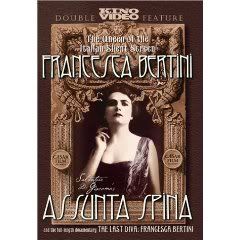
1914 Italy Color Tinted 62 Min.
Directed by Francesca Bertini and Gustavo Serena
From the cover:
Italian silent screen goddess Francesca Bertini appears in her most famous role in ASSUNTA SPINA, an operatic tale of love and sacrifice in turn of the century Naples.
After being assaulted by her jealous lover Michele (Gustavo Serena), Assunta (Bertini) becomes the mistress of a corrupt Don (Carlo Benetti) so she can visit Michele while he is in prison. When Michele is unexpectedly released, he discovers Assunta's "betrayal," setting the stage for the film's exquisitely tragic finale.
Special Features:
-- The Last Diva: Francesca Bertini (dir. Gianfranco Mingozzi, 1982, 85 min). A feature length documentary, in which 94-year-old Bertini recalls her life and career while attending a private screening of ASSUNTA SPINA.
Stills from the DVD in the screen captures thread.
. . . . . . . . . . . . . . .
I searched the forum, but basically came up with a blank on this wonderful Kino release from 2003. This is the kind of effort that Kino should receive more credit for. Not only do they provide a fine presentation of a key Italian film of the silent period, but it is presented with a rich and unique score compiled from a wide variety of contemporary 1910s Italian and Italian-inspired composers by Rodney Sauer and Susan Hall. There is even a feature listing the different musical cues with the ability to jump to the specific moment in the film, where that particular piece is used as accompaniment.
The film runs a good hour, and is accompanied by an eighty minute documentary on Bertini, who was the great diva of the Italian screen in the teens, and who stars in -- and co-directed -- Assunta Spina. After an introductory sequence, Bertini "invites" the documentary filmmaker to a screening of Assunta, and we are invited with them to view the film with the ageing star. In essence, this part of the documentary is a commentary of the film by Bertini with the added attraction of seeing her face at different times during the screening. Bertini's comments are fairly short and few, but they add more to the experience of the film than many a learned film historian's commentary track. She observes that the film was shot with only the available light of the sun in November of 1914 (the rainy period of the year), in the streets of Naples, using local people as actors. "We invented neo-realism" she half-jokes at one point. And, it is true, that a lot of the attraction of this film comes from the authenticity of the people and the clothes they wear, the meals they take together, the way they speak with their eyes and hands and postures, as well as the backdrops of the Neapolitan hills and streets for the heated romantic rivalries of Assunta and her lovers.
As to Bertini's own performance, she comments on how she was difficult to work with, because of her penchant for not rehearsing scenes. She recalls how her jump into a boat in one particular scene inspired headlines in the local Neapolitan newspapers -- "people were easier to please, then..." she notes with a little smile. She further comments that she performed without make-up, and that her screen kisses were all faked, as she couldn't stand the men she starred with. Bertini comments on her younger self in the film as "her," noting the costumes "she" wears, "her" flirtatiousness, "her" profile, "her" beauty, etc. For a former super-star, who is repeatedly likened to Norma Desmond in the course of the documentary, Bertini had a charming sense of humor and self-distance at the age of 94.
After the screening, the documentary wraps up with an overview of Bertini's career after Assunta. She starred in more than 100 films during the teens, working 14 hour days, and eventually damaging her eyes by the exposure to the harsh lights that were used in the later films of the era. After 1920 she would only star in films very occassionally -- the last time being in Bertolucci's 1900, more than fifty years later. There are excerpts from several of these films, none of which are of course available on DVD. Most tantalizing is an extended sequence inter-cutting Bertini's signature performances in two different versions of Odette -- Marcel L'Herbier's film from 1935, and a version from 1916 by Giuseppe de Liguoro. The nuances in Bertini's performance as a sensual younger woman, and her more sophisticated approach in the latter film, are fascinating to behold.
What is left for us to see these days, aside from the fragments in Diva Dolorosa, Bertini has a miniscule part in Pastrone's epic Cabiria. And she stars in several of the films in the Silent Shakespeare set -- King Lear and The Merchant of Venice come to mind, although in my opinion there is little comparison between these very early shakespearean films, and her tour-de-force performance in Assunta Spina. For the more adventurous set, there are copies of at least Ugo Falena's Romeo and Juliet (1912) and Gustavo Serena's La signora delle camelie (1915) floating around on the internet.
1914 Italy Color Tinted 62 Min.
Directed by Francesca Bertini and Gustavo Serena
From the cover:
Italian silent screen goddess Francesca Bertini appears in her most famous role in ASSUNTA SPINA, an operatic tale of love and sacrifice in turn of the century Naples.
After being assaulted by her jealous lover Michele (Gustavo Serena), Assunta (Bertini) becomes the mistress of a corrupt Don (Carlo Benetti) so she can visit Michele while he is in prison. When Michele is unexpectedly released, he discovers Assunta's "betrayal," setting the stage for the film's exquisitely tragic finale.
Special Features:
-- The Last Diva: Francesca Bertini (dir. Gianfranco Mingozzi, 1982, 85 min). A feature length documentary, in which 94-year-old Bertini recalls her life and career while attending a private screening of ASSUNTA SPINA.
Stills from the DVD in the screen captures thread.
. . . . . . . . . . . . . . .
I searched the forum, but basically came up with a blank on this wonderful Kino release from 2003. This is the kind of effort that Kino should receive more credit for. Not only do they provide a fine presentation of a key Italian film of the silent period, but it is presented with a rich and unique score compiled from a wide variety of contemporary 1910s Italian and Italian-inspired composers by Rodney Sauer and Susan Hall. There is even a feature listing the different musical cues with the ability to jump to the specific moment in the film, where that particular piece is used as accompaniment.
The film runs a good hour, and is accompanied by an eighty minute documentary on Bertini, who was the great diva of the Italian screen in the teens, and who stars in -- and co-directed -- Assunta Spina. After an introductory sequence, Bertini "invites" the documentary filmmaker to a screening of Assunta, and we are invited with them to view the film with the ageing star. In essence, this part of the documentary is a commentary of the film by Bertini with the added attraction of seeing her face at different times during the screening. Bertini's comments are fairly short and few, but they add more to the experience of the film than many a learned film historian's commentary track. She observes that the film was shot with only the available light of the sun in November of 1914 (the rainy period of the year), in the streets of Naples, using local people as actors. "We invented neo-realism" she half-jokes at one point. And, it is true, that a lot of the attraction of this film comes from the authenticity of the people and the clothes they wear, the meals they take together, the way they speak with their eyes and hands and postures, as well as the backdrops of the Neapolitan hills and streets for the heated romantic rivalries of Assunta and her lovers.
As to Bertini's own performance, she comments on how she was difficult to work with, because of her penchant for not rehearsing scenes. She recalls how her jump into a boat in one particular scene inspired headlines in the local Neapolitan newspapers -- "people were easier to please, then..." she notes with a little smile. She further comments that she performed without make-up, and that her screen kisses were all faked, as she couldn't stand the men she starred with. Bertini comments on her younger self in the film as "her," noting the costumes "she" wears, "her" flirtatiousness, "her" profile, "her" beauty, etc. For a former super-star, who is repeatedly likened to Norma Desmond in the course of the documentary, Bertini had a charming sense of humor and self-distance at the age of 94.
After the screening, the documentary wraps up with an overview of Bertini's career after Assunta. She starred in more than 100 films during the teens, working 14 hour days, and eventually damaging her eyes by the exposure to the harsh lights that were used in the later films of the era. After 1920 she would only star in films very occassionally -- the last time being in Bertolucci's 1900, more than fifty years later. There are excerpts from several of these films, none of which are of course available on DVD. Most tantalizing is an extended sequence inter-cutting Bertini's signature performances in two different versions of Odette -- Marcel L'Herbier's film from 1935, and a version from 1916 by Giuseppe de Liguoro. The nuances in Bertini's performance as a sensual younger woman, and her more sophisticated approach in the latter film, are fascinating to behold.
What is left for us to see these days, aside from the fragments in Diva Dolorosa, Bertini has a miniscule part in Pastrone's epic Cabiria. And she stars in several of the films in the Silent Shakespeare set -- King Lear and The Merchant of Venice come to mind, although in my opinion there is little comparison between these very early shakespearean films, and her tour-de-force performance in Assunta Spina. For the more adventurous set, there are copies of at least Ugo Falena's Romeo and Juliet (1912) and Gustavo Serena's La signora delle camelie (1915) floating around on the internet.