Page 1 of 1
Flipside 017: Lunch Hour (James Hill, 1961)
Posted: Tue Jan 19, 2010 8:37 pm
by MichaelB
James Hill's stylish film starring Shirley Anne Field, with Hill's award-winning 'Trade Test' films as extras - now confirmed as a 2010 release, courtesy of a brief mention on Kim Newman's Guide to the Flipside of British Cinema.
More details when I get them.
Re: Lunch Hour (James Hill, 1961)
Posted: Tue Jan 19, 2010 8:56 pm
by antnield
Particularly interested in seeing the 'Trade Test' titles. I'm guessing that both
Giuseppina (1959) and
The Home-Made Car (1963) will be putting in an appearance. Screenoline info
here and
here.
Re: Lunch Hour (James Hill, 1961)
Posted: Tue Jan 19, 2010 9:29 pm
by ellipsis7
From Time Out...
LUNCH HOUR
Further evidence that, indeed, sexual intercourse didn't begin until 1963, as Field and Stephens, frustrated office colleagues, vainly seek somewhere to bonk. In fact the whole piece is redolent of the early '60s (post-Austerity, pre-Swinging), from its Theatre of the Absurd affectations to the way it manages to be simultaneously liberating and oppressive. It's also quite amateurish, going unreleased at the time and only latterly, some 40 years on, finding a niche as late night TV fodder for cine-socio-nostalgists.
Author: BBa Time Out Film Guide
Re: Lunch Hour (James Hill, 1961)
Posted: Thu Jan 21, 2010 11:07 am
by colinr0380
Great news! Lunch Hour is a fascinating little film - only a British film could leap straight from the awkwardness of first wooing a girl and remove any idea of sex or fun from the relationship as the 'love hotel' encounter lets the couple jump straight into arguments about the children and the unsatisfying marriage that they have concocted as a cover story for the proprietor of the hotel!
It is a deeply flawed film I hasten to add, but it is a fascinating one and a definite product of conflicting social forces. It is also quite funny at times!
Do not take the films I'm going to compare it to next as any qualitative comparison, more just films that have similar tones to this one that came to mind when I saw it that may help to give some idea about how uniquely bizarre this film feels (at least to me!)
Think of an Il Posto-style drab workplace wooing, with seeming heavy influence from Brief Encounter's illict romance (without the hints of adultery but just as much awkward embarrassment between the couple) and a hint of the rented room for assignations that turns out too good to be true from Orwell's 1984 for the first half of the film. Then fuse that with similar kind of visualisations of flights of fancy of Billy Liar along with total female mental breakdown seemingly caused by fear of sexuality taking place in the sparsely furnished hotel room which brings to mind something like Repulsion for the second half (though not taken to quite as extreme an extent as in those films!), then you might get a good idea of some of the curio factor of this film!
I'll go into some detail about the content of the film below. Spoilers will likely follow:
It begins as sort of realistic portrait of the workplace (a wallpaper factory) where a tentative wooing occurs between a mid-level white collar chap and the new girl taken on to paint pictures (mostly flowers) for use on the wallpaper. She turns out to be an art student, so you know she is going to cause trouble by being too sensitive!
There is a neat portrait of the stratification of the company, as both the more senior people and the chaps manning the printing machines on the factory floor both make (different kinds of) passes at Field but she seems set on Stephens, making this a kind of aspirational lower middle class type of story I guess.
The couple then try and find places to make out but seem uncomfortable with kissing openly in the park, unlike other couples they see, and this leads to the search for the hotel. Their relationship seems to be constantly contrasted with the more broader behaviours of the people around them, unafraid to be unlikeable yet quick to jump on others for perceived breaches of etiquette (which seems to prefigure the way that Field feels intimidated by other people enough to even create hostile imaginary characters to prevent her from having her hotel liaison). Everything is also rather sordid in a way as all of Stephens' plans, or attempts to put on airs and act with class and wit, invariably get scuppered by others in the most mundane manner. I especially liked the tour guide in the museum breaking off from describing the heady eroticism of a particular painting to give the security guard the nod to throw the attempting to canoodle couple in the other room of the gallery out!
Once the seedy hotel has been chosen for the lunch time meeting between the couple (with a quite funny brief shot of the man standing outside the Savoy, before thinking again about the choice of hotel, likely due as much to the cost as to keep things more middle class and low key!), things take a turn into the psychotic as Field becomes incensed by the rather outlandish back story concocted by Stephens (that he is meeting his wife for the day who has travelled from up north just to meet him in this hotel), and we get her imaginings of the arduous hundreds of miles long train trip there and back that she has to undertake to have been able to have this day visit that Stephens has casually told the landlady about. Field gets steadily more upset about the callousness of Stephens towards this fictional wife (especially when she finds out he has told the landlady that they have children as well, which leads to heated, and increasingly disturbing arguments in which she insists to have a plausible explanation about where she has put the kids in order to have this afternoon meet up!) whereas of course Stephens was just saying anything vaguely plausible in order to get the room for the lunch hour! The girl seems to relish getting into the character of this housewife in Scarborough (even if she initially seems insulted at having to be from the north!) who Stephens has abandoned whilst in London - perhaps it lets her 'play housewife' - though she steadily becomes more and more disenchanted with the illusion (delusion?) throughout the course of her flashback to this hypothetical wife's preparations for the trip to London, especially when she gets saddled with the two bratty children and then adds the detail that Stephens' family hates her!
It of course completely destroys the tentative relationship between the couple, but then there is a strangely ambiguous (and chilling!) final shot over the end credits that suggests it was all an elaborate performance by Field to get out of the relationship (or perhaps Stephens was another in a line of men Fields has led on and destroyed for the pleasure of it, if we want to have a misogynist take on the outcome!)
Looked at as the realistic portrait of a relationship the film is a complete failure - too broad in the first half and too completely off the wall in the second. But looked at as a portrait of one woman's self-perpetuated descent into insanity, or as a broad comedy, it actually has much to recommend it! I'll be very interested to see the reviews for this one and what others make of it - I think it may be quite a polarising film.
There are also some nice verite street scenes that occasionally made me think of some of my favourite moments in Godard films like Band of Outsiders or Woman Is A Woman - you have the occasional shots of small, dowdy, elderly (real) women carrying their shopping in the street as if to act in contrast to the elfin Anna Karina skipping through the scene - real life and real people keeping the society ticking along in the background while the heightened filmic reality takes precedence in front of it.
Some choice lines:
Field in mid-rant talking about the perceived snobbery of Stephens' aunt towards her: "My father was an ordinary bus driver for 25 years and there was one person he would not give house room to in any circumstances, and that was a SNOB...he also couldn't stand the Welsh".
A couple of Field's work colleagues who have interrupted a romantic lunch and start talking about their plans for the future leads to this bizarrely whimsical statement: "I'd like to do something perfectly idiotic with goats!"
Re: Flipside: Lunch Hour (James Hill, 1961)
Posted: Wed Sep 01, 2010 5:32 am
by MichaelB
A few more details:
With a screenplay written by John Mortimer, and starring Shirley Anne Field and Robert Stephens as the lovers who conduct their affair during the lunch breaks at the factory where they both work, this early-60s rarity is by turns intense, perceptive and disturbing.
Also included on this Dual Format Edition (DVD + Blu-ray) are three of director James Hill's (Black Beauty, A Study in Terror) award-winning short films, Skyhook (1958), Giuseppina (1959) and The Home-Made Car (1963), all of which have come to enjoy cult status amongst aficionados of the BBC's 'Trade Test Transmissions'. All films are presented in new HD transfers from original film elements held in the BFI National Archive.
Re: Flipside: Lunch Hour (James Hill, 1961)
Posted: Thu Dec 02, 2010 5:16 pm
by antnield
The press release for Private Road and Duffer/Moon Over the Alley says this will be released in April 2011.
Re: Flipside: Lunch Hour (James Hill, 1961)
Posted: Tue Feb 01, 2011 2:14 pm
by antnield
Re: Flipside: Lunch Hour (James Hill, 1961)
Posted: Wed Feb 02, 2011 12:55 pm
by ellipsis7
Specs
Lunch Hour
A Film by James Hill
Shirley Anne Field gives a fiery performance as a young designer on the brink of starting an affair with a married male supervisor (Robert Stephens) at the wallpaper factory where she works. Based on the play by acclaimed writer John Mortimer (Rumpole of the Bailey), Lunch Hour is directed by James Hill (Black Beauty, Born Free). With its tightly-focused plot and real-time narrative this stylish examination of an illicit lunch-hour rendezvous features an underlying sexual radicalism that tells us much about the time in which it was made.
Also presented here are three of James Hill s critically acclaimed and fondly remembered short films, all of which have more recently garnered an appreciative fan-base amongst enthusiasts of so-called Trade Test films (which were broadcast, to test the then-new colour transmission system, by BBC TV engineers during the 60s and 70s).
Extra Features:
Dual Format Edition: includes both Blu-ray and the DVD versions of the main feature and extras
All films newly remastered using materials preserved in the BFI National Archive
Skyhook (James Hill, 1958, 17 mins): Sumptuous colour documentary film
Giuseppina (James Hill 1959, 32 mins): Academy Award® winner for Best Documentary Short Subject
The Home-Made Car (James Hill, 1963, 28 mins): Fondly-remembered and hugely entertaining short film
Fully illustrated booklet features newly commissioned sleeve notes
Latest entry into the BFI s hugely successful, and universally praised Flipside series
Re: Flipside: Lunch Hour (James Hill, 1961)
Posted: Thu Mar 03, 2011 12:17 pm
by antnield
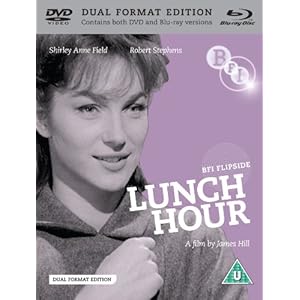
New cover art:

Re: Flipside: Lunch Hour (James Hill, 1961)
Posted: Sat Mar 05, 2011 4:39 pm
by RossyG
Gorgeous photograph. It'd be an iconic image if the film was better know.

Re: Flipside: Lunch Hour (James Hill, 1961)
Posted: Sat Mar 05, 2011 9:18 pm
by colinr0380
It certainly makes Shirley Anne Field look both sultrier and creepier than the first cover! Which is appropriate! (I'm also thinking back to the difference between those covers featuring Chantal Goya for the Criterion release of Masculin Féminin)
Re: Flipside: Lunch Hour (James Hill, 1961)
Posted: Fri Mar 18, 2011 3:30 pm
by MichaelB
New from the BFI Flipside Collection
Dual Format Edition releases on 25 April 2011
‘Flipside is not just a dynamite DVD label, but a goldmine of great British cinema.’
Nicolas Winding Refn (Bronson, Valhalla Rising)
The BFI’s Flipside label continues on its mission to expose the hidden history of British cinema, presenting two rare and little seen films – both exploring changing attitudes towards sex and gender equality in 1960s Britain – for the first time on DVD and Blu-ray.
Released on 25 April, James Hill’s intimate two-hander, Lunch Hour (1962), stars Shirley Anne Field and Robert Stephens as a couple embarking on an illicit affair, while Mike Sarne’s freewheeling Joanna (1968) – often described as ‘the female Alfie’ – stars Genevieve Waite as a carefree modern girl out to have fun. Available in collectable Dual Format Editions (containing both DVD & Blu-ray discs), these world premiere releases also include rare film shorts, mastered from elements preserved in the BFI National Archive, and come with illustrated booklets containing new essays and original promotional materials.
Lunch Hour
Shirley Anne Field (Saturday Night and Sunday Morning) gives an unforgettable, fiery performance as a young designer on the brink of an affair with a married male executive (Robert Stephens) at the company where she works, in a film based on the play by John Mortimer. With a tightly-focused plot telling the story of an illicit lunch-hour rendezvous in ‘real-time’, this is a stylish and highly-charged story of subterfuge, simmering tensions and sexual conflict.
Also included are director James Hill’s delightful colour BP shorts. Much-loved by audiences, these appealing films have been rewarded with new-found appreciation amongst aficionados of so-called ‘Trade Test Transmissions’, and have never been previously released in any format.
Special features
- Skyhook (James Hill, 1958, 17 mins): the adventure of oil exploration, deep in the tropics of Papua New Guinea
- Giuseppina (James Hill, 1959, 32 mins): Oscar-winning short in which a young girl watches the quirky characters who pass by her father’s petrol station over the course of a summer’s day
- The Home-Made Car (1963, 28 mins): a man restores his dilapidated Bullnose Morris, under the watchful eye of a curious young neighbour
- All films presented in both High Definition and Standard Definition
- Illustrated booklet with essays by Sue Harper, James Piers Taylor and Rob Harries
Lunch Hour (Flipside 017) RRP £19.99 / Cat no: BFIB1042 / UK / 1962 / Cert U / black and white / English language / 63 mins / original aspect ratio 1.66:1 / Region 0 // Disc 1: BD50 / 1080p / 24fps / PCM mono audio (48k/24-bit) // Disc 2: DVD9 / PAL / PCM mono audio (48k/24-bit) (Extras Dolby Digital 320 kbps)
The next BFI Flipside titles, released in July, will be Deep End (1971), starring Jane Asher, 1971) and Requiem for a Village (1975) by David Gladwell, editor of If…. and O Lucky Man!
Re: Flipside 017: Lunch Hour (James Hill, 1961)
Posted: Fri Mar 18, 2011 6:26 pm
by colinr0380
The latest
MovieMail Podcast is an excellent discussion of the film. Graeme Hobbs is also a lot kinder towards the motivations of the girl in Lunch Hour than I was in my write up of the film, talking about her annoyance at the hypocrisies of life causing her to mercilessly puncture the man's bubble, in a way prefiguring the way the 60s were to overturn convential behaviours.
It was also interesting to hear in the podcast about how many times the three shorts included on the disc were screened on British television in their role as 'test films' - apparently over 200 times for Skyhook!
Re: Flipside 017: Lunch Hour (James Hill, 1961)
Posted: Sun Apr 17, 2011 9:39 pm
by MichaelB
Re: Flipside 017: Lunch Hour (James Hill, 1961)
Posted: Thu Apr 21, 2011 8:25 am
by antnield
Re: Flipside 017: Lunch Hour (James Hill, 1961)
Posted: Thu May 05, 2011 10:31 am
by MichaelB
Mondo Digital:
Keeping up an astonishing track record of unbroken releases with nary a dud in sight, the BFI's Flipside series continues with this 17th entry in their usual dual-format edition containing both a DVD and a Blu-Ray. The latter is the way to go if you can play it; as with their past B&W titles, the clarity is impeccable and offers demo-level proof that vintage titles of all stripes absolutely deserve to be preserved in HD.