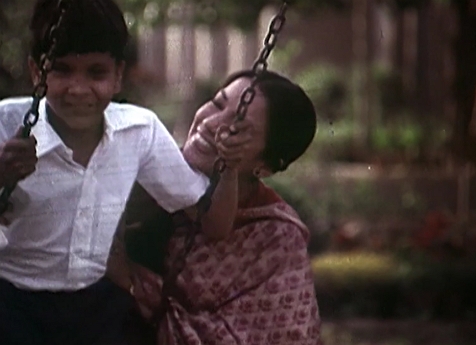
The Indian films I’ve seen from this year, ranked. Part one of three. These first five I adore.

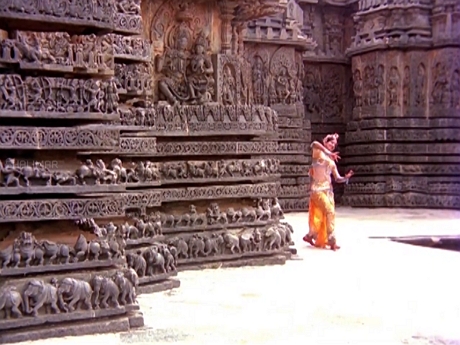 1. Sankarabharanam (K. Viswanath)
This Telugu film is in some ways my favorite of the Indian musicals I’ve seen, though I’m not naturally inclined toward its classical sound. Music is sacred in this, not something to be doled out as interlude or obligation; it’s “an infinite flow of elixir,“ the binding, boundless force of connection between living things. This is a story of two strangers’ deep appreciation and severe dedication to its sustenance.
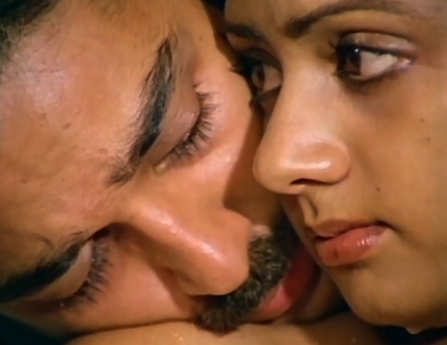
He is a temperamental master vocalist who stays furious days after a performance is interrupted by a negotiation concerning an unknown woman. She has been raised by her mother to be a courtesan, trained in song and dance to entertain clients, but fell too in love with music to devote herself to anything else. It’s an interruption that will beget continuity. He will need to save her, she will provide him salvation. They almost never speak, and their relationship is implied as chaste. They have their music.
Here is how they meet.
They almost never speak, and the film can follow their example. Other than a pair of introductions, the first thirteen minutes are without dialogue. Even when the wordlessness errs artificial, it’s welcome. (Viswanath amplifies both the singer’s authority and the courtesan’s insecurities by avoiding star casting, importing seasoned stage actor J. V. Somayajulu –who can look a little like Brezhnev, or Oskar Homolka – and moving dancer Manju Bhargavi center and minimizing her make-up.) Words are for lawyers and gossips and annoying little children. When the musician speaks, it’s often to lecture or scold; though the film too often assumes he’s right, it’s also knows that’s his problem.
The film has its outbursts as well. It is fundamentally a melodrama determined to resist melodramatic tones, and it insists you embrace both its story and manner. Episodic thrusts are made to fit one way or another, by charm or amusement, because its true focus is strong. The music is all that matters. Nothing but the music. Its climax is a symbolic one that will either make your eyes roll or well up. I found it perfect.
Sankarabharanam makes its classical music palatable the same way it reconciles plot and tone, corralling raga into pop-sized spurts. This film made without regard to selling records wound up selling a lot of them, making its playback singer a crossover recording star and driving a renewed popular interest in traditional music. Viswanath would continue mining this vein in years to come.
Sankarabharanam is
streaming on YouTube with optional English subtitles. Crushed from 1:33 to the wrong aspect ratio, so watch with a video stretcher like
this one.
Other musical highlights:
"Raagam Taanam Pallavi",
"Shankaraa Naadasareeraparaa".

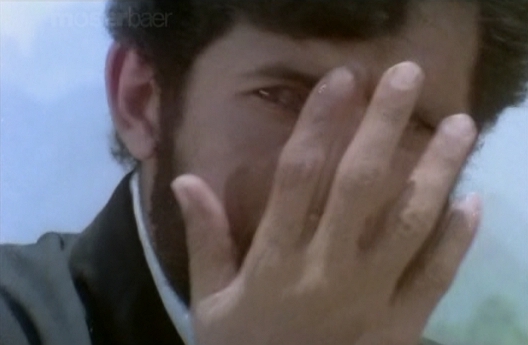
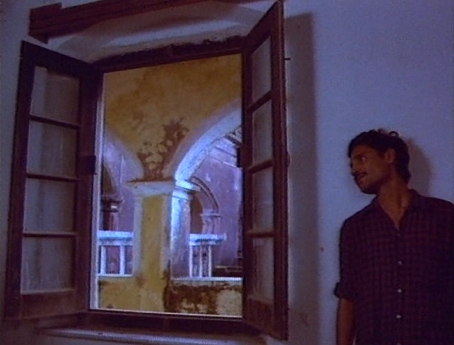 2. Satah Se Uthata Aadmi / Arising from the Surface (Mani Kaul)





 3. Esthappan (Govindan Aravindan)
Esthappan inhabits a small fishing village where traditional lifestyles coexist (for now) with encroaching modernization. He may be a drunken nuisance or a holy fool or a great seer and artist. Depends who you ask. But he does not lead a normal life. He does not have "a house, a net, a wife." He may not be alive at all, anymore, if he ever was. “He who has nothing has no end or beginning.”
In a time of change, he exists in both the old place and the new place. Esthappan may have saved the daughter of a poor prostitute from illness, he may have saved the daughter of a wealthy mixed-race couple from drowning. People tell stories about Esthappan. People contradict stories about Esthappan. People tell stories about people telling stories about Esthappan. He may have come from the ocean, he may have walked into the ocean, he may be in several places at once. At some point everyone who ever met him will be gone, but everyone will still know him.
Aravindan and his stellar DP Shaji contemplate the purpose, permanence, and malleability of local legend through a tale of tales that came from who knows where, but their real story is this place and the people who they found there. As in
Kummatty and
Thampu, they thrill at faces. Wonder at where the people who had those faces then are now, take comfort knowing they'll always be right here forever should you need see them again.
Unfortunately the version of
Esthappan left streaming on YouTube has a watermark that is in conflict with the burned-in English subtitles.

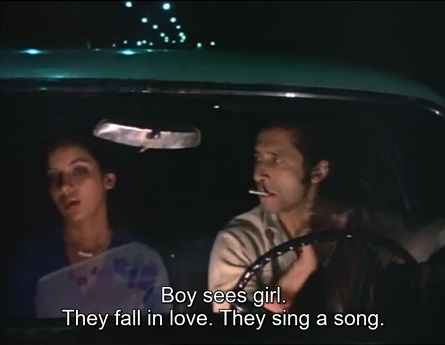
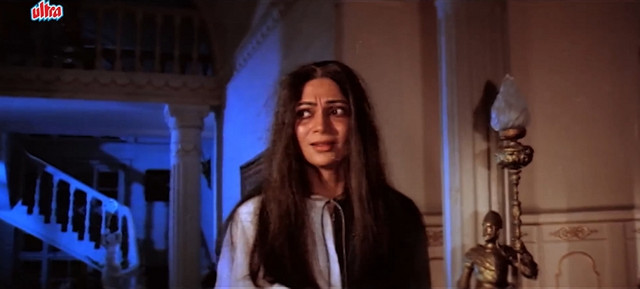 4. Karz / Debt (Subhash Ghai)
If you’ve seen 2007’s reincarnation smorgasbord
Om Shanti Om, you’ve already seen bits of
Karz; that film opens on the set of this one, during the filming of
the dizzying musical number for the insanely catchy hit with which the New Bollywood film shares its name. And if you’ve seen J. Lee Thompson’s 1975 horny paranormal mystery
The Reincarnation of Peter Proud, you’ll feel a sense of déjà vu; an acknowledged (but uncredited) inspiration,
Karz also features a man who sees flashes of his murder in a previous life and stumbles back toward it.
Karz naturally refashions
Proud’s fatalistic somnambulism into something active and overstuffed, a search for justice and birthright instead of a struggle with identity and purpose. And into something musical: Instead of Peter Proud, thirtysomething college prof whose visions begin on a random birthday, we get Monty (Rishi Kapoor), an orphan pop star triggered by a tune. Your past life is
a song stuck in your head.
Instead of following Proud’s questionable romance with his own-but-not-really daughter, Monty sets out to seduce and gaslight his former wife (Simi Garewal), now of course much older. (An intertextual add: Rishi’s first role was as a pubescent version of his father in Raj Kapoor’s autobiographical epic
Mera Naam Joker. In that, Garewal played a teacher, the object of his sexual awakening.) The movie doesn’t abandon intimations of incest; the relationship between Garewal and her brother is off from the start.
Karz retains and reworks some of the least significant details from
Proud like it was adapting a checklist instead of a script. The nervous habit of tapping a drinking glass that Proud shares with his former self is reassigned to a mute gangster as a form of communication (a la
Breaking Bad’s bell). The random references to Native Americans are now costume ideas. Perfunctory skepticism (“You’re talking about… rebirth in these modern times?”) feels imported to an industry where reincarnation constitutes a small genre (
punar janam). “Might you have seen these images in a film?” a doctor asks.
Karz also carries over the feeling in
Proud that the murderous wife has a more interesting story and a lot more going on than the main character.
Speaking of a lot going on, Subhash Ghai. You may have emerged from that musical number up there with a lot of questions (Like: Why is Jason Sudeikis so enthusiastic? Wait, how old is Jason Sudeikis? and Are you sure that isn’t Jason Sudeikis?) and often the answer is Why Not.
Vidhaata was the first Ghai I saw, it was a fun mess. This earlier film is a
great mess. You sense a desperation to have something, anything, happening in every shot, even if just an arbitrary bit of business (Why not start Q-Tipping your ears at a crime scene?) or a ridiculous choice of wardrobe or decor. Usually, it’s movement – of the frame, within the frame (sometimes to manufacture a questionable frame-within-the-frame),
into and out of the frame. There are comic henchmen nicknamed “Left” and “Right” who leap in from their respective sides. The main titles are
scattered around a set so there’s somewhere for the lens to land before it starts looking again.
Obsessed with how Ghai has two guitarists wheeled into the foreground to frame Kapoor, wheels them right back out so he can push in. Successfully fills four whole seconds:
Ghai copies
Peter Proud’s flash frame flashbacks but, the same way the story also integrates bits of
Diabolique,
Hamlet, an adorable painting of kittens, who knows what all else – “Om Shanti Om” is itself
an uncredited remake – makes them one of many options. Techniques that could be thematically appropriate – double-exposures, background shadows and silhouettes – register as something else to do. Other
punar janam use the same actor for both lives; it’s easy shorthand, treats their star to a double role.
Karz preserves
Proud’s separate casting, which makes sense for its story, but also adds another mouth to feed. As befits a masala, tones butt against each other, but Ghai double-exposes those as well. We’re asked to believe a grown woman is terrified by a Silly Symphony. It regularly stages staged fights. While it largely de-complicates Peter Proud by heroing up Monty, Kapoor does get an anguished scene where he seethes with both lust and fury and it’s chilling.
It builds to the most elaborate dedication of a high school auditorium in history ever and an overcaffeinated climax that can’t keep the time of day straight. But
Karz is never so much incoherent as excitedly impetuous. Its accumulation of why nots froths amusement into joy, its density of distraction makes happenstance preordained. Leagues above slapdash filler, its immediate pleasures have led to lasting reputation. It bests the overburdened
Om Shanti Om from before its time.
Karz is streaming
on YouTube with optional English subtitles (and a few brief sound drop-outs) and is available to rent on Amazon.
Om Shanti Om is streaming on Netflix.
The musical highlights are long, involved sequences, you may want to preserve their surprises (especially the last one’s) for the feature. But in case you don’t:
"Dard-E-Dil",
"Kamaal Hai, Kamaal Hai",
"Ek Haseena Thi" (another uncredited
grab).
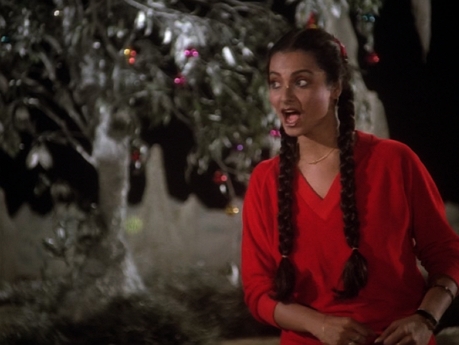
 5. Bancharamer Bagan / The Garden of Bancharam (Tapan Sinha)
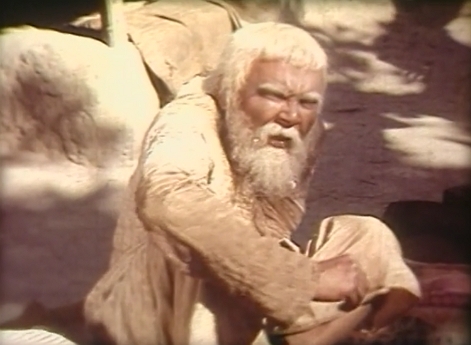
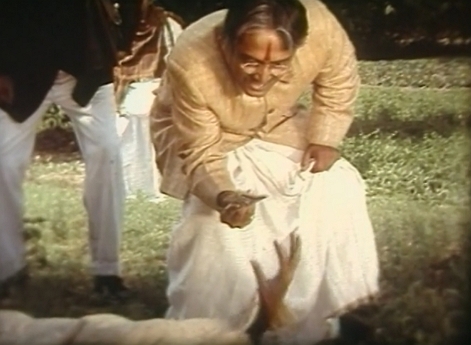
Death plays hide-and-seek, foxes and dogs play tug-of-war.
Bancharam’s father once saved the life of the zamindar for whom he toiled; he was rewarded with a plot his son has developed into a lush and fruitful garden. That zamindar’s son has grown into an idle, insomniac tyrant whose covetousness transcends his physical being and bleeds into subsequent generations. They want most what they cannot have. Bancharam’s only surviving descendant, a grandson, eyes the land for development. But Bancharam lives on, perhaps against his own will.
This Bengali drama is an adaptation of a play by Manoj Mitra, stars the playwright, and (at least in translation) its theatrical origins are most preserved in select acting styles and cosmetics. It’s talky, but exterior settings and era-spanning action automatically open things up. Sinha teases a formal adventurousness early, but is mostly content to keep things flowing smoothly. Focusing on the fracas, keeping easy parable and moral wagging to the minimum, letting the changing face of the nation play out incidentally. Occasionally he pauses for groundskeeping. There should probably be more of that.
The fuel for the film is predictably delicious estate comedy, crowd-pleasing cruelty erupting as everyone acts the wrong way to news of death or dying. None of this would work as well without Mitra keeping Bancharam a cantankerous question mark. It’s a physical performance, a lemon-puckered puss atop a gnarled frame, a manifestation of perpetual misery waiting on a promise. What mix of natural humility, internalized obeisance, and sarcasm the old man gives off is inscrutable. Survival has rubbed away the line between calculation and obliviousness. He is a captivating and insufferable hero. And perhaps his company would not be worth it if the film didn’t earn the right to emotionally turn a corner, which it does, though still casts some irony on an affirmation.
A small treasure, like its garden.
I swear the first time I watched it
Bancharamer Bagan was full-frame and complete, but that link’s gone dead. The subtitled options left on YouTube are
this digital restoration that’s been heinously cropped from 1.33:1 to 2.35:1, and another ancient print with translucent burned-in titles that’s been trimmed by 20 minutes.
Next: Eight others to be admired. Later, some for amusement, some to be avoided.
1978 -
1981 - 1982 (
1,
2)