Page 12 of 48
Re: 1980s List Discussion and Suggestions
Posted: Sun Feb 16, 2014 9:03 pm
by MichaelB
Yojimbo wrote:I remember watching a tv broadcast of Moonlighting in the early 80s - which must have been the year of release, or shortly afterwards - and not thinking much of it, but then a work colleague pointed out to me that I should have been considering it in the context of Poland's then critical political situation - with Solidarity, General Jaruzelski, etc, etc.
All you need to know to understand the film is that martial law was declared back home in Poland while the builders were working in London, something that's obvious from the context of the narrative. My understanding of 1970s/80s Polish history is far more advanced now than it was when I first saw the film in 1983, but it made absolutely no difference to appreciation.
(I loved the film, both then and when I rewatched it for Screenonline
a few years ago: it was my first Skolimowski and it made me a lifelong fan, and I thought it stood up remarkably well given its original torn-from-the-headlines production.)
My thing with allegorical films is that they should be able to stand up as dramas, or stories - aside from their power as allegories.
Why do you think it's an allegory? And for me it stood up perfectly well as drama - in fact, alongside
Four Nights with Anna it's probably the most rigorously controlled narrative that Skolimowski has created.
Re: 1980s List Discussion and Suggestions
Posted: Mon Feb 17, 2014 12:43 am
by Yojimbo
MichaelB wrote:
All you need to know to understand the film is that martial law was declared back home in Poland while the builders were working in London, something that's obvious from the context of the narrative. My understanding of 1970s/80s Polish history is far more advanced now than it was when I first saw the film in 1983, but it made absolutely no difference to appreciation.
(I loved the film, both then and when I rewatched it for Screenonline
a few years ago: it was my first Skolimowski and it made me a lifelong fan, and I thought it stood up remarkably well given its original torn-from-the-headlines production.)
Why do you think it's an allegory? And for me it stood up perfectly well as drama - in fact, alongside
Four Nights with Anna it's probably the most rigorously controlled narrative that Skolimowski has created.
Irish people took a special interest in the situation in Poland in the late 70s and early 80s, partly due to a special affinity with conquered lands, but also having been charmed by Pope John Paul II during his visit here. So I was well aware not only of the declaration of martial law - and I even recall watching the TV announcement at the time - but beginning with the Solidarity union strike at the Gdansk shipyard.
The allegorical aspect is as I recall my work-colleague pointing out to me at the time
is the way the apparently ungrateful workers turned on Jeremy Irons' character at the end: it wasn't so much that they were being ungrateful, per se, it's just that they resented being treated like children, and would have preferred more control of decisions which affected them
But as I didn't get a chance to re-watch it - in those pre-vcrdays- and haven't had a chance to re-watch it since, I haven't been able to confirm the accuracy of his assessment, or to determine any wider allegorical aspects.
As for Skolimowski. I was quite young when I saw 'Deep End' for the only time, but I was underwhelmed by it. After loving Wajda's 'Innocent Sorcerers' on the recently-released Polish Cinema Classics box-set, I subsequently bought a box-set of his but I'll wait until I've watched the entire set - and re-watched 'Deep End' - before I give a more definitive assessment of him as a director.
I don't know the full extent of his contribution to 'Innocent Sorcerers' and the Polanski Masterpiece 'Knife In The Water', but I'm willing to accept that it was significant; which is something to be proud of.
Re: 1980s List Discussion and Suggestions
Posted: Mon Feb 17, 2014 10:22 am
by MichaelB
Yojimbo wrote:Irish people took a special interest in the situation in Poland in the late 70s and early 80s, partly due to a special affinity with conquered lands, but also having been charmed by Pope John Paul II during his visit here. So I was well aware not only of the declaration of martial law - and I even recall watching the TV announcement at the time - but beginning with the Solidarity union strike at the Gdansk shipyard.
But my point is that you don't actually need to know this going in. The one important element - that martial law has been declared back home - is spelled out perfectly clearly in the film itself, and I don't recall Solidarity so much as being mentioned.
The allegorical aspect is as I recall my work-colleague pointing out to me at the time
is the way the apparently ungrateful workers turned on Jeremy Irons' character at the end: it wasn't so much that they were being ungrateful, per se, it's just that they resented being treated like children, and would have preferred more control of decisions which affected them
I'm slightly puzzled by part of that interpretation, because:
Why would they be grateful? They've been systematically lied to over a period of weeks, not "for their own protection" but because Nowak wanted them to finish the job without any distractions. And I'd argue that they're not so much "ungrateful" as absolutely furious, and they have every right to be - they haven't so much been "treated like children" as utterly exploited.
But as I didn't get a chance to re-watch it - in those pre-vcrdays- and haven't had a chance to re-watch it since, I haven't been able to confirm the accuracy of his assessment, or to determine any wider allegorical aspects.
You are of course welcome to read any number of "wider allegorical aspects" into the film (or any other film), but what I'm taking issue with is your implication that Skolimowski intended it as an allegory from the start. Which, given the circumstances of production, I find extremely hard to believe - it reads to me like a very personal response to one particular historical event.
Re: 1980s List Discussion and Suggestions
Posted: Mon Feb 17, 2014 1:09 pm
by domino harvey
MichaelB, Yojimbo is hardly the first to read the film as an allegory. In fact, you appear to be one of the few to deny this aspect. You can find it unconvincing or coincidental, but you can't treat his reading as unusual
Re: 1980s List Discussion and Suggestions
Posted: Mon Feb 17, 2014 1:46 pm
by MichaelB
domino harvey wrote:MichaelB, Yojimbo is hardly the first to read the film as an allegory. In fact, you appear to be one of the few to deny this aspect. You can find it unconvincing or coincidental, but you can't treat his reading as unusual
My objection wasn't so much that he was reading it as an allegory but his implication that that's the only legitimate reading because the film is apparently insufficiently dramatic - a charge with which I profoundly disagree. But it's clear that the film resonated with me on a much deeper level than it did with either of you.
Re: 1980s List Discussion and Suggestions
Posted: Mon Feb 17, 2014 5:47 pm
by knives
Also wasn't the film finished, if not presented theatrically, before the 'allegorical' problems with Poland actually occurred? By the way the film does make a few references to solidarity, but almost exclusively through posters in the background (If I remember rightly Irons rips up a few). I have to agree with Michael though that the film works excellently in regards to its surface story elements which are pretty clearly communicated so that even someone with no knowledge of Poland or cold war politics would be able to understand everything that is going on (I say this from experience).
Re: 1980s List Discussion and Suggestions
Posted: Mon Feb 17, 2014 5:50 pm
by domino harvey
Ebert's review at the time of release touches on both sides (His compatriot Gene Siskel even named it the best film of 1982):
"Moonlighting" invites all kinds of interpretations. You can take this simple story and set it against the events of the early 80's, and see it as a kind of parable. Your interpretation is as good as mine. Is the house itself Poland, and the workmen Solidarity -- rebuilding it from within, before an authoritarian outside force intervenes? Or is this movie about the heresy of substituting Western values (and jeans and turkeys) for a home-grown orientation? Or is it about the manipulation of the working classes by the intelligentsia? Or is it simply a frontal attack on the Communist Party bosses who live high off the hog while the workers are supposed to follow the rules?
Like all good parables, "Moonlighting" contains not one but many possibilities. What needs to be insisted upon, however, is how much fun this movie is. Skolimowski, a Pole who has lived and worked in England for several years, began writing this film on the day that Solidarity was crushed, and he filmed it, on a small budget and with a small crew, in less than two months: He had it ready for the 1982 Cannes Film Festival where it was a major success. It's successful, I think, because it tells an interesting narrative in a straightforward way. Skolimowski is a natural storyteller. You can interpret and discuss "Moonlighting" all night. During the movie, you'll be more interested in whether Irons gets away with that frozen turkey.
Re: 1980s List Discussion and Suggestions
Posted: Mon Feb 17, 2014 8:14 pm
by knives
Another Woman
Between recently watching this and September I really think that Santo Loquasto deserves a lot of credit not just for his work with Allen, but as a true auteur of his position. It's some truly amazing and consistent work. Certainly, again, it helps wisk the film past some of its weaker elements like the narration which always seems to come in at the worst times interrupting the weird melancholy that the film builds. It really is a minor complaint though when the truly great moments like the scene with her father at the table or any of the stuff with the grate seem o regularly pop up turning physical the sort of terrors that Allen usually only verbalizes.
Actually in general, which might be why the narration seems so wrong, this is one of the best seeing films I've encountered by Allen who really excels at making most of the exposition come across with a Pierceian flair. Not only in the obvious ways either. I suppose this is really where Loquasto sold me on the film as a whole, but just the placement of items in the background, like a reverse of Dreyer, and the way their colour blazes onto the characters despite their dead tones really transforms each scene beyond the unusually weak page.
Hello Again
Am I crazy or is this the origin of the Touchstone music? The film itself is pitched from the absolutely weirdest place. The delivery seems better placed in some daytime melodrama than a wacky romantic(ish) comedy and that's only the start of this cleaned up PG John Waters thing. What really makes the film work though is that for the weird pitch the film is extraordinarily dead pan with everyone just accepting the premise like an attempt to remake Libeled Lady post code. I don't know if I actually bought this line or if it's actually good, but damn.
An Innocent Man
I died and went to respectably trashy heaven. The film at times films like a made for television movie (though I suspect that the lead being Selleck is what gives me that impression) and yet Yates some of the time makes this seem like it could have been a legit excellent wronged man film. Like usual with Yates the film is at its best when it treats the plot lightly and allows the characters to just mess with each other. This leads to an odd pacing with the film where the opening of scenes are exhausted by exposition, but end in a way that leaves the impression they're good by having two characters just look at each other and maybe have a quietly spoken comment on what just happened. Though the ratio really improves once things go into prison where Yates seems to be at his most comfortable exploring the little society that it has developed (though in a pretty cliche way). Oddly Laila Robins' wife is the high part of the film making even the lamed exposition sound like a real human speaking and acting out lost in an impossible situation. I'm tempted to say she makes this a must see despite all of the film's already seen components.
It's not like they are given opportunities to give great performances also, but I would feel terrible not mentioning the embarrassment of riches that the supporting cast offers. Probably the most pleasantly surprising one is Phillip Baker Hall as a Judge near the beginning, but there's also Dann Florek and Tobin Bell in similar sized cameos. Even David Rasche in a bigger role as the coked up cop gives a pretty great Rutger Hauer impression. Hell even Selleck who I teased at the start plays with the situation of his character far better than I expected from him.
Lightning Over Water
I like Wenders for the most part, but haven't really loved his films till now. I suspect in part that is because of my own connection to Nick Ray through his cinema and the movie certainly plays to that. I haven't seen The Lusty Men, but as it takes up the screen I couldn't help but be drained with these images somehow making Ray's status as a dying man more real than his actual fragile state. The film also really feels like a Ray film especially in the colour which really brings home how the fiction has become a part of Ray's life. There's so much power in the reds and the greens that occupy so much of the exterior. They also, along with the dialogue which I assume was at least mostly written, help prevent the film from being hagiography. This is really where the presence on screen on Wenders helps as he isn't just entirely enamored through the camera, but also on screen which isolates that love in a way that allows for Ray to just be Ray. There's no need to be pretty.
This isn't as out there as We Can't Go Home Again, but I think that being a smaller jump helps the film in a lot of ways almost as a text to bridging one set of concerns with another. The two films share a lot in common with the main difference being this one loses most of the Tracey Fragments type mis-en-scene though it even gives play to that with some of the video sequences though I think Wenders' aim with them are different from Ray's. Mostly though I just appreciate that the film allows for itself to relax, be humourous on occasion, and allow for Ray to just sit there and fill the screen.
Conan the Destroyer
I suppose the only way to make a sequel to the original that wouldn't automatically fail in comparison is by changing everything leaving a Jackie Chan to Milius' Bruce Lee. Unfortunately while the humour is mostly effective a lot of that striving for difference functions just as downplaying the quirks of Conan's personality like the sex and violence leaving the film as a far more ordinary beast. There's a few moments that suggests that with a less classical director, rather than Milius who is classically aware, this could have been a nice satire of the original forcing Conan into new situations where his morality doesn't function or aid. Instead the movie is just sort of limp. Enjoyably limp to the degree I'd argue it doesn't deserve its reputation, but limp all the same.
Re: 1980s List Discussion and Suggestions
Posted: Mon Feb 17, 2014 8:36 pm
by zedz
knives wrote:Another Woman
Between recently watching this and September I really think that Santo Loquasto deserves a lot of credit not just for his work with Allen, but as a true auteur of his position. It's some truly amazing and consistent work. Certainly, again, it helps wisk the film past some of its weaker elements like the narration which always seems to come in at the worst times interrupting the weird melancholy that the film builds. It really is a minor complaint though when the truly great moments like the scene with her father at the table or any of the stuff with the grate seem o regularly pop up turning physical the sort of terrors that Allen usually only verbalizes.
Actually in general, which might be why the narration seems so wrong, this is one of the best seeing films I've encountered by Allen who really excels at making most of the exposition come across with a Pierceian flair. Not only in the obvious ways either. I suppose this is really where Loquasto sold me on the film as a whole, but just the placement of items in the background, like a reverse of Dreyer, and the way their colour blazes onto the characters despite their dead tones really transforms each scene beyond the unusually weak page.
I quite like
Another Woman (considering I'm lukewarm on Allen at the best of times), and the awkward narration is one of my favourite aspects of it, since it comes across not as the spontaneous reflection of the character, but as the (slightly stilted) reading of a script, or journal entry, or article, that she's written for herself. That seems to me how Rowlands plays it, and it's a nuance that's completely in keeping with her character. Whose idea that was, I don't know, but it's a great touch.
Re: 1980s List Discussion and Suggestions
Posted: Mon Feb 17, 2014 8:39 pm
by knives
That works really well since the narration is also so very distanced from the action and in the past tense.
Re: 1980s List Discussion and Suggestions
Posted: Mon Feb 17, 2014 9:08 pm
by Yojimbo
MichaelB wrote:domino harvey wrote:MichaelB, Yojimbo is hardly the first to read the film as an allegory. In fact, you appear to be one of the few to deny this aspect. You can find it unconvincing or coincidental, but you can't treat his reading as unusual
My objection wasn't so much that he was reading it as an allegory but his implication that that's the only legitimate reading because the film is apparently insufficiently dramatic - a charge with which I profoundly disagree. But it's clear that the film resonated with me on a much deeper level than it did with either of you.
Just to clarify, Michael: I hadn't read it as an allegory as I was watching it; but a colleague pointed out that allegorical aspect to me at work the following day and what he said made sense.
But I definitely plan to re-watch it for this poll and I'll give my definitive - updated - opinion on it then.
Re: 1980s List Discussion and Suggestions
Posted: Tue Feb 18, 2014 11:57 pm
by flyonthewall2983
knives wrote:An Innocent Man
I died and went to respectably trashy heaven. The film at times films like a made for television movie (though I suspect that the lead being Selleck is what gives me that impression) and yet Yates some of the time makes this seem like it could have been a legit excellent wronged man film. Like usual with Yates the film is at its best when it treats the plot lightly and allows the characters to just mess with each other. This leads to an odd pacing with the film where the opening of scenes are exhausted by exposition, but end in a way that leaves the impression they're good by having two characters just look at each other and maybe have a quietly spoken comment on what just happened. Though the ratio really improves once things go into prison where Yates seems to be at his most comfortable exploring the little society that it has developed (though in a pretty cliche way). Oddly Laila Robins' wife is the high part of the film making even the lamed exposition sound like a real human speaking and acting out lost in an impossible situation. I'm tempted to say she makes this a must see despite all of the film's already seen components.
It's not like they are given opportunities to give great performances also, but I would feel terrible not mentioning the embarrassment of riches that the supporting cast offers. Probably the most pleasantly surprising one is Phillip Baker Hall as a Judge near the beginning, but there's also Dann Florek and Tobin Bell in similar sized cameos. Even David Rasche in a bigger role as the coked up cop gives a pretty great Rutger Hauer impression. Hell even Selleck who I teased at the start plays with the situation of his character far better than I expected from him.
You forgot F. Murray Abraham as the token "con takes our hero under his wing" role. It's pretty cliche but he's an actor known to make chicken salad out of chicken shit (depending if you feel the latter about these two, he's the best thing going by a thin margin in both
Scarface and
Last Action Hero).
Re: 1980s List Discussion and Suggestions
Posted: Wed Feb 19, 2014 1:11 am
by knives
He is very likable in the role, but I really have nothing else to say about it because like you said he exists entirely as a servant to the lead.
Re: 1980s List Discussion and Suggestions
Posted: Wed Feb 19, 2014 1:14 am
by domino harvey

Every member and their children and their children's children are banned from invoking
Last Action Hero... for three months.
Re: 1980s List Discussion and Suggestions
Posted: Wed Feb 19, 2014 3:37 am
by Feego
First Name: Carmen (1983, Jean-Luc Godard)
Bizet’s opera
Carmen proved a popular source for movie directors in the early 80s, also inspiring Carlos Saura and Francesco Rosi. Godard’s loose (in the loosest way possible) reworking of the story is fascinating in its adherence to the basic storyline of the original opera while seeming as though Godard and crew just made it up as they went along. In this version, Carmen is in with a gang of small-time terrorists who set about pulling off their always-unsuccessful heists by claiming to be filmmakers. While they are robbing a bank, Carmen falls for the aggressive bank guard, and they quickly begin a tumultuous love-hate affair. But the “story,” which is frequently intercut with and even superseded by a string quartet practicing Beethoven, is really incidental as Godard uses the recognizable tropes of romance and action-film violence as part of his formal experimentation. As a result, the movie feels constantly fresh and improvisational, often funny (especially the two big shootouts), and edgy. The two leads are appropriately angst-ridden, and Godard makes a delightfully self-deprecating appearance as a cerebral filmmaker who claims to be sick but is really just an asshole.
Endless Love (1981, Franco Zeffirelli)
Apparently hoping to repeat his
Romeo and Juliet success, Zeffirelli tackles another story about star-crossed teenaged lovers pulled apart by their families, but this one fizzles pretty quickly. Brooke Shields and Martin Hewitt play the high-schoolers in question whose passionate discovery of their special purpose sends Shields’ free-love championing father into a hypocritical rage. When forbidden from seeing Shields, Hewitt logically burns her house down and is subsequently sent to a psych ward, where the movie effectively becomes
The Snake Pit 2: Electric Booglaoo. Zeffirelli’s directorial style is totally wrong here, failing to match the high melodrama of Judith Rascoe’s screenplay. The arson episode is only one of several bizarre twists, and there are undercurrents of incestuous desire for Shields from her dad (Don Murray) and older brother (James Spader). But Zeffirelli directs the film with the bland restraint of an after-school special or movie-of-the-week where the high emotional intensity of a Douglas Sirk or a Nicholas Ray would have been more appropriate. Shields and Hewitt, both untrained and raw, do a good job of conveying their initial puppy love and sexual discovery, but Hewitt doesn’t have the range to pull off his character’s emotional complexity post criminal indictment. The only person who gets it right is Shirley Knight, playing Shields’ cradle-robbing mother with creepy abandon that leaves everyone else in the dust.
Body Heat (1981, Lawrence Kasdan)
Okay, anyone who has seen
Double Indemnity knows exactly how this movie is going to play out, right to the very last “twist.” There are no surprises here, the banter, supporting characters, and fatalism are all carry-overs from the great noirs of the 40s, and yet I was completely taken in by this movie. Ned Racine and Matty Walker are the transparent creations of a screenwriter, but as played by William Hurt and Kathleen Turner, they come alive in full sexual heat. Ted Danson does the miraculous in turning his Fred Astaire-aping lawyer into a likable human being. While there’s no denying Kasdan’s self-conscious approach to reviving (and not deconstructing) the noir genre, everything aligns so perfectly, from performance to music to sweaty atmosphere, that I felt like I was experiencing it all for the very first time (cue Madonna’s “Like a Virgin”).
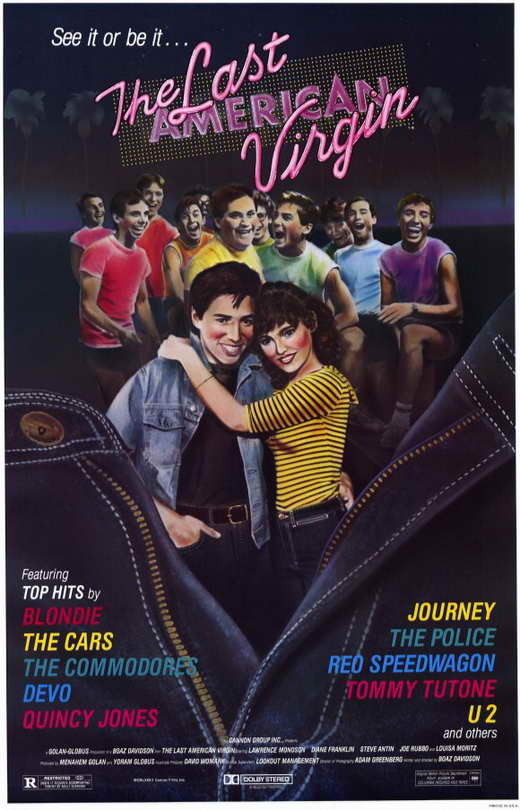
The Last American Virgin (1982, Boaz Davidson)
As I already wrote about
Sixteen Candles, this is another teen movie that tries to be both a raunch fest and a sensitive portrait of modern adolescence. It doesn’t entirely work here, either, but this one is more successful than the Hughes movie becomes it gets its sexcapades out of the way first and progressively becomes more serious, leading to a decidedly un-Hollywood ending. Following a group of boys who attempt to get laid over and over again, the film is amusing enough, but director Davidson treats each sexual encounter with the right amount of awkwardness to make his characters believable and endearing. His candy color scheme is an interesting touch, but even more memorable is his use of a near non-stop parade of great 80s hits by the likes of Blondie, Journey, The Cars, U2, and The Commodores for a soundtrack. It’s no wonder the
theatrical one-sheet gives more prominent billing to the musicians than the actors.
Vice Squad (1982, Gary Sherman)
I don’t normally believe in guilty pleasures. If I like something, I see no point in feeling guilty about it. But I genuinely feel dirty for liking this movie as much as I did. Allegedly based on real criminal activity from the Hollywood crime beat, this low-budget thriller takes place over one nightmarish evening as tough-talking prostitute Princess turns tricks while trying to evade sadistic, murderous pimp Ramrod (yes, those are their names). If this movie serves any purpose at all it’s apparently to rub our noses in the filth that roams the streets at night in all of its neon stank, expertly shot by none other than John “
Barry Lyndon” Alcott. The immortal Wings Hauser gives an extraordinarily bat-shit performance as Ramrod (and even
sings the film’s theme song too!). But the icing on the cake is a mind boggling, seemingly Buñuel-inspired episode in which Princess is hired to indulge a rich john’s fetish by donning stripper-bridal regalia and making her way toward a casket in which he pretends to be dead.
Re: 1980s List Discussion and Suggestions
Posted: Wed Feb 19, 2014 3:44 am
by domino harvey
Well, you inadvertently did a good job making me want to see Endless Love!
Re: 1980s List Discussion and Suggestions
Posted: Wed Feb 19, 2014 3:49 am
by Yojimbo
domino harvey wrote:Well, you inadvertently did a good job making me want to see Endless Love!
With two cardboard-cutouts playing the leads, Dom?
 Seriously
?
Re: 1980s List Discussion and Suggestions
Posted: Wed Feb 19, 2014 3:51 am
by Feego
I actually don't think Endless Love is quite the disaster it's often made out to be, just more of a missed opportunity. Most critics, it seems, dislike the film for its over-the-top story. For me, that was the best part, but as I wrote, Zeffirelli wasn't up to the task in his directing. We needed someone who wouldn't take it so stone-cold seriously. It's a movie that is crying out for a good remake, but from what I hear, the one currently playing in theaters ain't it.
Re: 1980s List Discussion and Suggestions
Posted: Wed Feb 19, 2014 3:55 am
by domino harvey
While I don't think much of Body Heat (though I wouldn't say I dislike it), I agree that special praise is earned by Danson in the film. I think the biggest problem is in not emulating a code-bound noir in its ending, which goes to show how these kind of films really can't be repeated anymore
Re: 1980s List Discussion and Suggestions
Posted: Wed Feb 19, 2014 4:02 am
by Feego
I can see that, re: the ending. It would have been better if that last scene was left out entirely and the film ended with Hurt making his discovery, leaving some room open to speculation. But for me, the pleasure of Body Heat was more in the journey than the destination.
Re: 1980s List Discussion and Suggestions
Posted: Wed Feb 19, 2014 4:21 am
by Yojimbo
Feego wrote:I can see that, re: the ending. It would have been better if that last scene was left out entirely and the film ended with Hurt making his discovery, leaving some room open to speculation. But for me, the pleasure of Body Heat was more in the journey than the destination.
Body Heat was a decent attempt to revive the noir genre, and I liked that sting in the tail, but 'Double Indemnity' casts a giant shadow; and Lawrence Kasdan is no Billy Wilder.
And all three main actors fall short in comparison with their 1940s equivalent.
But it's a helluva lot better than the tv 'Double Indemnity' remake
Re: 1980s List Discussion and Suggestions
Posted: Wed Feb 19, 2014 5:54 pm
by colinr0380
Yojimbo wrote:domino harvey wrote:Well, you inadvertently did a good job making me want to see Endless Love!
With two cardboard-cutouts playing the leads, Dom?
Seriously?
If you don't want to subject yourself to the film directly,
The Cinema Snob has just done an episode on it to tie in with the upcoming remake!
Re: 1980s List Discussion and Suggestions
Posted: Wed Feb 19, 2014 5:55 pm
by Yojimbo
colinr0380 wrote:Yojimbo wrote:domino harvey wrote:Well, you inadvertently did a good job making me want to see Endless Love!
With two cardboard-cutouts playing the leads, Dom?
Seriously?
If you don't want to subject yourself to the entire film,
The Cinema Snob has just done an episode on it to tie in with the upcoming remake!
and that's not me, Col!

Re: 1980s List Discussion and Suggestions
Posted: Fri Feb 21, 2014 8:42 am
by matrixschmatrix
Since, just by happenstance, I just finished watching all of the '80s Bond movies, I figured I'd write them up:
For Your Eyes Only (1981)
One of the lease silly of the Roger Moore Bond movies, which is both a strength and a failing- it holds together reasonably well, and it shows the series' image of what a Bond Girl is beginning to change- here, she actually does stuff, and there's never a point where she suddenly becomes a useless ninny. It helps too that Carole Bouquet is a fair actor, which gives this one a huge edge over its 'wait which one is that again' counterpart, The Spy Who Loved Me. It's not too memorable, though- the plot is jockeying over a code machine, shades of From Russia With Love, but instead of SPECTRE and Red Grant, we have some slightly twisty politics with warring Greek smugglers- and while I generally like it when Bond has an ally, his Greek smuggler pal isn't terribly memorable. The Moore movies, if you like them, tend to be strongest when they've got jaw droppingly ridiculous elements, and this one doesn't have them- but, it's solid and it doesn't have any really bad elements, either.
Octopussy (1983)
Ah, now we're back into the camp zone. This one opens with Bond flying a mini airplane out of a fake horse's ass, and doesn't really get a lot less silly throughout- though it's not especially gadget heavy, it does have the contested-loyalty Octopussy and her circus-troupe army of women who are loyal to her due to belonging to, you know, the Octopus cult. Lots of Bond hanging out with a couple of fun allies, and some sort of interesting spots where Bond uses cash as though it were a gadget unto itself, throwing it to crowds to bog people down behind him in a chase and tossing it in people's faces and so forth. The actual plot is something about an evil Russian general- a renegade, of course, because we can't make the Russians look bad- selling Kremlin jewels to buy a nuclear warhead or something, it's sort of a mystery plot that doesn't really build the way normal plots due. The important part is: Bond winds up in some sort of ethnic knife thrower costume, a gorilla costume, and a clown suit, all within the same reel, and it's not even the silliest part of the movie (since it follows that up with an all women ninja circus raid on the evil Louis Jourdan's estate.) This one has Q in the field, in a hot air balloon! I love when they give Desmond Llewellyn stuff to do.
A View to a Kill (1985)
Oh, man, this one's amazing. Bond and Moneypenny at Ascot wearing top hats and fancy dresses, followed by half an hour of wealth porn with Bond hanging out with John Steed at the most absurdly posh horse auction palace thing, plus Grace Jones, Christopher Walken, and an elderly monocle sporting German man who, surprise!, turns out to be a Nazi mad scientist. This one has a sort of pseudo Goldfinger plot, where Walken wants to wipe out Silicon Valley so he can have all the microchips (MICROCHIPS!!! They're amazing!!) and also cruises around in a zeppelin. Moore is showing his age a bit in this one, but it's fine, really- this one's more about just crazy stuff happening in sequence and wry looks than it is about fisticuffs. This is yet another one where the bad guy is a rogue Russian, and it ends with Bond getting the Order of Lenin. I don't really know why that was such a thing for these movies in the 80's, but I enjoy it anyway.
This is Lois Maxwell's last Bond as well as Moore's, and I've heard that Moore said he thought she should have been promoted to playing M to replace the then-departed Bernard Lee, and they really should have done it- her interplay with the Bonds was one of the consistent high points of these movies, even when she only had a few minutes in them.
The Living Daylights (1987)
The Dalton Bonds are always frustrating, because it feels like he allllmost got something really good working, but both of his are sort of overwhelmingly Reagan-y. This one features heroic mujahideen, openly killing a bunch of Russian soldiers in Afghanistan, a bunch of interplay about opium, and a Bond Girl who's more or less just a normal person, kind of overwhelmed by what's going on. Oh, and an eviil Joe Don Baker, which, there's a surprise. This one has a fair number of silly parts- Bond sledding on a cello case, steering with the cello, a whistling based explosive keyfob, and a cut scene where Bond would have been riding a magic carpet. Dalton's good, somewhat predicting Craig's Bond- he takes the role very seriously, and seems to fit in better when the movie takes him seriously as well. He's also really Welsh sometimes, in a way that's slightly distracting, but you can't blame him for that. Anyway, it's a solid movie, but it's not one that really sticks the landing for either seriousness or silliness.
Licence to Kill (1989)
This one goes all out in trying to be serious, but seems to wander off into being a Schwarzenegger movie or something- Bond's on a personal vendetta to avenge a woman he loved and a buddy, going after a cocaine druglord, and he's ignoring orders from his organization because the RULES are keeping him from DOING WHAT NEEDS TO BE DONE. Dalton is good at that kind of movie, though, believably angry and bordering on obsessive, and it... works, but it's a bit off putting in a way. However, about halfway in, Q shows up, and it turns magically back into a Bond movie- the emotional arcs keep going, but now he's got gadgets, and Q keeps popping up and being wry, and the whole thing gets more fun without losing the intensity it was going for. Also a guy gets exploded in a depressurizing submarine, which is neat. At any rate, it's a shame this is Dalton's last role, because I would have liked to see him in movies less obsessed with 80's action tropes, but it's a pretty good movie on the serious end of the Bond spectrum.
Overall, I don't know that any of these would merit placement on a list- though I could imagine A View to a Kill sneaking into the bottom ten of mine.
Re: 1980s List Discussion and Suggestions
Posted: Fri Feb 21, 2014 1:25 pm
by Tommaso
Two recommendations for Japanese films:
The Human Promise (Kiju Yoshida 1986): Fourteen years after "Coup d'état" Yoshida returned to feature filmmaking with this film about old age, senility, and the question of assisted suicide. The suffering of an old lady who yearns for death reveals not only the disruptions in her family, but is also the cause for a police investigation when she's finally found dead and her husband, already also senile, is suspected to have killed her at her wish. This is a deeply moving and profound film which avoids any sentimentality and leaves these old people all their dignity in spite of the suffering and dementia. Absolutely striking performance by Sachiko Murase who would play the old lady in Kurosawa's "Rhapsody in August", too, a few years later. Yoshida's style is quite different here from his more overtly experimental approach in his earlier works, but while this is more 'conventional', it's astonishing in its visual precision. Every shot simply feels right. I'm immensely impressed. This will be definitely on my list.
Hokusai Manga (Kaneto Shindo 1981): I intentionally kept the Japanese title here, which roughly tranlates as "Hokusai's Sketches", as the international title "Edo Porn" is rather misleading and much too sensationalistic. Admittedly there's a lot of nudity here, but basically the film is concerned with the obsession with art and a particular female that this 19th century Japanese artist (you know, he who made the "36 Views Of Mount Fuji" series) falls for. I didn't find it terribly profound, but at least it's visually amazing with its beautiful colours and sets, and of course there's the sequence in which Hokusai creates his woodcut
The Dream of the Fisherman's Wife. And if you've seen that image: yes, this is presented with a real actress in the film... outrageous in a good way, and very memorable, to put it mildly.