The editing/gun shots are also Godard, the conversations between Blanchet and the critic are Godard, Ledger's misogynistic conversation with the crude contest is Godard. There is a lot of Godard in the film as well.David Ehrenstein wrote:If you can't sense Todd's vulnerabilty I really don't know what to say. Maybe you should move to Portland and hang out with him.
The chief Godard reference in the film is a direct quote from Masculine Feminine. Otherwise there's a lot of Fellini -- especially the giant curved white chair from the spa scene in 8 1/2.
I'm Not There (Todd Haynes, 2007)
-
justeleblanc

- Joined: Wed Nov 03, 2004 10:05 pm
- Location: Connecticut
-
Antoine Doinel

- Joined: Sat Mar 04, 2006 5:22 pm
- Location: Montreal, Quebec
- Contact:
For me, that summarizes my issue with the film. There are plenty of ways to explore the '60s and the various other themes Haynes deals with outside of using the prism of Dylan. To use Dylan and not address the music is like talking about the Mona Lisa and not mentioning the smile.Andre Jurieu wrote:In my mind, Haynes isn't especially concerned with Dylan's music. So music might be an emotional subject, but music isn't really the subject of I'm Not There. Haynes seems more concerned with exploring the concept of creating a portrait of any artist rather than worrying about the art that the artist produces.Antoine Doinel wrote:But music in an of itself is an emotional subject and to approach it so clinically is somewhat bizarre.
Last edited by Antoine Doinel on Mon Dec 17, 2007 7:21 pm, edited 1 time in total.
-
justeleblanc
- Joined: Wed Nov 03, 2004 10:05 pm
- Location: Connecticut
Why not? Why mention the smile when you discuss the painting? Certainly there are other things worth mentioning that have not become cliches.Antoine Doinel wrote:For me, that summarizes my issue with the film. There are plenty of ways to explore the '60s and the various other themes Haynes deals outside the prism of Dylan. To use Dylan and not address the music is like talking about the Mona Lisa and not mentioning the smile.Andre Jurieu wrote:In my mind, Haynes isn't especially concerned with Dylan's music. So music might be an emotional subject, but music isn't really the subject of I'm Not There. Haynes seems more concerned with exploring the concept of creating a portrait of any artist rather than worrying about the art that the artist produces.Antoine Doinel wrote:But music in an of itself is an emotional subject and to approach it so clinically is somewhat bizarre.
-
Antoine Doinel
- Joined: Sat Mar 04, 2006 5:22 pm
- Location: Montreal, Quebec
- Contact:
So Dylan's music has become cliche? Then what's the point?justeleblanc wrote:Why not? Why mention the smile when you discuss the painting? Certainly there are other things worth mentioning that have not become cliches.Antoine Doinel wrote:For me, that summarizes my issue with the film. There are plenty of ways to explore the '60s and the various other themes Haynes deals outside the prism of Dylan. To use Dylan and not address the music is like talking about the Mona Lisa and not mentioning the smile.Andre Jurieu wrote: In my mind, Haynes isn't especially concerned with Dylan's music. So music might be an emotional subject, but music isn't really the subject of I'm Not There. Haynes seems more concerned with exploring the concept of creating a portrait of any artist rather than worrying about the art that the artist produces.
-
David Ehrenstein
- Joined: Wed Oct 12, 2005 12:30 am
-
Andre Jurieu

- Joined: Tue Nov 02, 2004 7:38 pm
- Location: Back in Milan (Ind.)
Whether Dylan's music has become cliché isn't really the point (I'm sure you can find someone around here who will say it has become cliché). I think the point is that it has become cliché to create a portrait of an artist primarily by attempting to capture how specific moments of his life influenced his certain works of art. Haynes isn't interested in a generic sketch of Dylan that shows why exactly certain songs were created or what events inspired certain songs, but rather takes the themes of Dylan's songs and applies them within his depiction of an artist and the era that stimulated his creativity. In fact the content of many of the songs are allowed to comment upon scenarios that occur well after the songs are conceived by "Dylan."Antoine Doinel wrote:So Dylan's music has become cliche? Then what's the point?justeleblanc wrote:Why not? Why mention the smile when you discuss the painting? Certainly there are other things worth mentioning that have not become cliches.Antoine Doinel wrote: To use Dylan and not address the music is like talking about the Mona Lisa and not mentioning the smile.
-
Antoine Doinel
- Joined: Sat Mar 04, 2006 5:22 pm
- Location: Montreal, Quebec
- Contact:
As previously mentioned, I'm not looking for Dylan directed by Todd Haynes. I'm looking for a mere acknowledgement and interaction with the direct impact of his music rather than lots of coy references. I don't care how it's done and would actually prefer it wasn't a song-by-song dance like Ray or Walk The Line. Certainly the arc of Dylan's music can be explored without cliche (as Haynes so astutely did with his life during that era).Andre Jurieu wrote:Whether Dylan's music has become cliché isn't really the point (I'm sure you can find someone around here who will say it has become cliché). I think the point is that it has become cliché to create a portrait of an artist primarily by attempting to capture how specific moments of his life influenced his certain works of art. Haynes isn't interested in a generic sketch of Dylan that shows why exactly certain songs were created or what events inspired certain songs, but rather takes the themes of Dylan's songs and applies them within his depiction of an artist and the era that stimulated his creativity. In fact the content of many of the songs are allowed to comment upon scenarios that occur well after the songs are conceived by "Dylan."Antoine Doinel wrote:So Dylan's music has become cliche? Then what's the point?justeleblanc wrote: Why not? Why mention the smile when you discuss the painting? Certainly there are other things worth mentioning that have not become cliches.
But oddly, in avoiding cliches, Haynes employs some truly hamfisted references. The "just like a woman" line was a particular eye roller and the aforementioned machine gunning of the Newport crowd (I can only imagine how much more powerful that scene could've been it done with a lot more subtlety) are just a couple.
Haynes tries to have it both ways but for me it just doesn't work.
Jeez, writing about this I'm liking the film less and less than when I saw it a couple of days ago.
-
justeleblanc
- Joined: Wed Nov 03, 2004 10:05 pm
- Location: Connecticut
No, but talking about the emotional impact of music on the human condition is (watch the trailer for AMAZING GRACE) and I'm happy to see that Haynes didn't focus on the "Mona Lisa's smile" and discussed something a bit more unique. He didn't try to cover everything, he just wanted to make a point on idolatry.Antoine Doinel wrote:So Dylan's music has become cliche? Then what's the point?
-
John Cope

- Joined: Thu Dec 15, 2005 9:40 pm
- Location: where the simulacrum is true
Steven Shaviro weighs in on this film. I can't quite muster up his level of enthusiasm for it, though I'm equally disinterested in going toe to toe with DE over its merits. Quite simply I was impressed with it but not overwhelmed. I have only so much patience for Haynes' academic cinema. God forbid but I was more fully absorbed by and impressed with Michael Clayton.
-
David Ehrenstein
- Joined: Wed Oct 12, 2005 12:30 am
-
Antoine Doinel
- Joined: Sat Mar 04, 2006 5:22 pm
- Location: Montreal, Quebec
- Contact:
How? They are both two entirely different films. Michael Clayton is very much both a throwback and reinvention of the legal thriller. I'm Not There is in another ballpark altogether - it's a film about film about music and the interpretation therein.
I guess one could "enjoy" both, but I can't imagine the reasons being close.
I guess one could "enjoy" both, but I can't imagine the reasons being close.
-
David Ehrenstein
- Joined: Wed Oct 12, 2005 12:30 am
-
Antoine Doinel
- Joined: Sat Mar 04, 2006 5:22 pm
- Location: Montreal, Quebec
- Contact:
Not to rehash the previous couple of pages, but I disagree about just how emotional I'm Not There is. But I will agree that Michael Clayton does have a certain Melville like cool to it, but I would argue it is far more emotional than Haynes' film.David Ehrenstein wrote:I'm Not There is a very emotional film, for all it's "post-modern" cool. Michael Clayton is an exceedingly distanced Jean-Pierre Melville-like character study.
-
John Cope
- Joined: Thu Dec 15, 2005 9:40 pm
- Location: where the simulacrum is true
For me that was certainly the case. The emotional content of Haynes' film (as usual for him) has to work filtered through a number of layers of meta-textual commentary that can have the unintended (one hopes) side effect of acting as a distancing device. The distance or remove from pure feeling in Clayton has more to do with the initial stance of the character and how we are aligned with him, sharing his sensibility. There is deep sympathy in that picture for Clayton's social position and circumstances which seems even more radical and daring than the aesthetic calisthenics of I'm Not There. Anyway, the Haynes' picture emerged as problematic for me for the above reason and clearly it wasn't so for David. I genuinely wish I could see it with his eyes but that just ain't gonna happen. FWIW, I certainly liked this film better than Haynes' last foray into meta-textual distancing and "intellectual inquiry".Antoine Doinel wrote: But I will agree that Michael Clayton does have a certain Melville like cool to it, but I would argue it is far more emotional than Haynes' film.
-
David Ehrenstein
- Joined: Wed Oct 12, 2005 12:30 am
-
ezmbmh
- Joined: Tue Nov 02, 2004 8:05 pm
Do I really want to wade in here?
(Pause.)
What the hell.
As usual, lots of incisive commentary on the film. I agree with much that's been said, think Dylan can be a view into the 60's, think the formal audacities in the film work amazingly well sometimes (Blanchett), less so others (Ledger, for me). Think the parallaxing of myth and biography is brilliant.
As to the emotional content of the film, I agree with DE entirely. Part of a film's (or book's or whatever's) persuasiveness lies in the depth of its creator's engagement with the subject. That's what we feel, I'd say, looking at the Mona Lisa, what makes Raskolnikov fascinating even as he makes us itch to get away, Rembrandt's self-portraits, etc. That kind of emotion was all over Haynes' film, for me. It allowed him to be an observer of Dylan, the music, the myths, the time, and reflect his immersion back to us in a way I found convincing and quite moving. I wish every film had the depth and variety of the ways Haynes engages his subject here.
On another note, does anyone know much about the choice of musicians for the sound track, who was in charge, how it happened? I think it's terrific, except for the remarkably affected way the Cats' singer says Ma Ma in Memphis Blues. Sounds like she's never said the word in her life. The Going to Acapulco rendition by Jim James (I think I'm remembering it right) is heartbreaking.
(Pause.)
What the hell.
As usual, lots of incisive commentary on the film. I agree with much that's been said, think Dylan can be a view into the 60's, think the formal audacities in the film work amazingly well sometimes (Blanchett), less so others (Ledger, for me). Think the parallaxing of myth and biography is brilliant.
As to the emotional content of the film, I agree with DE entirely. Part of a film's (or book's or whatever's) persuasiveness lies in the depth of its creator's engagement with the subject. That's what we feel, I'd say, looking at the Mona Lisa, what makes Raskolnikov fascinating even as he makes us itch to get away, Rembrandt's self-portraits, etc. That kind of emotion was all over Haynes' film, for me. It allowed him to be an observer of Dylan, the music, the myths, the time, and reflect his immersion back to us in a way I found convincing and quite moving. I wish every film had the depth and variety of the ways Haynes engages his subject here.
On another note, does anyone know much about the choice of musicians for the sound track, who was in charge, how it happened? I think it's terrific, except for the remarkably affected way the Cats' singer says Ma Ma in Memphis Blues. Sounds like she's never said the word in her life. The Going to Acapulco rendition by Jim James (I think I'm remembering it right) is heartbreaking.
-
L.S. Pan
- Joined: Sun Sep 09, 2007 5:12 pm
Oh for goodness sake, episodes of sitcoms are dedicated to people, and that doesn't make them anymore emotional for the viewer. You feel the need to triangulate yourself into Todd and Jim's relationship even though Haynes specifically denied it influenced the film. We've all lost people we've loved and the fact that Haynes hasn't been mawkish about Lyons has been something I respect him for.David Ehrenstein wrote:I'm Not There is a "work of mourning" for James Lyons -- to whose memory it is dedicated. If you can't see the emotion in that then I'd advise you to check your pulse.
-
David Ehrenstein
- Joined: Wed Oct 12, 2005 12:30 am
You forgot the "Harmpf !"
There's nothing "mawkish" about any of this.
And then he said maybe I was right."You feel the need to triangulate yourself into Todd and Jim's relationship even though Haynes specifically denied it influenced the film."
There's nothing "mawkish" about any of this.
Last edited by David Ehrenstein on Thu Jan 10, 2008 12:09 am, edited 1 time in total.
-
foggy eyes

- Joined: Fri Sep 01, 2006 1:58 pm
- Location: UK
I'm in love with this film. The use of music is astonishing (easily one of the best song-based soundtracks I have ever heard), and the versatility of Lachman's cinematography equally impressive. I'm surprised to read the recent discourse on this thread about a clinical approach to the music - seriously, just feel it - and the film's lack of a so-called "strong emotional core". Albeit not as localised or easily accessible as we may be used to, this core operates in the form of a delirious resonance across and beyond the body of the text (style, music, ideas, performance, micro-narratives, meta-narratives, whatever). An intellectual or academic approach certainly should not preclude or negate emotion, and everything David has said so far strikes me as spot on. I think Nathan Lee's short piece in his Village Voice Top Ten sums up my feelings after a couple of viewings, and I can't wait to go back and look at (and listen to) it again tomorrow:
For this non-boomer, having lived through none of the era chronicled, knowing little of Dylan's life and caring not much more for his music, I'm Not There struck me—hard—as an emotional experience unencumbered by historical baggage. Haynes's clear-eyed, heart-wrenching solicitude for the drive and demand for personal reinvention, attending as well to its costs and consequences, had me on the verge of tears from start to finish. Or maybe it was the music.
-
denti alligator

- Joined: Thu Nov 04, 2004 1:36 am
- Location: "born in heaven, raised in hell"
I adore this film. After all the hype and expectations, it blew them all away, and was better than anything I expected. Wow.
Question: I want my dad to see this on the big screen. He's in So. Cal between Palm Springs and L.A. Is it playing anywhere there (still, yet)? Can't find anything with rudimentary google searches.
Question: I want my dad to see this on the big screen. He's in So. Cal between Palm Springs and L.A. Is it playing anywhere there (still, yet)? Can't find anything with rudimentary google searches.

-
domino harvey

- Dot Com Dom
- Joined: Wed Jan 11, 2006 6:42 pm
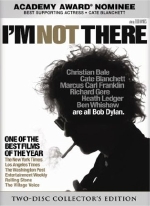
cue someone not using the search function and making a thread about this DVD release tomorrowGenius Products and The Weinsten Company has announced I'm Not There in which six characters embody a different aspect of Bob Dylan's life and work. The 2-disc collector's edition will be available to own from the 6th May, and should retail at around $28.95. Extras will include an audio commentary (participants to be confirmed), deleted scenes, featurettes, a music video, audition tapes, a gag reel, a Bob Dylan filmography and discography, and more.
-
Jeff

- Joined: Wed Nov 03, 2004 1:49 am
- Location: Denver, CO
I'm Not There
OnVideo wrote:The Weinstein Co. and Genius Products will release on May 6 "I'm Not There," director Todd Haynes' biographical film about legendary singer-songwriter Bob Dylan. The film follows six distinct characters, depicting different stages of Dylan's life, embodying a different aspect of his life story and music: Cate Blanchett, Christian Bale, Richard Gere, the late Heath Ledger as well as Ben Whishaw and Marcus Carl Franklin. The two-disc set. includes commentary by Haynes, nine deleted scenes, a "Making of I'm Not There," "Subterranean Homesick Blues" music video, Ben Whishaw and Marcus Carl Franklin audition tapes, a gag reel, a conversation with Haynes, a "Making of the Soundtrack" featurette, a Dylan filmography and discography, more.
-
denti alligator
- Joined: Thu Nov 04, 2004 1:36 am
- Location: "born in heaven, raised in hell"