Re: John Ford
Posted: Wed Jul 08, 2015 5:54 pm
by hearthesilence
Ford's films are usually imperfect in a way that can turn off modern/younger audiences - more innocuous stuff like his taste for broad humor (in
The Searchers, after the famous moment where John Wayne finally has Natalie Wood in his arms, we dissolve to Ward Bond getting something pulled out of his ass) and more disarming stuff like anything that seems like a stereotype. For the latter, the knee-jerk reaction is usually hostility, but context is always important.
In
The Searchers, people have problems with Martin's Native American bride and Mose, but it says a lot that they are the only types of Native Americans that are (more or less) "welcomed" into these people's lives when they are so different from those who are not assimilating into white society. Play this against the women who have become "Indian" ("it's hard to believe that they used to be white"). What does this say about integration? Or rather people's fears about integration? (think about the famous reaction shot of Edwards, in close-up, as he looks at one of these women…is this how he imagines Debbie? Even when Debbie seems all right, that doesn't change what he feels.)
You mentioned Fetchit, which is also an excellent example.
Here's what Dave Kehr wrote with regards to The Sun Shines Bright:
The lynching [that was cut from Ford's
Judge Priest) is back in [this] remake, although Fetchit had aged out of the victim’s role by that point. Instead the target of the mob’s wrath is a frail teenager (played by Elzie Emanuel) who bears, for the South of the late 19th century, the highly unfortunate name of U. S. Grant Woodford.
In an early scene the judge asks the young man to demonstrate his prowess on the banjo by playing a military song — and the teenager responds with a rousing rendition of the Union anthem “Marching Through Georgia.” The scene, though played for comedy, remains the most gripping sequence in “The Sun Shines Bright” and one of the most revealing passages in all of Ford’s work. As he hears the first bars of the hated march, a look of shock and fear crosses Fetchit’s face, and he breaks his usual studied shuffle to dash to the boy’s side.
Looking the boy in the eyes, a black man communicating with a black man, Fetchit desperately struggles to communicate just how inappropriate the choice of music is — at least if the two men intend to live through the day — and manages to persuade U. S. to segue into “Dixie.”
The scene lasts only a couple of seconds — a brief moment in which the curtain drops, and Ford allows a glimpse of the greater reality that lies behind the stereotypes. In this time and place to shuck and jive is the only available survival strategy. The lynch mob awaits those who let the mask slip.
Re: John Ford
Posted: Wed Feb 03, 2016 5:21 am
by mizo
Thanks to a couple of minor upheavals within my daily life (most notably the unexpected discovery of how close I am to a library with a really respectable film collection and my first time ever participating in a list project of any scale on this forum) I’ve recently become more aware than ever of just how vast some of the blind spots in my film experience are. So, as a corrective measure, I’m now embarking on a fairly expansive viewing project that should fill in some of the more conspicuous holes. I plan on tackling, in chronological order, the complete (available) works of the most prominent international filmmakers whose names I regularly see bandied about here and elsewhere sort of like code words, signifying a certain style or disposition or worldview, that barely hold any meaning to me. To give an example, while experience has given me a pretty solid idea of what is meant by “Hitchcockian,” I have only the vaguest notion of what “Fordian” could indicate. I mean, I’ve seen Stagecoach, The Grapes of Wrath, They Were Expendable, and The Searchers, but each one at a very different time in my life, and I’ve certainly never tried to suss out what it could be that’s emblematic of the artist behind them. I guess now is the time for doing just that (and I’m beginning to hear a reverb-laden voice intone, “Join me, ladies and gentlemen, as we travel down the mind-bending auteurist wormhole of Fordiana!”). To start me off, I’ve watched two films from Ford’s very first year in the business (at least, behind the camera): 1917’s Straight Shooting and Bucking Broadway. I tried to identify absolutely everything in them that either rings a bell (in relation to one of the others I’ve seen) or otherwise strikes me as possibly central to Ford’s artistic persona. I ended up with about twenty pages of notes, so you’re going to have to bear with me folks as I try to come up with some conclusions!
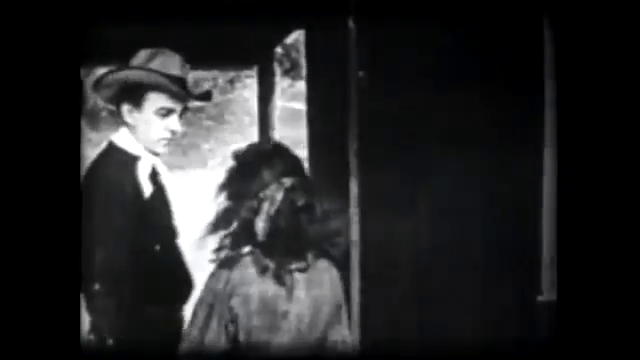
If the credits are to be taken as the final authority on the matter, Harry Carey is playing the same character in both movies; however, his Cheyenne Harry persona reads, to my mind, less like Chaplin in the 20’s and more like Bowie in the 70’s! From film to film, he could hardly be more different. I’ll begin with Straight Shooting, in which the version of the character he plays dominates the drama (against what is, surprisingly, fairly decent competition). Now, I don’t think you need a lot of experience with Ford to identify that shot of John Wayne framed in the doorway, from The Searchers, as an important reference point for the director’s visual and thematic preoccupations. It did surprise me, though, how ubiquitous that image is, even this early on. If a story has any characters that could be seen as outsiders (which Straight Shooting has in spades) you can bet that this visual motif will show up, and usually more than once! It’s most associated with Cheyenne Harry, though, and he certainly comes across as the archetypal loner.
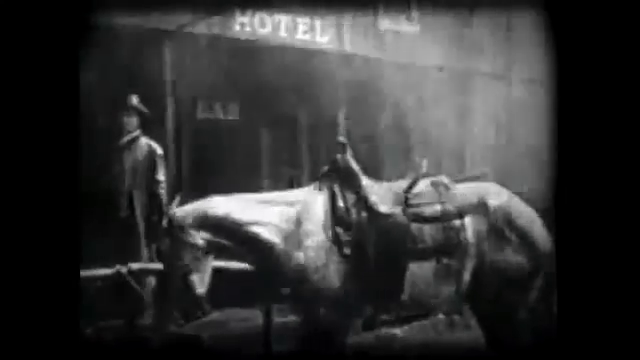
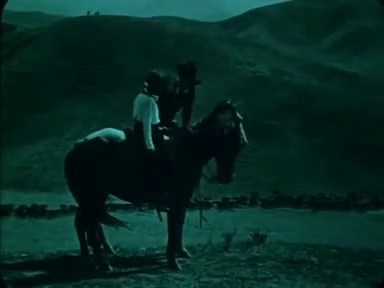
Another particularly potent symbol for Harry’s loneliness is the image of his horse standing in the rain outside a saloon. Here, the horse is not only soaking wet, but also distinctly weary. I’m not saying he gives an Oscar-worthy performance here (if he is indeed a he) but it’s not hard to read weariness into the sort of sad, numb non-reaction he gives to the dimwitted sheriff who pushes him around with random aggression (evidently recognizing the horse to be that of hired killer Harry). The strangely disinterested response to inhuman treatment has a direct parallel with Harry’s lack of interest in the ethics of his violent profession (a lack of interest that he expresses in no uncertain terms, indiscriminately referring to a couple of friendly, harmless farmers as “the enemy”) and the way that he is, to look at the broader picture, basically being exploited by the ranchers who have hired him. He is little more than a beast of burden – his ignorance being his defining characteristic – and, not to get all Marxist or anything, but that seems to engender a pretty deep-seated sense of isolation within him.
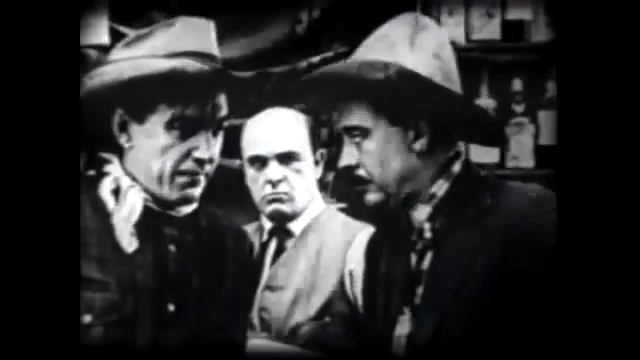
Constantly reiterated is his failure to quite align with any recognizable group or cause. The closest thing to a compatriot he has is Placer Fremont, a rancher, and apparently an old friend, though the nature of their friendship remains somewhat ambiguous. One insight we do get comes during the saloon sequence when Fremont is introduced. We see the two men in medium close-up, embroiled in a kind of drinking contest. Fremont’s quick gulps of whisky (taken with his head thrown upward and his eyes shut) contrast with Harry’s long, confident ones, during which he never takes his eyes off Fremont. The staging here is surprisingly elegant, with the space between the intense, inscrutable faces of the two men being taken up by the bartender, who nervously watches their every action, and whose visible reactions guide our emotions through this rather opaque sequence (this is before we know much of anything about either character, except that Harry is a wanted criminal). The tension here is only lifted when, after a fade elides much of their contest, we return to see them desperately drunk, and with that, they’re cemented in our minds as pals. For a film that seems much more comfortable in action or contemplation, it’s a surprisingly graceful moment of comedy (although the goodwill it inspires does get tested as the scene goes on. And on…). Of course, light comedy doesn’t really define this subplot (in stark contrast to Bucking Broadway, humor here exists mainly as something to be broken by the entrance of tragedy). On the contrary, it’s one of the most explicitly tragic in the film. I was reminded of the traits the two men exhibit in the drinking scene (Harry’s unwavering stare versus Fremont’s quick breaks) when they are turned against each other by competing alliances and forced into a shoot-out; Fremont blinks nervously every few seconds, but Harry’s gaze remains constant. The irony of this defining aspect of their friendship returning just before one is to kill the other soon gives way to violence and, after Fremont’s frightened retreat lends an air of desperation to the showdown, the actual shooting is blocked from our view by an explosion of white smoke in the center of the frame. Then, Fremont falls, pathetically, like a wounded animal. This is the kind of fatalistic action I would normally associate with Anthony Mann before I’d think of Ford. And indeed, much like Gary Cooper stalking out of the ghost town toward the end of Man of the West, Cheyenne Harry stiffly, and with an air of disgust, makes his slow, solemn way out of the town where he’s killed his best friend, looking more alone than ever before.
I did slightly contradict myself above in saying that Harry was fundamentally alienated from all groups (being largely uninterested in causes), and then going on to say that his conflict with Fremont arose due to “competing alliances.” Halfway through the film, after he witnesses the Sim family (of farmers) grieving over the brutal murder of their son by a rancher, Harry renounces his (already pretty perfunctory) alliance with the ranchers in order to defend the victimized farmers. While the film raises no doubt that this change of heart is sincere for Harry, Ford is very careful about the degree to which he portrays Harry and the farmers as being united in mindset. Just in case we weren’t sufficiently clued in about Harry’s complicity in the Sim boy’s death, when the latter is killed, there’s a lone horse, unaware of and uninterested in what’s going on, that dominates the frame.
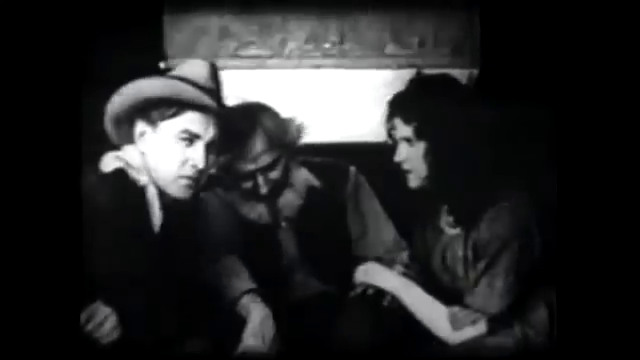
It must be emphasized that, fundamentally, Harry and the farmers are incompatible, and this is endlessly reiterated to us through composition. During the grieving scene (which takes place outdoors) Sweet Water Sim (the father) and Joan (the daughter) are both dramatically dwarfed by Harry. Indeed, the former two rarely remain standing up for very long, as they always seem to fall to the ground from despair or shock, particularly in Harry’s presence. This motif of incongruity continues in the Sim home, where Harry always seems out of place – awkward and perhaps too big. An inescapable quality of the film is how artificial and flimsy many interiors look; they seem rather ineffective barriers against the potent vastness of the plains. Moreover, they tie characters like Harry to the outside, particularly when Harry is shown, as he usually is when indoors, in a long shot that emphasizes the artificiality of the interiors by making the very real (and powerful) exteriors visible through windows and open doorways. These are the same doorways that we so often see Harry trapped inside, not feeling at home within the family unit that he dwarfs like the encroaching horizon, but also alienated from the outside, a place inhabited by violent ranchers, whose cause he no longer believes in (if indeed he ever did). So, while the father and Joan are characters tied with the interior, the home, and the family unit, Harry is tied with the open stretches and loneliness of the outside.
Also tied with the outside, however, is Sam Turner – a young man, ostensibly a rancher, but also a close friend of the Sim family – who seems even more remote. Very early on, Sam first appears in the doorway while the Sims are gathered around the dinner table, already introducing him as something of an outsider. He maintains this status for the entire time he appears on screen, cut off from the others due to his alliances and, perhaps more potently, Joan’s lack of receptivity to his romantic advances. Later, after the Sim boy’s death, he is not permitted into the family’s private grieving and instead remains in the shadows. Ford doesn’t quite manage to make him a tragic figure, though, as audience sympathy is constantly hampered by Sam’s endless obliviousness (most annoyingly, when he cannot. Get it. Though. His thick. Skull. That Joan. Doesn’t. Want him. Like seriously, Ford tries to pull off having him have that big wordless moment where he realizes he’s unloved like three times and gets significantly diminishing returns each time). Another surprisingly semi-tragic character is the ostensible villain of the film, the chief rancher Thunder Flint, who manages to appear both lonely (when he meditates atop the mountain above where the cattle are spread out) and as a kind of patriarch (when he is with the other ranchers, who gather around him like disciples awaiting his sage wisdom). At one point, Ford executes a graphic match between Sam’s trail down the hill (off to find Harry on Flint’s instructions) and Flint’s tall, frame-filling body, and this seems to hint at Flint being less a man than a force of nature and, by extension, the most alienated from other people of them all. Certainly, he seem as out of place if not more so within his own home as Harry or Sam do.
The film’s (sort of tacked-on) ending sees Harry, after some contemplation, settling down to a life with Joan. Significantly, the scene plays outdoors, which makes it all the more difficult to believe. The quiet life of a farmer with a family is surely no life for Harry, as we’ve been made to intuitively feel from the beginning, so why should this change of heart be convincing? Ultimately, he belongs elsewhere (“Shane! Come back!”).
All this emphasis on loneliness might make one think that Ford’s conception of the archetypal Western hero has a fundamental sense of isolation, but Bucking Broadway seems to refute this. In that film, the Cheyenne Harry character (who, in stark contrast to the mostly solemn and tragic figure of Straight Shooting, is loveable, goofy, and is first seen flocked by his chums, the other ranch hands) although he is colored by shades of the same loneliness that afflicts the earlier incarnation, also has some very different motivations.
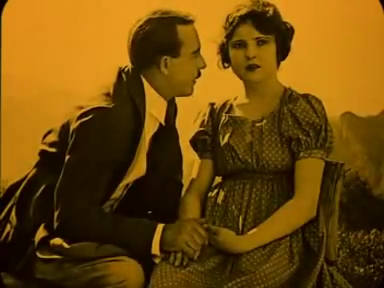
The sense of the West that I’ve tried to express here, and that Ford articulates far more clearly in images (the lone horse, the figure in the doorway, etc.) than I ever could in words, is defined by almost oppressively open spaces, broken by the occasional flimsy fence or artificial house, and peopled with lonely souls looking for meaning or friendship or something indefinable (already it sounds hackneyed when I try to explain it, but I’ll be damned if those images aren’t powerful!). But there’s something at the heart of it – something that’s invisible at the macro level I’ve outlined. In a key scene (central, I think, to Ford’s worldview) Harry takes Helen, the boss’s daughter and the girl he’s in love with, to the home he’s built himself, where he asks her to marry him. It’s the middle of the night. We never see the outside of the home – only Helen’s fairly confused reaction to first coming upon it. Then we’re inside. Ford keeps the camera very close to the stars, who are illuminated by the warm light of a fireplace. It’s an extraordinarily tender scene (even if Helen’s slowness in catching on to Harry’s intentions strains credulity a bit). What’s really important, though, is the closeness or, more precisely, the insularity. There’s no chance of this interior seeming flimsy; the walls aren’t even visible to us. Harry has retreated from the emptiness of the outdoors (and taken Helen with him) into a fantasy, utopian by virtue of its insularity, of the impossibly deep bond of family and love.
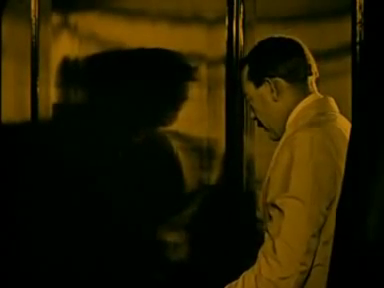
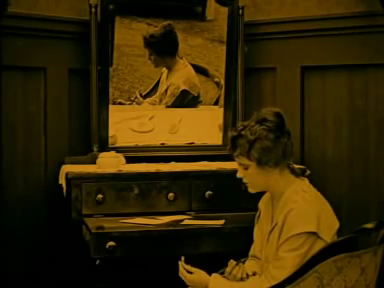
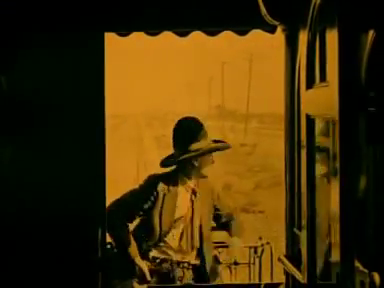
A central conflict of the film is of this kind of quasi-sacred bond against the implacable efforts of modernity to apparently destroy it (I say “apparently” because, as we find out by the end, there really isn’t that much difference between the Westerners and the city folk, so really this whole element is just a fantasy taking place in the uber-emotional protagonists’ minds) which is first impressed on us with bold diagonals, in stark contrast to the parallel lines that previously dominated the compositions. Another way Ford expresses modernity, imbuing it with a real sense of almost existential discomfort, is through the use of reflections. As Helen is being taken to the city by her devious suitor, Thornton, she locks herself in some compartment (a powder room?) to be alone, while he waits for her outside, his face stretched grotesquely in the reflective wood of the door. Once Helen is in the city, we see her sitting alone and forlorn, while her double in a mirror matches and seems to amplify her misery. Finally, and most subtly, Ford suggests the imperviousness of the purest old world values to encroaching modernity (and, by extension, the underlying absurdity of the whole conflict) in the scene when Harry jumps off his horse onto a speeding train (because of course he does). As he climbs aboard, we can briefly see his reflection in the shining wood. Unlike Helen and Thornton, he does not linger by it, but instead remains resolute.
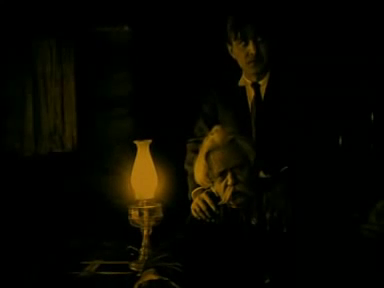
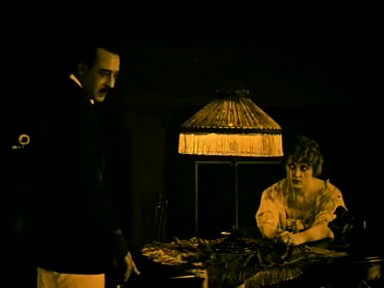
Moreover – once we’ve seen a fireplace for the second time (when Harry asks Helen’s father for her hand in marriage) and it’s been sufficiently locked in the viewer’s mind as a symbol of the familial bond so that Ford can begin to play variations on it – the third fireplace (the same one as the second, but in a much later scene) appears when Thornton, who is visiting the ranch, persuades Helen to ignore Harry’s proposal and slip away with him in the night to get married in the city. The two of them whisper this plan while her father sleeps in the same room, his face illuminated by an oil lamp. Oil or electric lamps (a sort of bastardization of the more pure light of the fireplace, I guess) always seem to shine on broken families here. An oil lamp lights the scene where a quietly grieving Harry consoles the more outwardly distraught father about Helen’s disappearance. Another lamp casts ominous shadows onto the face of Thornton’s sister (in New York) whose coldness will push Helen into despair over the absence of the family bond in this new, frightening environment.
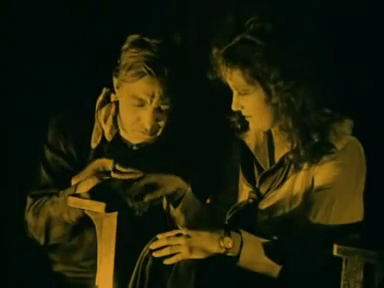
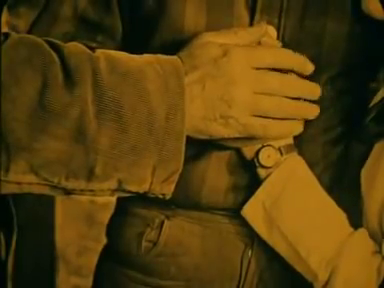
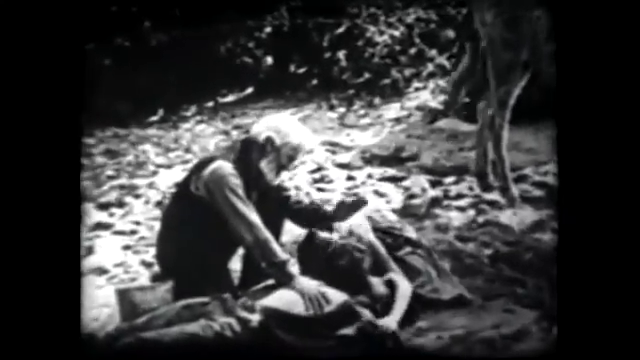
Ford also makes frequent use of another symbol for the bond, one that’s even more powerful: hands. After Harry asks Helen to marry him, she toys with him briefly (expressed visually through some frilly hand gestures) before slowly allowing her hand to rest on his, communicating her answer. When they go to her father, he ultimately blesses the union by putting his hand on theirs, which (in close-up) are already interlocked. When Thornton is wooing Helen, there’s a moment when he grabs her hand and she suddenly goes off mentally to another place, looking ruefully into the distance, as if she’s thinking of Harry. This same symbol also appears (and very prominently, I might add) in Straight Shooting. Following the Sim boy’s death, we get an extraordinarily powerful image of a broken family: the father, transported by his despair, is patting his sobbing daughter’s head with one hand while the other lies on the chest of his dead son. Hands are used again to convey grief in the gorgeously simple scene where Joan takes a moment to caress her dead brother’s plate before putting it back in the cabinet for good (a private moment to which Harry, now outside of the family unit and in the outdoors, is a rather embarrassed witness). Very quiet, but still astonishingly moving stuff.
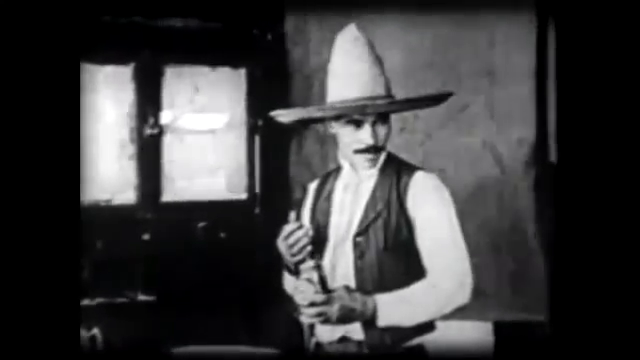
And that’s about all I have to say, except for a few idle thoughts I can’t really expand on too much. For example, I speculated that the flimsy interiors might be a metaphor for the solubility of boundaries (of the farmer vs. rancher, rural vs. urban sort) and I do think that solubility is an element of Ford’s conception of the west. The female characters here don’t really have a whole lot of agency, although I appreciated the relative complexity and emotional depth they are afforded (considerably more than the patriarchs, whose respective despairs are sort of bland and bathetic in comparison). In particular, I recall fondly one scene in Straight Shooting where, after Sam Turner is (non-fatally) shot and Harry seems to have no interest in staying with her, Joan briefly worries about the prospect of being married off (almost like an offering, out of pity) to Sam. Ford respectfully declines to offer any judgement here. I would also like to point out that each movie features the same Hispanic dude. He wears a sombrero and, in Straight Shooting, he steals jam from the Sims while, in Bucking Broadway, he makes a crack about Harry and Helen’s relationship before being chased away by the other ranch hands, never to be seen again. We’re a ways away from the racial politics of The Searchers at this point, folks!