

Buy Physical Copy At:


Symbiopsychotaxiplasm Take One | Symbiopsychotaxiplasm: Take 2 1/2
Licensor Information
William Greaves Productions
Directed by: William Greaves
Featuring: Patricia Ree Gilbert, Audrey Henningham, Don Fellows, Shannon Baker, Jonathan Gordon, Bob Rosen, Marcia Karp, William Greaves, Steve Buscemi
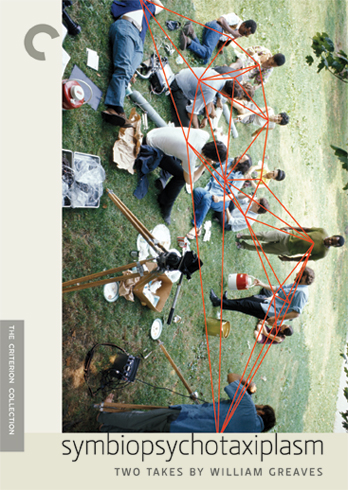
In his one-of-a-kind fiction/documentary hybrid Symbiopsychotaxiplasm Take One, director William Greaves presides over a beleaguered film crew in New York’s Central Park, leaving them to try to figure out what kind of movie they’re making. A couple enacts a break-up scenario over and over, a documentary crew films a crew filming the crew, locals wander casually into the frame: the project defies easy description. Yet this wildly innovative sixties counterculture landmark remains one of the most tightly focused and insightful movies ever made about making movies. Criterion presents this long-unreleased gem in a special two-disc edition, along with its sequel, Take 2½, made thirty-five years later with executive producers Steven Soderbergh and Steve Buscemi.
Details by Film
Symbiopsychotaxiplasm Take One
Year: 1968
Time: 75
Aspect Ratios
1.33:1
Audio
English Dolby Digital Mono 1.0
Streaming Options
30358.
+16416
Stream
2

Symbiopsychotaxiplasm: Take 2 1/2
Year: 2003
Time: 99
Aspect Ratios
1.78:1
Audio
English Dolby Digital Mono 1.0
Streaming Options
Stream
2
Release Information:
Technical Specifications
Format:
DVD
Discs:
DVD-9 (2 Discs)
Total: 2 Discs
Regions:
1 (DVD)
Aspect Ratio:
1.33:1
1.78:1
Audio Options:
English Dolby Digital Mono 1.0
Resolution:
480p/29.97
Subtitles:
English
Supplements
Types of Supplements Included: Documentary, Theatrical Trailer, Interview, Booklet
- Discovering William Greaves, a new documentary on Greaves’s career, featuring William Greaves, his wife and coproducer Louise Archambault, actor Ruby Dee, filmmaker St. Claire Bourne, and film scholar Scott MacDonald
- Theatrical trailer for Take One
- New video interview with actor Steve Buscemi
- A booklet featuring a new essay by critic Amy Taubin and production notes by William Greaves for Take One
Forum Member Statistics
Sign-in with your forum account to rate this release
Symbiopsychotaxiplasm Take One
Symbiopsychotaxiplasm: Take 2 1/2
Picture
Audio
Supplements
Artwork
Release Credits
Artwork: Neil Kellerhouse
Producer: Debra McClutchy
Artwork: Peter Grant
Release Notes on Restoration
Symbiopsychotaxiplasm Take One
Symbiopsychotaxiplasm Take One is presented in its original aspect ratio of 1.33:1. On widescreen televisions, black bars will appear on the left and the right of the image to maintain the proper screen format. This new high-definition digital transfer was created on a Spirit Datacine from a 35mm print. At the behest of director William Greaves, corrections to the picture and sound were kept to a minimum, in order to retain the “authentic” look and spontaneity of the original film. One of the theories behind making the film, Greaves notes, was that any “mistake” that was consciously or unconsciously made during filming or afterward would add to the immediacy of the viewers’ experience, by involving them more directly in the filmmaking process. The MTI Digital Restoration System was to remove occasional instances of dirt, debris, and scratches caused by the historical nature of the degradation of film sources.
To maintain optimal image quality through the compression process, the picture on these dual-layer DVD-9s were encoded at the highest possible bit rate for the quantity of material included.
The soundtracks were mastered at 24-bit from the optical soundtrack prints, and audio restoration tools were used to reduce clicks, pops, hiss, and crackle. The Dolby Digital 1.0 signal will be directed to the center channel on 5.1-channel sound systems, but some viewers may prefer to switch to two-channel playback for a wider dispersal of the mono sound.
To maintain optimal image quality through the compression process, the picture on these dual-layer DVD-9s were encoded at the highest possible bit rate for the quantity of material included.
The soundtracks were mastered at 24-bit from the optical soundtrack prints, and audio restoration tools were used to reduce clicks, pops, hiss, and crackle. The Dolby Digital 1.0 signal will be directed to the center channel on 5.1-channel sound systems, but some viewers may prefer to switch to two-channel playback for a wider dispersal of the mono sound.
Symbiopsychotaxiplasm: Take 2 1/2
Take 2 ½ is presented in the aspect ratio of 1.78:1. On standard televisions, the image will appear letterboxed. On widescreen televisions, the image should fill the screen. The transfer was created from the original 16mm and 35mm elements from Take One and digital sources from various tape formats.
To maintain optimal image quality through the compression process, the picture on these dual-layer DVD-9s were encoded at the highest possible bit rate for the quantity of material included.
The soundtracks were mastered at 24-bit from the optical soundtrack prints, and audio restoration tools were used to reduce clicks, pops, hiss, and crackle. The Dolby Digital 1.0 signal will be directed to the center channel on 5.1-channel sound systems, but some viewers may prefer to switch to two-channel playback for a wider dispersal of the mono sound.
The soundtracks were mastered at 24-bit from the optical soundtrack prints, and audio restoration tools were used to reduce clicks, pops, hiss, and crackle. The Dolby Digital 1.0 signal will be directed to the center channel on 5.1-channel sound systems, but some viewers may prefer to switch to two-channel playback for a wider dispersal of the mono sound.